

Five of Scotland’s most amazing archaeological discoveries from 2025
Published: 17 December 2025
UofG's Burnswark hillfort archaeology dig named among Scotland’s top discoveries after settlement breakthrough
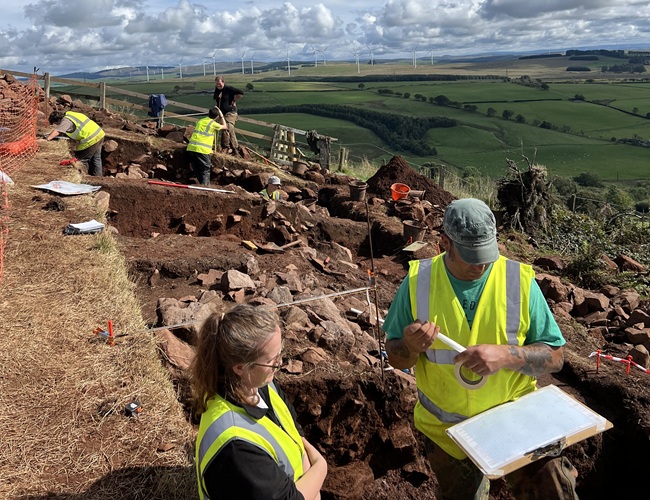
Scotland’s Burnswark hillfort has again leapt into the spotlight after being named one of the country’s most significant archaeological discoveries of 2025.
For centuries the site has been defined by Roman conflict, but now archaeologists have turned the story on its head as they start to uncover the people who lived there more than 1800 years ago.
A team from the University of Glasgow, the Trimontium Trust and the University of Manchester, working side by side with students and local volunteers, has revealed a bustling settlement inside the seven-hectare hillfort – the equivalent to 10 football pitches – near today’s town of Lockerbie, Dumfries and Galloway. To put its size in context, that’s twice the surface area of the Acropolis in Athens.
Trackways cut across the interior, showing a carefully planned and densely inhabited community, while the rampart itself was rebuilt on a monumental scale after Roman contact. Far from being abandoned, Burnswark continued to thrive as an indigenous centre well into the Late Iron Age.
This discovery forces a rethink of Iron Age life in northern Britain. Burnswark may have been an urban-like hub nearly a thousand years before Scotland’s first recorded towns, a place where local people organised, rebuilt and endured in the shadow of Rome.
It is this breakthrough that has earned the project a place on Dig It!’s list of the most amazing archaeology finds of the year in Scotland.
James O’Driscoll, Lecturer in Geospatial Archaeology at the University of Glasgow, said: “Burnswark is more than a battlefield - it may represent a lost chapter of Iron Age urbanity, a thriving community at the edge of Empire whose fate was shaped by Rome’s northern ambitions. This research will not only resolve decades of debate but also contribute to broader narratives of prehistoric urbanism, frontier warfare and cultural transformation in Britain and beyond.”
Dr John Reid, Chair of the Trimontium Trust, said: “Burnswark Hill has a truly special place in the early history of Scotland, and it is a privilege to be going back to the site to help unpick yet more of its complex story. Once again, this is an exciting opportunity for volunteers from all walks of life to work alongside professional archaeologists, to help reveal something of the confrontation between Scotland’s first peoples and one of the fiercest military machines ever known.”
Professor Stuart Campbell, Trimontium Trust and University of Manchester said: “Burnswark is an outstanding and dramatic archaeological site that gives us new insights into large scale settlements of the Iron Age in southern Scotland. The Roman remains speak to one particularly dramatic episode in its history but Burnswark is of much wider significance than that, helping us understand the scale and organisation of this Iron Age community.”
Burnswark hillfort originates from the early Iron Age - about 800BC - and was defended by earth ramparts and contained timber roundhouses.
On the surface, Burnswark’s remains are unique: a seven-hectare hillfort, one of the largest in Scotland, flanked by two unusually shaped Roman camps. Representing the only known remains of a Roman siege in Britain. The scale of evidence for a Roman assault at Burnswark is exceptional, say archaeologists and historians, which offer a unique lens on the choreography of conflict and the interplay between Rome and local polities.
Yet, until recently, archaeologists and historians knew very little about the indigenous hilltop settlement and the community that lived there.
Last summer, a new project was launched to investigate the local people who called Burnswark home. This work has revealed, for the first time, a dense internal settlement within the hillfort. Roads and trackways indicate a well-organised community. Excavations of the rampart uncovered evidence for monumental reconstruction following Roman contact, suggesting that the hilltop settlement continued to function as an important indigenous centre into the Late Iron Age.
This challenges long-held assumptions about Iron Age communities in northern Britain and raises the possibility that Burnswark was an urban-like centre during the Late Roman Iron Age, developing nearly a millennium before the first recorded towns in Scotland.
The team is already preparing for the next stage. A larger campaign of survey and excavation is planned for the summer of 2026, targeting the rampart and indigenous houses to uncover more of the community that once stood at the edge of Empire.
A digital reconstruction of the siege - based on forensic ballistics, archaeological mapping and geophysics - was revealed earlier this year.
The site will be fully reinstated after the excavations.
Dig It! Announcement
Dig It!
-
Dig It! is a hub for Scottish archaeology which encourages members of the public to discover Scotland’s stories through archaeology by sharing events, leading on initiatives and projects, promoting the sector, working with underrepresented communities and more.
-
The project is coordinated by the Society of Antiquaries of Scotland (Charity No. SC010440) and primarily funded by Historic Environment Scotland.
-
For more information, visit www.DigItScotland.com
Evidence of a Possible Roman Siege in Dumfries & Galloway
-
This new work in 2025 is the latest update in a decades-long debate amongst experts about whether Burnswark hillfort was attacked by the Romans or merely used as an empty training ground for nearby Roman camps.
-
In the 1960s, experts found the largest collection of Roman lead sling bullets from any one site in Britain and North-western Europe, along with stone ballista balls, iron ballista bolts, arrowheads and even a Roman sword (the first ever found in Scotland).
-
The discovery of the ammunition around the entrance areas of the hillfort has been interpreted as evidence that these were used as targets for training Roman soldiers.
-
The 2025 work was undertaken by staff from the University of Glasgow, the University of Manchester and the Trimontium Trust.
-
Archaeology at the University of Glasgow is a vibrant community of students and staff working together and in partnership with a range of heritage organisations. The premier provider in Scotland, Archaeology at the University of Glasgow’s key strength is their commitment to practical heritage experience and vocational training that enables graduates to flourish in diverse future careers. For more information, visit https://www.gla.ac.uk/subjects/archaeology/
First published: 17 December 2025