

How Conflict Analysis changed the way I understand peace
Published: 5 August 2026
Sahara takes us through one of the most inspiring aspects of her one-year Master's experience at the University of Glasgow and how it taught her a new way of seeing the world.
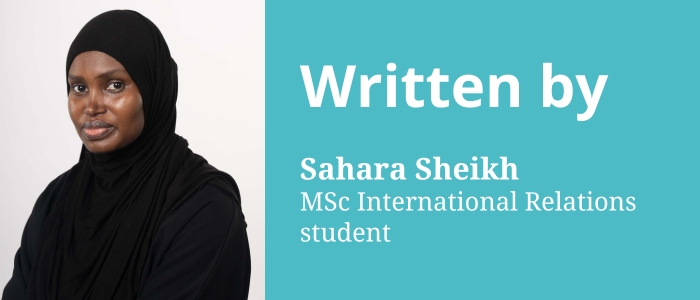
Author: Sahara Sheikh, MSc International Relations student
For as long as I can remember, conflict has never been a concept confined to textbooks or news broadcasts. It was something I had experienced and understood through its human consequences such as the fear, the uncertainty, and the way ordinary routines dissolve overnight. So, when I arrived in my MSc International Relations programme, I assumed I already understood conflict fairly well. What I couldn't figure out was why something so obviously painful was also so hard to stop. Why do people who all seem to want an end to violence struggle to actually reach one? My Conflict Analysis course is where I finally started getting an answer, though it took most of the semester to sink in.
Week by week, I started to see conflict as more than suffering. It was something closer to a stuck machine: power sitting in the wrong places and institutions that have their own reasons to keep things exactly as they are. The turning point came during our semester-long negotiation simulation. Assigned to represent a faction with competing security and economic priorities, I entered the room committed to reaching a deal. Hour after hour, every version of a compromise ran into somebody's red line, and by the end there was no deal on the table at all.
Watching and living the negotiation fall apart taught me that conflict is rarely straightforward. Everyone in that room was, in their own way, committed to resolution. But commitment is not the same as compatibility. Actors had different incentives and different constraints. As such,agreement failed not because people were unreasonable, but because the architecture of the negotiation made failure more likely than success. I left that simulation with a new respect for the diplomats and mediators who do this work in real conditions, with real consequences.
That shift in thinking followed me beyond the classroom. A few months ago, my flight to Kenya was cancelled because of airspace disruptions tied to conflict in the Middle East. Before the course, I probably would have felt frustrated and asked why leaders could not just sort this out. Instead, I found myself thinking about the layers underneath that one cancelled flight: competing security concerns, political constraints, the fact that de-escalation is rarely a single decision but a tangle of decisions no one actor fully controls. A delayed flight is a small thing. But it was a reminder that conflict reaches far beyond battlefields.
This new way of thinking has real implications for the work I care about. I have spent time in education access and advocacy, supporting students from underserved communities. I chose to pursue this master's because I wanted to understand how policy can navigate barriers to education, and conflict is one of the most significant of those barriers. My studies helped me see that education doesn't exist in a vacuum. The challenges students face are entangled with broader political and social realities. As I move into a career in education and international development, I know that designing effective programs takes more than good intentions. Real change requires understanding contexts: the same forces that make negotiations succeed or collapse.
What made Conflict Analysis the most inspiring part of my studies was not that it taught me new facts. It taught me a new way of seeing. Living through conflict gave me an understanding of its human cost. Studying it gave me a deeper respect for how difficult peace is to build, and how much unglamorous work goes into it.
I hope to carry that lesson forward: into education, into international development, into whatever comes next. Not as a lesson learned once and filed away, but as a way of paying attention to the world that stays with me.
First published: 5 August 2026
<< Learn