

Into the Wild Conference & Discussion Meeting - 21st & 22nd May 2026
Published: 12 January 2026
Call for papers and discussion participation
Into the Wild: exploring (re)wilding, nature-based land-use and the historic environment
Organisers: Nicki Whitehouse1, Emma Jenkins2, Kim Ward3, Hannah Fluck4
1Archaeology, School of Humanities, University of Glasgow, UK
2Archaeology, Bournemouth University, Talbot Campus, Poole, UK
3School of Geography, Earth and Environmental Sciences, University of Plymouth, UK
4National Trust, UK
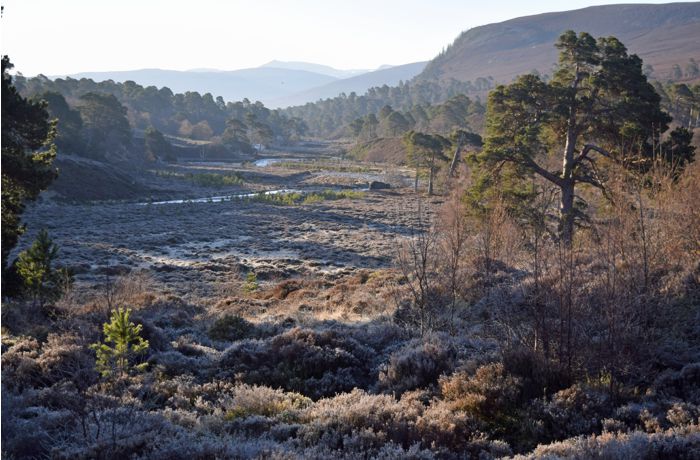
Photo credit: Regenerating Pine Forest, National Trust for Scotland, Mar Lodge, Scotland
This conference and discussion meeting will bring together a collaborative group of researchers, practitioners and policy makers from archaeology, geography, nature conservation, land-holders and managers, and land charities The conference will promote dialogue and knowledge exchange across these groups on the relationships between the historic environment, land use, and nature-based approaches to land management. While there is a particular focus on (re)wilding, the conference welcomes discussion of a broad range of related approaches.
We would like to foster dialogue around how the historic environment may be impacted or contribute to (re)wilding and other nature-based interventions (e.g. nature recovery, biodiversity net gain; net zero). It will explore how archaeology and historic environment expertise can enhance understandings of landscape change, (re)wilding practices, and the co-design of land-management projects. Key questions include:
· How can the historic environment community add value to land-use decisions and landscape management projects? What does best practice look like in this area?
· What challenges arise in the management and regulation of (re)wilded historic environments? What can historic environment specialists learn from landholders and nature conservation practitioners and researchers, and vice versa?
· What skills development and support are needed to establish and embed good practice? What support do historic environment and land manager communities need in terms of skills development in this area and the development of good practice?
· Finally, what new areas of research are required across these communities?
Building on insights from two previous workshops on this topic and an online questionnaire, we invite expressions of interest from practitioners and researchers who wish to participate in the conference. Attendees will have the opportunity to discuss the key findings to date, offer feedback, and contribute new perspectives. Papers addressing the conference themes are welcome.
The conference will comprise a mix of invited and contributed presentations, selected through open call, alongside focused round-table discussions. Participation will be limited to 60 attendees. We welcome offers of 15-minute papers; participants may choose either to present or to attend without presenting. Attendance is free and includes refreshments and lunch. In the event of over-subscription, participants will be selected by the conference organisers based on the relevance of their experience and contributions as outlined in their expressions of interest.
This research is funded by the Royal Society of Edinburgh. More information on the project may be found here: https://intothewildnetwork.glasgow.ac.uk
Deadline for Abstracts (max 350 words) and Expressions of interest: 2nd March 2026
Into the Wild: exploring (re)wilding, nature-based land-use and the Historic Environment – Fill in form
If you are unable to attend the conference in person there is an option available to participate remotely. Use the link above to register your interest.
First published: 12 January 2026
<< Latest news
