

UofG academic helps bring major international AI art exhibition to life
Published: 13 March 2026
A major new exhibition is exploring how artificial intelligence is reshaping contemporary life.
A major new exhibition opening today is exploring how artificial intelligence is reshaping contemporary life.
AI and the Paradox of Agency exhibition in Bildmuseet in Umeå, Sweden features new commissions and key works by leading international artists including Scot Rachel Maclean.
The exhibition asks a compelling question: who or what holds agency when it comes to humanity’s entanglement with artificial intelligence systems.
The show is co-curated by the University of Glasgow’s Professor Sarah Cook and Bildmuseet Director Katarina Pierre. Their curatorial vision brings together artworks spanning interactive installations, AI-generated films, digital works and a drone-activated hand-painted textile.
Spanning two floors of Bildmuseet, the works are grouped according to their perspective on who or what has agency: a human, a machine, society, the natural world, or lastly, an imagined more-than-human entity.
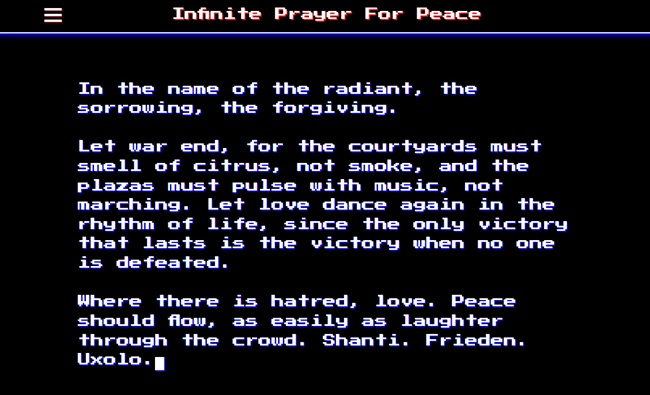
A distinctive element of AI and the Paradox of Agency is its online commission, which allows global audiences to engage with Canadian novelist and journalist Stephen Marche’s Infinite Prayer for Peace. It is Bildmuseet’s first online commission and is an AI-generated, endlessly renewing text-based artwork that uses machine learning trained on prayers for peace from multiple traditions.
The exhibition brochure says: “Could AI technology be used for peace-making instead of war? Almost every day the news reports that AI is making warfare increasingly efficient through the use of drones and other automated weapon systems that in part erode and remove human agency and responsibility. The online artwork Infinite Prayer for Peace is a manifestation of the idea of using AI to promote peace instead of war.”
The exhibition draws heavily on Professor Cook’s research into how art can illuminate the social, ethical and cultural implications of AI.
Professor Cook, who is Professor in Museum Studies in the School of Humanities | Sgoil nan Daonnachdan at the University of Glasgow and Guest Professor at UmArts with the Umeå School of Architecture, said: “This exhibition is part of ongoing research about how art can offer an opportunity to confront some of the challenges society faces in living with technology, including issues of surveillance and privacy, the use of drones, automated decision-making, and the resources and labour required for AI systems to work. Curating an exhibition allows visitors to consider these complex issues from different perspectives and offers space and time to collectively imagine other futures with AI.
“This is the first art exhibition to move beyond the questions AI art usually raises – about human-machine collaboration or creativity – to consider agency, the most important issue facing society as we seek to regulate the development of AI and be responsible about how it is used. Artists can draw our attention to what’s inside the black-box of technology, revealing the ethics, politics, and social aspects of living and working with AI tools such as AI assistants.
“People can access some of the art works online particularly the new online commissioned work by novelist and journalist Stephen Marche. Infinite Prayer for Peace uses AI to generate a new prayer to end war every minute of every day, expressing a hope that many of us share.”
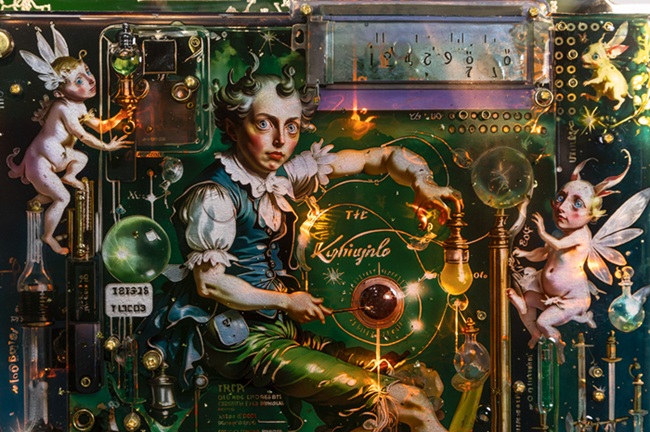
The exhibition also highlights Scottish artistic innovation. Glasgow based artist Rachel Maclean presents her installation They’ve Eyes Your Got which uses AI generated imagery drawn from her earlier work and is part of her larger project launching in Liverpool at FACT next week.
The Maclean installation including four sculptures (Oh! They greet you vs ye, Ogre vey youthy ese t, Ego they’re soy tuvey, Every ego to thuyes) and excerpts of AI generated films from the project They’ve Got Your Eyes. Through her sculptures and short films Maclean examines how style transfer technologies can both expand an artist’s creative voice and question the myths and fears that accompany emerging technologies.
Maclean’s work sits alongside art by leading international figures including boredomresearch, Tega Brain, Linda Dounia Rebeiz, Alexandra Daisy Ginsberg and many others. AI and the Paradox of Agency runs to 17 January 2027
AI and the Paradox of Agency
AI and the Paradox of Agency runs from 13 March 2026 to 17 January 2027.
It forms part of a research project at Umeå University into art and AI, taking its title from The AI Paradox by Virginia Dignum, Professor of Responsible AI at Umeå University. A publication accompanying the exhibition will be released during 2026.
Curators: Sarah Cook, UmArts Guest Professor (WASP-HS) at Umeå School of Architecture and Professor at the University of Glasgow and Katarina Pierre, Director at Bildmuseet.
The exhibition is produced by Bildmuseet at Umeå University with support from the Jacob Wallenberg Foundation and WASP-HS (Wallenberg AI, Autonomous Systems and Software Program – Humanity and Society). With thanks to UmArts, Curiosum, Umeå Academy of Fine Arts, Umeå School of Architecture, Umeå Institute of Design, and TAIGA at Umeå University, the University of Glasgow and the Fleck Fellowship programme at the Banff Centre for Arts and Creativity.
Participating artists include: boredomresearch, Tega Brain, Dennis Delgado, Linda Dounia, Alexandra Daisy Ginsberg, Nicolas Gourault, Zeno Gries, Lawrence Lek, Rachel Maclean, Stephen Marche, Lauren Lee McCarthy, Florian Model, Yuri Pattison, Planetary Portals, Raqs Media Collective, Daniel Shanken, Caroline Sinders & Romy Gad el Rab, Paola Torres Núñez del Prado, and Addie Wagenknecht.
More information: AI and Paradox of Agency
Stephen Marche - Infinite Prayer for Peace, 2026
AI-generated text-based work, endless loop (www.infiniteprayer.com) Could AI technology be used for peace-making instead of war? Almost every day the news reports that AI is making warfare increasingly efficient through the use of drones and other automated weapon systems that in part erode and remove human agency and responsibility. The online artwork Infinite Prayer for Peace is a manifestation of the idea of using AI to promote peace instead of war.
Canadian novelist and journalist Stephen Marche has created this AI-generated text-based work, which invites visitors to use their voice to call to the powers that be in the name of peace.
The work is based on a large language model trained on various religions’ prayers for peace to generate thousands of statements of the basic human desire to end the insanity of war.
A new prayer is displayed once every minute. Infinite Prayer for Peace is Bildmuseet’s first online commission. Stephen Marche is based in Toronto, Canada. Commissioned by Bildmuseet with support from the Jacob Wallenberg Foundation.
Rachel Maclean - They’ve Eyes Your Got, 2025-2026
Installation including four sculptures (Oh! They greet you vs ye, Ogre vey youthy ese t, Ego they’re soy tuvey, Every ego to thuyes) and excerpts of AI generated films from the project They’ve Got Your Eyes
In the installation They’ve Eyes Your Got, artist Rachel Maclean has created a body of work comprising sculptures and short films, all with content generated by AI from a model based on her previous work. The artist’s own face is transferred onto the image of a ‘Gentleman’. She uses what is sometimes called ‘style transfer’ in AI – the capturing of a specific style by a model so that it can be reproduced endlessly. This is taken here as a constructive strategy, in which the artist captures their own style and is able to build upon and make productive use of it – rather than allowing such capture to be imposed by a third-party technology company training on scraped data.
The faeries in the machine, appearing in Maclean’s work, represent the imaginings accompanying new technologies. Just as the Victorians in the 19th century felt about their new microscopes, we sometimes believe the use of an emerging technology can lead to a great discovery or create fresh knowledge about wholly new entities, but we don’t know yet what they are, what power they have, or how they will spawn, breed or regenerate. The artist here is both creator and controller, like a gentleman whose inflated ego distorts perception and casts the technology’s power as an echo of his own self-importance. Rachel Maclean is based in Glasgow, UK.
Courtesy of Josh Lilley Gallery. They’ve Got Your Eyes is a co-commission by FACT and Sonica with support from 1646 Gallery. Supported by the Scottish Government’s Festivals Expo Fund and Creative Scotland.
First published: 13 March 2026
<< Latest News