

Culturally Sustainable Development: Valuing Heritage for All
The ‘Culturally Sustainable Development: Valuing Heritage for All’ public seminar brought together economists and heritage researchers for an engaging dialogue on the hidden value of cultural heritage assets and their social benefits within a wellbeing economy. Organised by the University of Glasgow, the seminar was held in the University’s Senate Room on Tuesday 4th June 2024.
The seminar showcased the research of three distinguished speakers, welcomed by Professor Graeme Roy, Assistant Vice-Principal and Dean of External Engagement College of Social Sciences, University of Glasgow: David Throsby, Distinguished Professor of Economics at Macquarie University in Sydney; Ricky Lawton, PhD, Cultural Economist and Director of Economic Evaluation at Ipsos; and Patrizia Riganti, Full Professor in Tourism at the University of Glasgow.
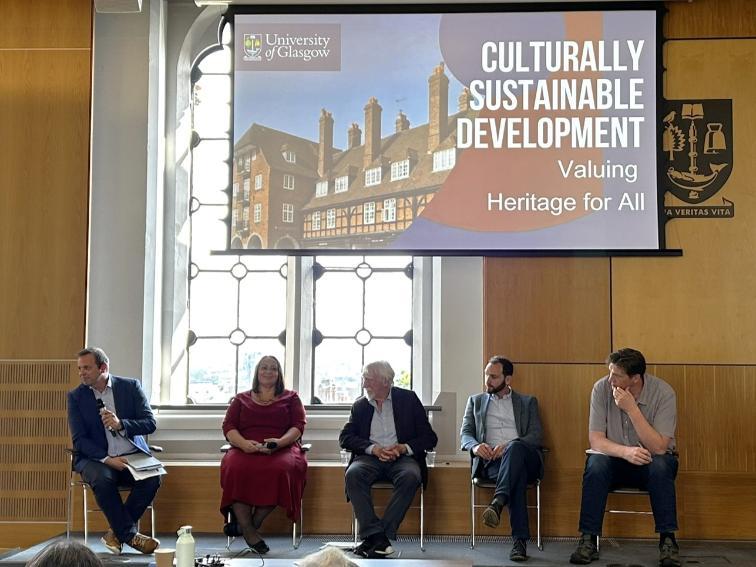
[L-R: Prof Fazio; Prof Riganti: Prof Throsby: Dr Lawton: Prof Campbell]
David Throsby delivered the keynote speech on the hidden value of heritage, arguing that although heritage has social benefits for both direct users and the wider public, it can often be missed in decision-making. Throsby suggested that interpreting cultural heritage items as a form of capital asset would allow heritage expenditure to be understood as an investment, and that doing so ensures, “We can apply conventional methods of public investment appraisal to evaluating [heritage’s] costs and benefits”. Throsby stated that, “With robust measurement of benefits, cultural heritage can be placed on an equal footing with other avenues of public investment in the competition for budget allocations.”
Next, Ricky Lawton presented culture and heritage capital research to date, in particular the Department for Culture, Media & Sport’s (DCMS) Culture and Heritage Capital (CHC) Framework, published in 2021. Lawton noted that the framework, “Set out a high-level systems approach to demonstrate how culture and heritage assets contribute to achieving the outcomes we seek as individuals and society.” The subsequent scoping study led to AHRC and DCMC announcing £3.1bn in funding for six multidisciplinary projects which measure the value of culture and heritage to society, one of which is the CAVEAT project, for which Patrizia Riganti is the Principal Investigator (PI).
To conclude talks from the evening’s speakers, Patrizia Riganti discussed the CAVEAT project: Triangulation of Values Using Different Valuation Methods. Riganti gave an overview of the objectives, methodology, and outputs of this ambitious project, which is centred around the historic English high street, and addresses a key policy and knowledge gap in its assessment and implementation of different economic valuation techniques. She explained that CAVEAT explores, “How existing valuation techniques can be triangulated to assess the value of the stock and flows of a complex historic asset, such as a historic high street or neighbourhood, to improve decision makers’ confidence when using such results in Social Cost-Benefit Analysis (SCBA).”
Giorgio Fazio, Professor of Microeconomics at Newcastle University then chaired a lively panel discussion between David Throsby, Ricky Lawton, Patrizia Riganti and Danny Campbell, Professor of Economics at Stirling University, as they fielded questions from the audience. The event was well attended by students and staff at the University of Glasgow, and members from creative and cultural organisations including Creative Scotland, New Lanark, Historic Environment Scotland, Historic England, New Lanark, and the Royal Conservatoire of Scotland.
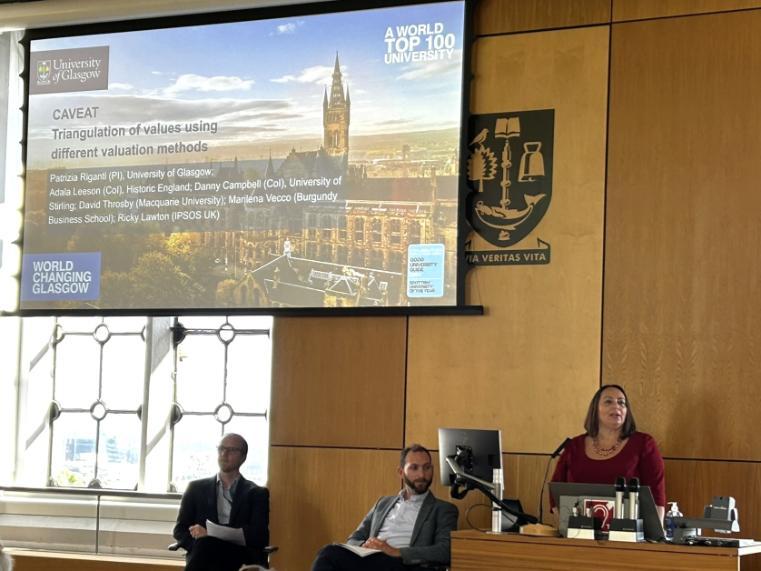
[L-R: Prof Roy; Dr Lawton; Prof Riganti]