

Pedagogy to support attainment in diverse classrooms Research Hub
Introduction to Mental Health in Schools
Promoting and supporting positive mental health in schools is becoming increasingly important to ensure that everyone in the learning community feels valued, healthy and safe. Positive mental health is important for everyone in schools: teachers, school staff, children and young people and their families.
Mental health is a difficult concept to define and can be hard for children and young people, and teachers, to talk about.
Aim: To strengthen teachers’ understanding of mental health in education and support them in applying research-informed approaches to wellbeing in their classroom practice.
Objectives:
- To examine contemporary definitions and research on mental health.
- To identify practical strategies for supporting community wellbeing.
- To begin planning a small-scale practitioner enquiry related to mental health or wellbeing.
Overall, the ambition is to provide a coherent model for understanding and supporting educational communities through the following learning units:
|
Stage |
Title |
Content |
|
1 |
Introduction to mental health and wellbeing in school – the 4 Rs |
|
|
2 |
Flourishing Educational communities |
|
|
3 |
RECOGNISING |
|
|
4 |
RESPONDING |
|
|
5 |
REFFERING |
|
|
6 |
REFLECTION |
|
Introduction to mental health and wellbeing in schools – the 4 Rs
What do we mean by mental health?
Mental health accompanies physical health and the two are deeply related. When we talk about mental health, we tend to talk about this in a medical sense e.g. someone who has depression or anxiety. However, everyone has their own mental health which changes depending on time, stress levels and internal and external stressors. At times our mental health can fluctuate for reasons which we find hard to identify. This is captured in the Scottish Government’s (2023) and the WHO (2025) definitions of mental health which states that:
‘Mental health is a part of our overall health, alongside our physical health. It is what we experience every day, and like physical health, it ebbs and flows daily. Good mental health means we can realise our full potential and feel safe and secure. It also means we thrive in everyday life’. (Scottish Government, 2023, p.12).
‘Mental health is a state of mental well-being that enables people to cope with the stresses of life, realize their abilities, learn and work well, and contribute to their community. It has intrinsic and instrumental value and is a basic human right. Mental health exists on a complex continuum, which is experienced differently from one person to the next’. (WHO, 2025).
What mental health issues are prevalent in Scottish Schools?
All schools come with their own stressors. For children and young people, this can be anxieties around friendships and relationships, bullying, body image (Goodfellow et al, 2022), puberty, exam stress, digital communication, social media and peer pressure. For teachers, job pressures around assessment deadlines, supporting children and young people to meet their needs, vicarious trauma and administration can increase stress (Hulme, Beauchamp, Wood and Bignell, 2025). Outside of school, everyone has their own life which impacts their mental health and can cause anxiety due to issues such as family issues, poverty, illness, bereavement and Adverse Childhood Experiences.
According to the 2022 Health Behaviour in School-aged Children (HBSC) study, 49% of children and young people experience mental health issues every week in areas such as feeling nervous, sleeping poorly and feeling irritable, and issues such as loneliness and low confidence also commonly reported. Some of the common mental health issues that teachers will likely come across when working with children and young people in schools are:
- Low confidence and low self-esteem
- Emotional distress e.g. anxiety and depression
- Relationship problems and bullying
- Self-harm
- Suicidal ideation
- Eating disorders
Why are mental health and wellbeing the responsibility of all?
Mental health and wellbeing in Scottish Schools are part of the ‘Responsibility of All’ teachers. In addition to this, children should be Safe, Healthy, Active, Nurtured, Achieving, Responsible, Respected and Included as part of the Getting it Right for Every Child framework (Scottish Government, undated). Teacher and staff wellbeing is also important too. Although the curriculum is changing, due to the current Curriculum Improvement Cycle, health and wellbeing will remain as a core part of the taught curriculum and school environment (Education Scotland, 2025).
The 4Rs
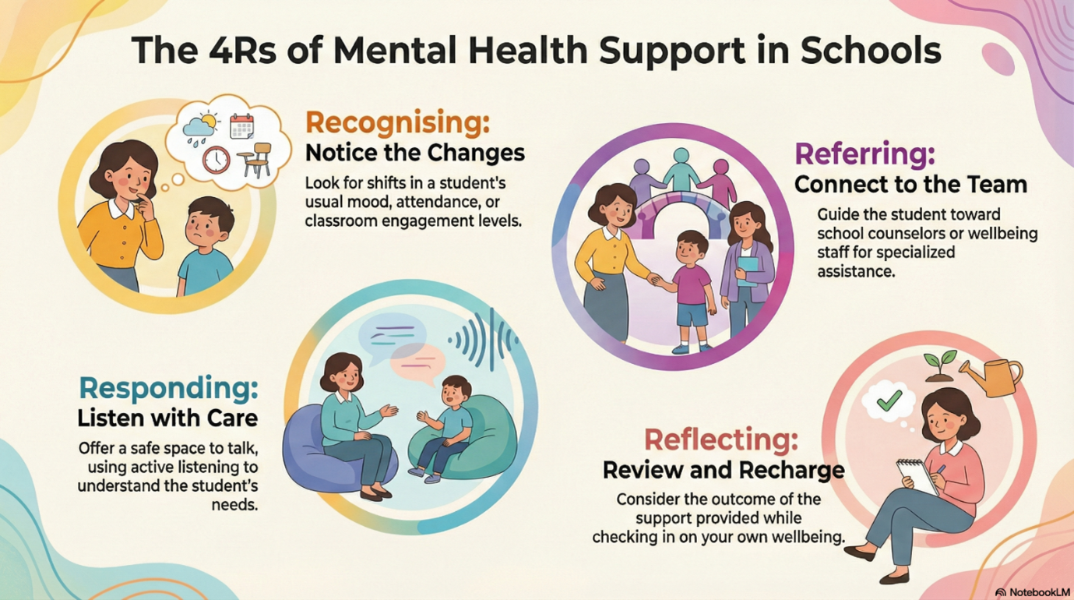
Throughout this resource, we want to encourage teachers to engage with professional enquiry and research-based practice to help them learn more about their knowledge of mental health and wellbeing in schools. This resource is based on the 4Rs model which helps teachers to ‘recognise, respond, refer and reflect’ on mental health issues in schools.
Something you can do this week
Download ‘the 4Rs of mental health Support in Schools’.
In the next few days engage in some professional noticing in your learning environment, asking when and where you engage in the 4R’s.
In the next few weeks, focus on this noticing and try changing some aspect of your practice based on the four Rs, for example, increasing opportunities to make space for listening to students, monitoring your sense of caring for individuals, or creating a reflective space for yourself. What changes does this generate?
Something you can do this month
Consider these reflective questions and use them to support your practice in this area.
- Do you agree with the Scottish Government’s (2023) and WHO’s (2025) definitions of mental health? If so, why? If not, what should it be changed to?
- How does this impact your classroom practice? What could you draw upon to demonstrate the impact?
‘Mental health is a part of our overall health, alongside our physical health. It is what we experience every day, and like physical health, it ebbs and flows daily. Good mental health means we can realise our full potential and feel safe and secure. It also means we thrive in everyday life’. (Scottish Government, 2023, p.12).
‘Mental health is a state of mental well-being that enables people to cope with the stresses of life, realize their abilities, learn and work well, and contribute to their community. It has intrinsic and instrumental value and is a basic human right. Mental health exists on a complex continuum, which is experienced differently from one person to the next’. (WHO, 2025).
- Do the 4Rs seem relevant to classroom interactions. If so, how can you use these in your own interactions with pupils, colleagues and families?
Practitioner enquiry
In what ways, do you see the presence or absence of the 4Rs affect your learning environment?
In using the 4 R’s with a specific learner, how does this affect their learning?
References
EDUCATION SCOTLAND, (2025). Curriculum Improvement Cycle (CIC) Working Together to Make Change Happen: A Discussion Paper. Edinburgh: Education Scotland.
GOODFELLOW, C., WILLIS, M., INCHLEY, J., KHARICHA, K., LEYLAND, A. H., QUALTER, P., SIMPSON, S., & LONG, E. (2023). Mental health and loneliness in Scottish schools: A multilevel analysis of data from the health behaviour in school-aged children study. British Journal of Educational Psychology, 93, pp. 608–625. https://doi.org/10.1111/bjep.12581
HULME, M., BEAUCHAMP., G., WOOD, J., & BIGNELL, C. (2025). Workload intensification and wellbeing among primary school teachers in Scotland. Education 3-13, pp. 1–14. https://doi.org/10.1080/03004279.2024.2448509.
SCOTTISH GOVERNMENT, (undated). Getting it Right for Every Child. Edinburgh: Scottish Government.
SCOTTISH GOVERNMENT, (2023). Mental Health and Wellbeing Strategy. Edinburgh: Scottish Government.