

Research in the lab
Our laboratory investigates the neural foundations of spatial navigation, memory, and naturalistic behavior. Understanding how the brain constructs internal representations of physical space is a central pursuit in systems neuroscience, which can offer critical insights into cognitive function and neurological health.
Navigating an environment and remembering where we are requires the coordinated activity of specialized brain regions and cell types. Below is an introduction to the core concepts and neural populations that form the foundation of our work.
The Hippocampus and memory
The hippocampus is well known for its key role in learning and episodic memory - damage to this brain region in humans causes severe memory loss and impairments. In animals and humans the hippocampus is also a vital hub for spatial navigation and decision-making. It links environmental experiences with temporal context to organize how we remember and navigate our surroundings. To study how the hippocampus underlies memory more generally, we study how this brain region operates in rodents, typically through spatial navigation and memory tasks as rodents have exceptional navigational abilities and because the rodent hippocampus is strongly linked to spatial memory (see below for why).
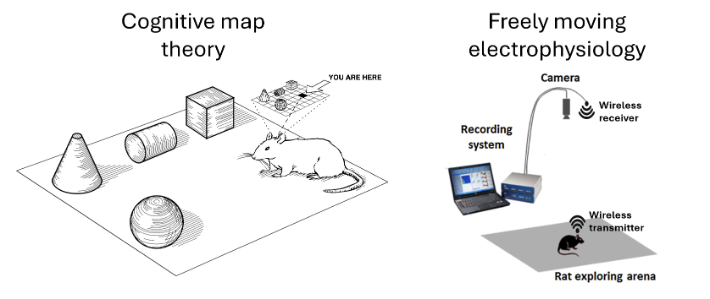
(left) Cognitive map hypothesis (Eichenbaum et al. 1999) (right) Recording approach for spatial neurons (Grieves and Jeffery, 2017).
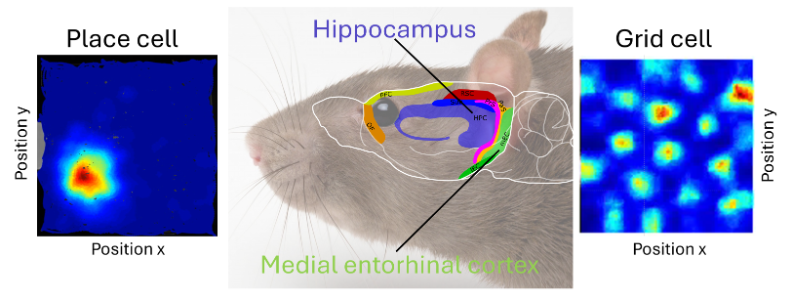
Example place cell (left) and grid cell (right) activity with anatomical location (Grieves and Jeffery, 2017).
Place cells (a sense of place)
Located mainly within the hippocampus, place cells are specialized neurons that become active when an animal occupies a specific location in its environment. Together, as a population, we think place cells form what we call a 'cognitive map' - an animal's internal representation of its surrounding environment. Interestingly, on top of this, place cells seem to also reflect non-spatial features like the animal's internal state and future choices.
Grid cells (a sense of distance)
Found mainly in the medial entorhinal cortex (a major input region to the hippocampus), grid cells fire in a striking, periodic, triangular pattern that spans across an entire environment. We think this multi-peaked periodic firing provides a metric coordinate framework that helps the brain measure distances and navigate spaces, although this has not been very clearly demonstrated.
Head direction cells (a sense of direction)
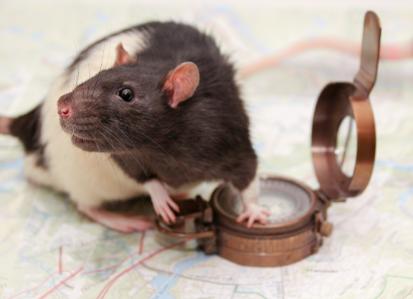
Head direction cells are found in many different brain regions, including many that developed quite early evolutionarily - in fact we know that even insects have head direction cells. These neurons fire when an animal's head points in a specific direction, regardless of the animal's current location or behaviour. We think they act a bit like an internal compass, helping the brain maintain a sense of direction even through periods of visual or spatial disorientation. Importantly, we talk about these cells resembling a compass, but they are not at all related to the Earth's magnetic field in the way true compasses are, their activity is internally generated and then updated based mainly on visual landmarks in the animal's environment.