

Milliwatt Ka-Band Resonant Tunnelling Diode Sources
Published: 6 October 2026
Qixiang Zhang, with support from Mahmoud Wagih, Edward Wasige and Abdullah Al-Khalidi, presents his research into resonant-tunneling-diode-based oscillators for mm-wave sources. This work is vital for readying next-generation technology for biomedical imaging, security screening and agricultural sensing
Millimetre-wave (mm-wave) sources are becoming increasingly critical for next-generation electronic systems. They enable applications such as biomedical imaging [1], non-metallic-material detection for security screening [2], and agricultural sensing [2]. Consequently, resonant-tunnelling-diode (RTD)-based oscillators have attracted attention as a compact, electronically driven alternative that offers reliable room-temperature operation and relatively simple fabrication.
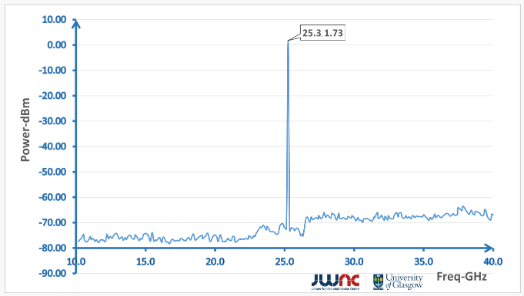
Figure 1: Standard RTD Oscillator Schematic Analysis
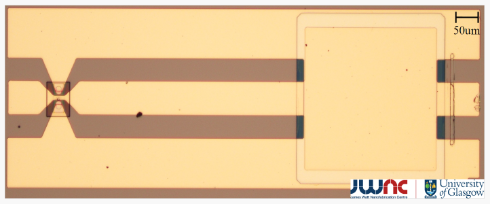
Figure 2: Micrograph of a fabricated RTD oscillator
As presented in Fig. 1, resonant tunnelling diodes (RTDs) exhibit negative differential resistance (NDR) characteristics. A state-of-the-art RTD-based terahertz (THz) oscillator can be conceptualized as a device that converts direct current (DC) power into radio frequency (RF) power.
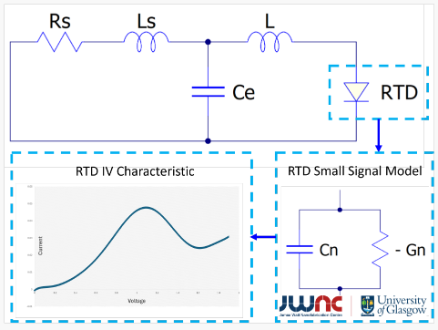
Figure 3: Measured and Calculated I–V Characteristics and Conductance of 5 ×
5μm2 RTD
This section presents a comparison between the calculated and measured I–V characteristics of the 5 × 5μm2 device, as shown in Fig. 3.
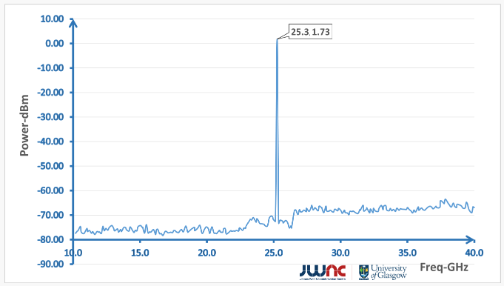
Figure 4: 30 GHz RTD Oscillator Spectrum
The oscillator chip was characterized using an on-wafer spectrum analyser measurement. The measured oscillation frequency was 25 GHz with an output power of 1.7 dBm (1.49 mW), as shown in Fig. 4.
In conclusion, good agreement between measured and fitted I-V was achieved. Measured RF spectrum demonstrates the RTD’s capability of generating useful powers in the Kaband. The target is to demonstrate transceiver modules for wireless communication applications.
References
[1] Zhi Chen et al. “A survey on terahertz communications”. In: China communications 16.2 (2019), pp. 1–35.
[2] Jue Wang. “Monolithic microwave/millimetrewave integrated circuit resonant tunnelling diode sources with around a milliwatt output power”. PhD thesis. University of Glasgow, 2014.
First published: 6 October 2026