

Insights from the Future Leaders Fellows Development Network Conference
Published: 16 June 2025
The FLFDN Inclusive Leadership conference encouraged authentic engagement, explored diverse definitions of leadership, and highlighted strategies for inclusive policy and cultural change. InFrame’s key takeaways include prioritizing wellbeing as a success measure, using 360 feedback to understand leadership perceptions, and simplifying development programmes to allow space for reflection and collaboration.
By Lisa Backwell (she/they), Community Knowledge Analyst for the InFrame project based at the University of Edinburgh
In November 2024, the InFrame team spent two days (joining in-person/online) at the Future Leaders Fellows Development Network (FLFDN) meeting on Inclusive Leadership.
FLFDN is a development network available to all eight cohorts of the Future Leaders Fellows that delivers specialised leadership training, mentorship and collaborative opportunities, which supports its members to lead interdisciplinary, cross-sector research and innovation.
Here I reflect on the conference and share some highlights from the event.
Setting the tone
10 minutes into arriving at the conference centre (Horizon Leeds), with a cup of tea (priorities) in hand and settling at a table for the first talk, I was struck by the refreshing welcome from FLFDN People Culture and Environment manager, Katie Nicoll Baines. As well as setting out some logistics and participatory rules of engagement (such as British Sign Language applause, challenging the judgements we make with each other, and giving us permission to move around as and when we need), Katie took the time to invite attendees to resist the urge to present as our polished ‘shiny-selves’, which is often the expectation at conferences.
Although it may seem like a small thing, this one comment immediately put me at ease, I felt I could be more authentically myself and it helped me to be more present through the next few days. It feels counter-cultural in academia to give people permission to be imperfect. Importantly, I felt this simple gesture broke down barriers and made it easier to build genuine connections.
Leadership is…
So, what is leadership anyway? Within InFrame we take a very broad approach to defining leadership as anyone leading work to make a change and/or supporting groups towards an outcome.
During the conference Joulie Axelithioti, InFrame Leadership Developer at the University of Glasgow co-facilitated group discussions where we defined aspects of leadership that we found were important (Figure 1).
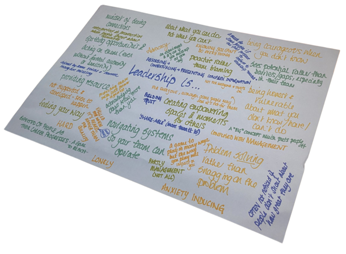
Figure 1. Defining leadership at the FLFDN Understanding Inclusive Leadership Conference
During these conversations, we talked about the contrasting interpretations of leadership: when it is hierarchical versus something for everyone to explore, when it is a career goal versus being imposed onto others, or when leadership is confused with management. Lastly, we noted that leadership can be a lonely experience and how we could do more to encourage people sharing in leadership roles.
We also heard perspectives from the Future Leaders Fellows on their experiences of becoming a research leader. They spoke of challenges such as having to accept the judgement of others, navigating institutional processes and experiencing imposter syndrome as well as strategies such as taking inspiration from other leaders and seeking support from FLF cohort.
These sessions were complemented by presentations exploring new ways of leadership from fellow projects funded by Wellcome’s Institutional Fund for Research Culture:
- The Newcastle University project building enhanced leadership capacity to enable psychological safe and inclusive research environments
- The University of Leicester project towards empathetic research leadership
- The Ignite project lead by the University of Cardiff towards enabling early career researchers, technicians and professional services staff to effectively lead positive research cultures
It was a great opportunity to connect with these teams, when we were at such an early stage of working on our own research culture change project.
Influencing policy: diverse perspectives
During a session on the role of leaders in shaping policy, we heard from panel members with experienced policy perspectives at the research funding, third-sector and parliamentary level.
The panel discussed the challenges associated with leading policy change and made potential recommendations to overcome these (Figure 2). In particular, the panel reflected on how they accommodate conflicting needs to develop a solution that best addresses the overall situation by:
- Being clear on the policy’s purpose
- Incorporating evidence to drive decisions
- Listening to different viewpoints throughout
- Modifying communication tone
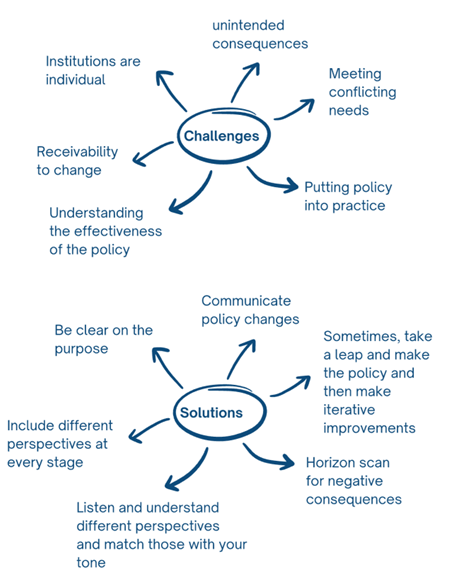
Figure 2. Challenges to leading policy change and recommended solutions
Charmaine Lim, Community Knowledge Analyst based at the University of Glasgow, valued that the funders, who hold a position of influential power, were taking responsible steps to mitigate the potentially cumulative impact of policies: “It was refreshing to hear about how Wellcome Trust was attempting to ‘walk their talk’ in their response e.g. withdrawal of funding from people who committed acts of bullying and harassment.” – Charmaine Lim
While the hierarchical structures and systems of privilege contribute to individuals exhibiting varying levels of influence and power towards changing policies, Faith Uwadiae, Wellcome Research Culture and Communities Specialist, highlighted that “everyone has a sphere of influence”. Ros Attenborough, InFrame Evaluation Manager, shared how this was a good “antidote against the feeling of powerlessness that can easily grip anyone in the research culture change game, regardless of our level of formal influence”. Here, Ros reflects on a research culture observation she heard, that “sometimes everyone – even senior leadership – talks about the culture of a university as if it is separate and uninfluenced by them”: “The takeaway for me over and over again is: it’s easy for everyone to feel like they can’t make a difference. There is truth to this: there is genuine disempowerment, and there are different ways to hold power. I wonder if we get stuck in disempowerment and keep it as we move into more senior positions. It can sometimes be convenient to hold onto powerlessness and use distancing rhetoric. But we all have a sphere of influence.” – Ros Attenborough
Consistent with the bell hooks’ theory, that there is an inverse relationship between upward mobility and radical thought, Matt Brim (in Poor Queer Studies : Confronting Elitism in the University. Durham: Duke University Press, 2020, p.95) argues an increased power in academia comes with an increased alignment to institutional norms. Perhaps this suggests those with less positional power, have more flexibility to try new ideas to drive research culture change.
InFrame Insights
Below some of the InFrame team share their key takeaways and how they plan to embed them into the work we do…
- Use wellbeing as a measure for success for policy
Daniel Rowley (Head of Policy & Comms, Samaritans Scotland) highlighted that wellbeing, can be used to measure success as well as or instead of other measures such as productivity. Both Ros and Charmaine shared that it made them think about where and how to include measures of wellbeing when evaluating the journeys of funded Culture Catalyst project teams. Indeed, preliminary findings from the Research Culture team at University College Dublin suggest indicators of researcher’s wellbeing may yield research culture insights.
“It also sparked a thought for me: which methods and approaches can most genuinely evaluate wellbeing in research cultures? This is one of the most important areas, but answers aren’t necessarily at surface level and may depend on trust.” – Ros Attenborough
- Capture perceptions of leadership through feedback
The presentation on the FLFDN 360 feedback process was insightful. 360 feedback provides individuals with an all-round view on their workplace behaviours. Within InFrame we strive to gather feedback both on how we work as a cross-institutional team, but also on our outward facing processes. 360 feedback data has the potential to capture rich data on the diverging perceptions of leadership, which we could embed into our framework on collegial leadership.
- Development Programmes: less less less!
Maddie Mitchell shared her lessons on developing an inclusive leadership programme for the Medical Sciences Division at the University of Oxford. It was useful to hear Maddie reflecting on how valuable it can be to carve out time for people to focus on leadership and how removing content from the programme helped enable participants to work out what inclusive leadership meant to them. Reflecting on this, InFrame have hosted writing labs and dedicated writing time for potential Culture Catalyst Fund Round 2 applicants. Through keeping these sessions content-light, applicants had time to focus on writing the application, with the InFrame team on hand to support them. Concurrently, collegial conversations among attendees emerged, where they shared ideas and institutional knowledge to support each other’s applications.
First published: 16 June 2025