June 2026 marks the launch of the project Bread & Roses: Rest and Free Time under Disabling Capitalism's First Research Phase: a UK-wide questionnaire
Published: 1 June 2026
Funded by the Leverhulme Trust and the University of Glasgow, Bread and Roses: Rest and Free Time In, Against, and Beyond Disabling Capitalism is a research project undertaken in the School of Social and Political Sciences by Ioana Cerasella Chis (Early Career Leverhulme and LKAS Fellow). The project’s launch in June 2026 is marked by the opening of a UK-wide questionnaire.
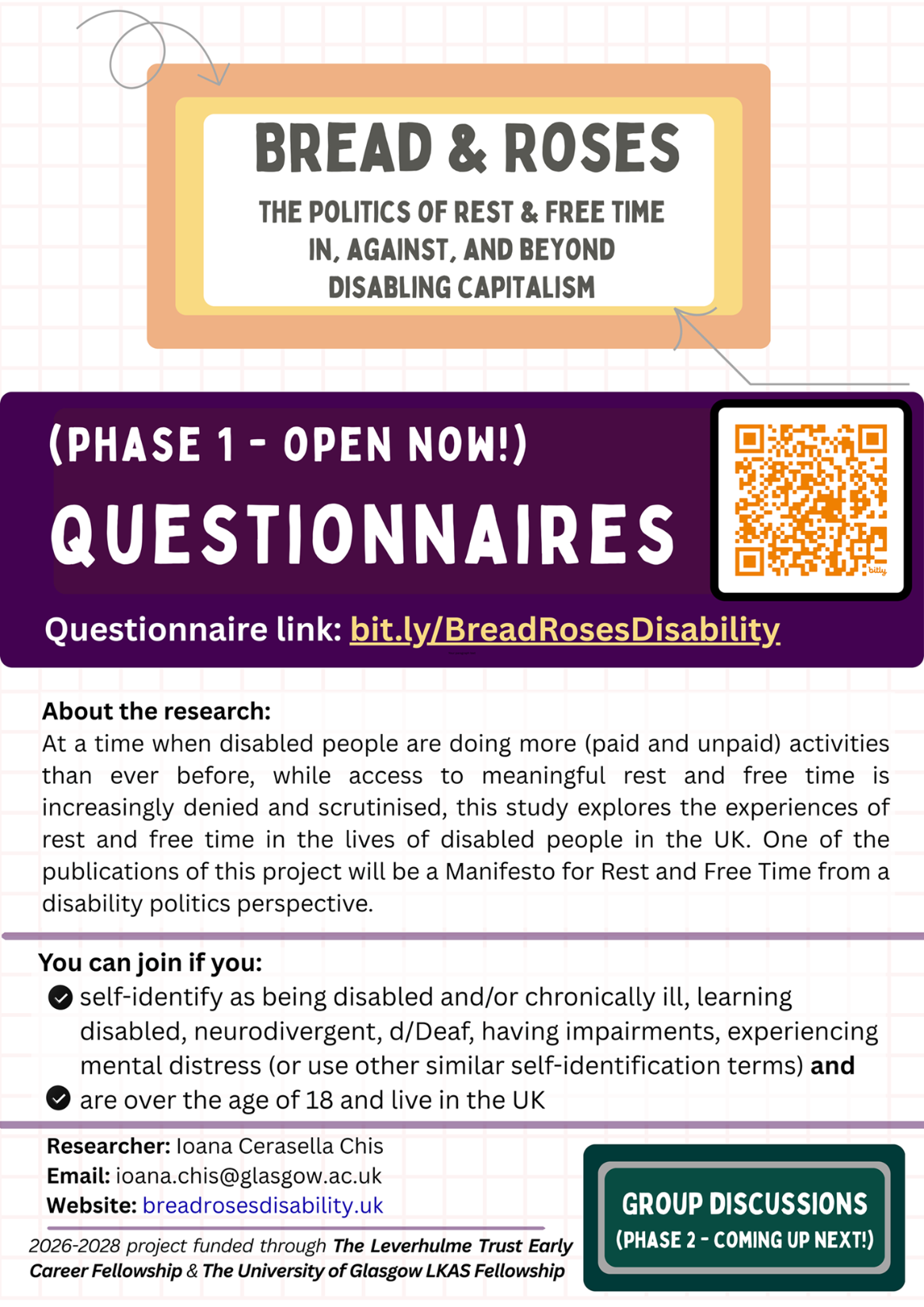
The questionnaire explores the politics of rest and free time in the lives of people who self-identify as people who are disabled, chronically ill, learning disabled, d/Deaf, neurodivergent, with impairments, and/or with experience of mental distress. Through this questionnaire, the study prompts research participants to:
- share their own understandings and experiences of rest and free time,
- reflect on the resources and time available for meaningful rest and free time,
- highlight the social restrictions and barriers they face when seeking to engage in meaningful rest, and
- point to the societal changes needed to ensure everyone has increased control over what they do in their free time.
Anyone aged over 18 from across the UK who fits the eligibility criteria of disability-related self-identification is invited to submit their responses and help inform the direction of the project. The questionnaire is available on the project’s website: https://breadrosesdisability.uk/questionnaire as an online form (for typing or uploading audio or other files) and as a downloadable Word Document file. Other ways for addressing the questions (as alternatives to the two formats listed here) can also be explored.
The wider project’s research phases:
This three-year project will unfold across several phases of engagement with research participants. The first phase, which consists of distributing the questionnaire to potential participants in the UK, will be followed by collective discussions/focus groups with the participants in late 2026 and 2027.
Rationale for the project:
Disabled people in the UK are working (paid and unpaid) harder and longer than ever before – but when do they (we) find time to rest meaningfully? What infrastructures and resources are available for pursuing meaningful activities in their time outside of work? Engaging the insights of disabled people over the age of 18 who live in the UK, this project explores how rest and free time are experienced, regulated, and denied under the contemporary disabling capitalist context of the UK.
This project will create time and space for discussions about the resources and ways of relating to one another that are necessary so that joyful, restful, and rejuvenating activities are no longer considered to be a ‘luxury’ reserved mostly for the very few.
Particular attention will be given to how the research participants have experienced free time and rest during periods of undertaking mostly unpaid work, no work, volunteering, or insecure paid work. Insights from disabled people with only experiences of full-time paid work are also welcome (the questionnaire asks questions about the participants’ particular experiences of work).
This project has been made possible through the Leverhulme Early Career Fellowship and the UofG College of Social Sciences Lord Kelvin and Adam Smith Leadership Fellowship.
Publications:
Alongside Open Access publications, through this project, a report in the form of a Manifesto for Rest and Free Time will be produced, following the analysis of questionnaire responses and collective discussions/focus groups. The report/manifesto will be distributed to relevant collectives, campaigning groups, and policy-makers.
Previous (related) research and its future book
This project builds on some of the findings of a previous study, undertaken in the early 2020s and titled The Politics of Disablement and Precarious Work in the UK. It examined the political economy of work under capitalism and the everyday paid and unpaid activities of disabled gig economy workers in the UK. It also highlighted participants’ aspirations and suggested alternatives to the current capitalist social relations (the way we relate to one another). A book manuscript based on this project is currently under review with Bristol University Press.
Future updates:
To follow more updates about the Bread and Roses project and to share its calls for questionnaire responses (and later) collective discussions/focus groups, please visit any of the following websites and social media pages:
If you wish to share the questionnaire with anyone who might be eligible, please share this link with them: https://breadrosesdisability.uk/questionnaire/
First published: 1 June 2026