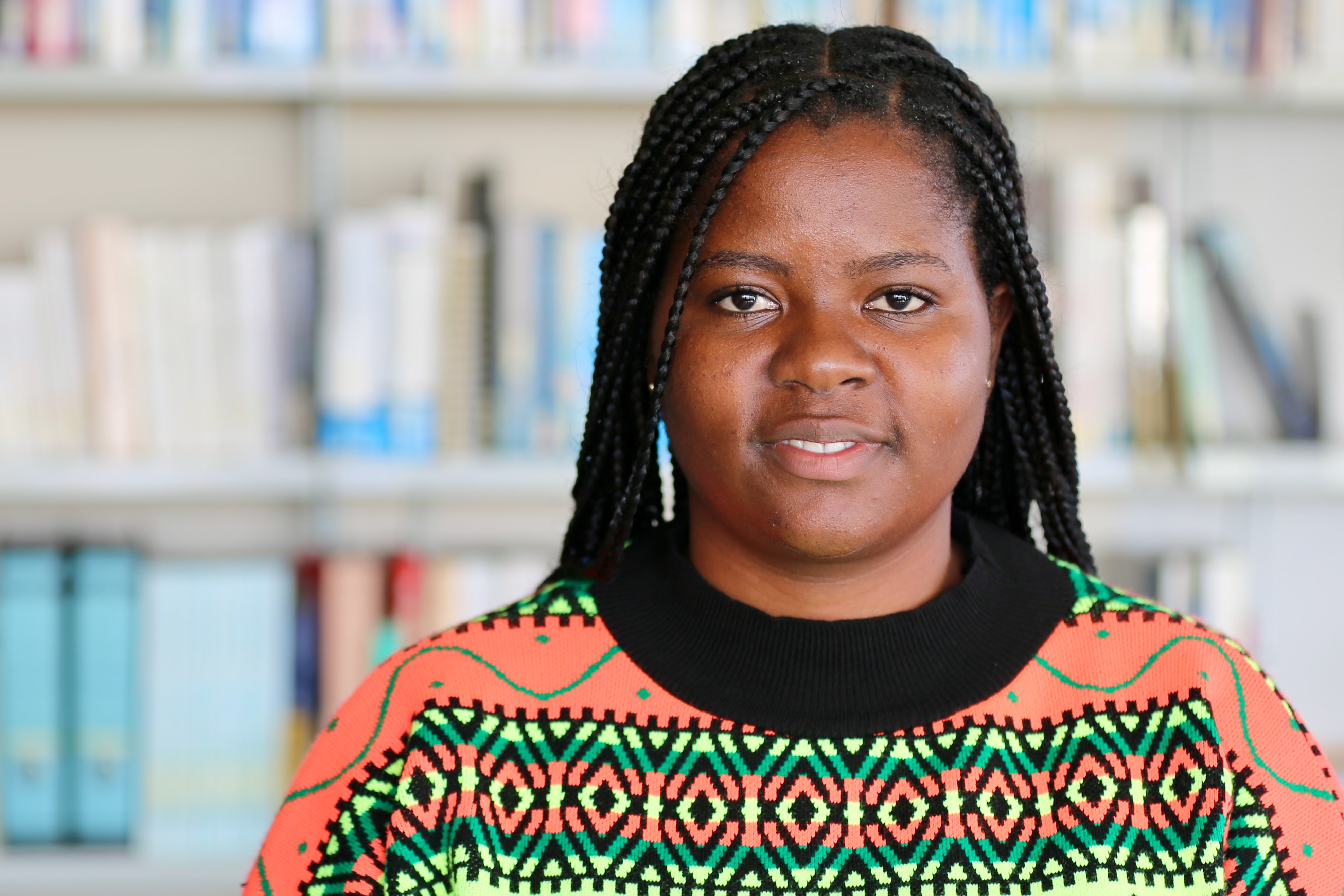
Ariane Nidelle Meli Chrisko
a.meli-chrisko.1@research.gla.ac.uk
Research title: Spatiotemporal GARCH Models with Asymmetric Volatility Spillovers
Research summary
We aim to introduce an extension of the exponential generalized auto-regressive conditional heteroscedasticity (E-GARCH) model, commonly used for time series analysis, to spatiotemporal data. We refer to this extension as the spatiotemporal E-GARCH (Sp-EGARCH) model. This model assumes that the asymmetric effect of the volatility is not only influenced by temporal
dependence but also by fluctuations in the considered local area. Spatiotemporal models are
about extending the auto-correlation in time series to spatial dimensions and was introduced as
stationary stochastic processes on the plane by Whittle (1954). Years later by Cliff et al.
(1970) developed how to test for spatial auto-correlation in possibly irregular spatial configurations, which later on inspired a lot of papers. Recent literature provides a different extension of
spatiotemporal models. These are Spatial ARCH models introduced by Otto et al. (2018) which
are considered as the spatial equivalent of ARCH models by Engle (1982). Spatial log-GARCH models suggested by Sato and Matsuda (2021) can be re-expressed as spatial auto-regressive moving average
(SARMA), which makes it possible to estimate the parameters also in a well-developed way
in the literature. Spatiotemporal GARCH models were also defined by Otto et al. (2022). It is a
popular econometric tool used to analyze and forecast the volatility of spatiotemporal data, which
can be observed in many fields such as finance, economics, environmental science, and public health. The novel spatiotemporal E-GARCH model combines the spatial and temporal dimensions of
data and allows for spatial dependence and heteroscedasticity in the asymmetric volatility structure. The spatial dimension captures the potential interdependence among different locations, while the temporal dimension accounts for the time-varying nature of the data.
Supervisors
Conferences
DeepLearn 2023 Spring: Bari, Italy April 3-7, 2023, https://deeplearn.irdta.eu/2023sp/
The Doktorand:innentreff der Stochastik 2023: Heidelberg, Germany August 21-23, 2023, https://stat.math.uni-heidelberg.de/dts2023/
Statistical Week 2023: Dortmund, Germany September 11-14, 2023, https://statistische-woche.de/
Retreat for Women in Applied Mathematics 2024: Edinburgh, Scotland, UK, January 08-12, 2024, https://www.icms.org.uk/RWAM2024/
Teaching
Statistics.