

Kelvin Quantum co-founder awarded £1.65m Future Leaders Fellowship
Published: 28 October 2026
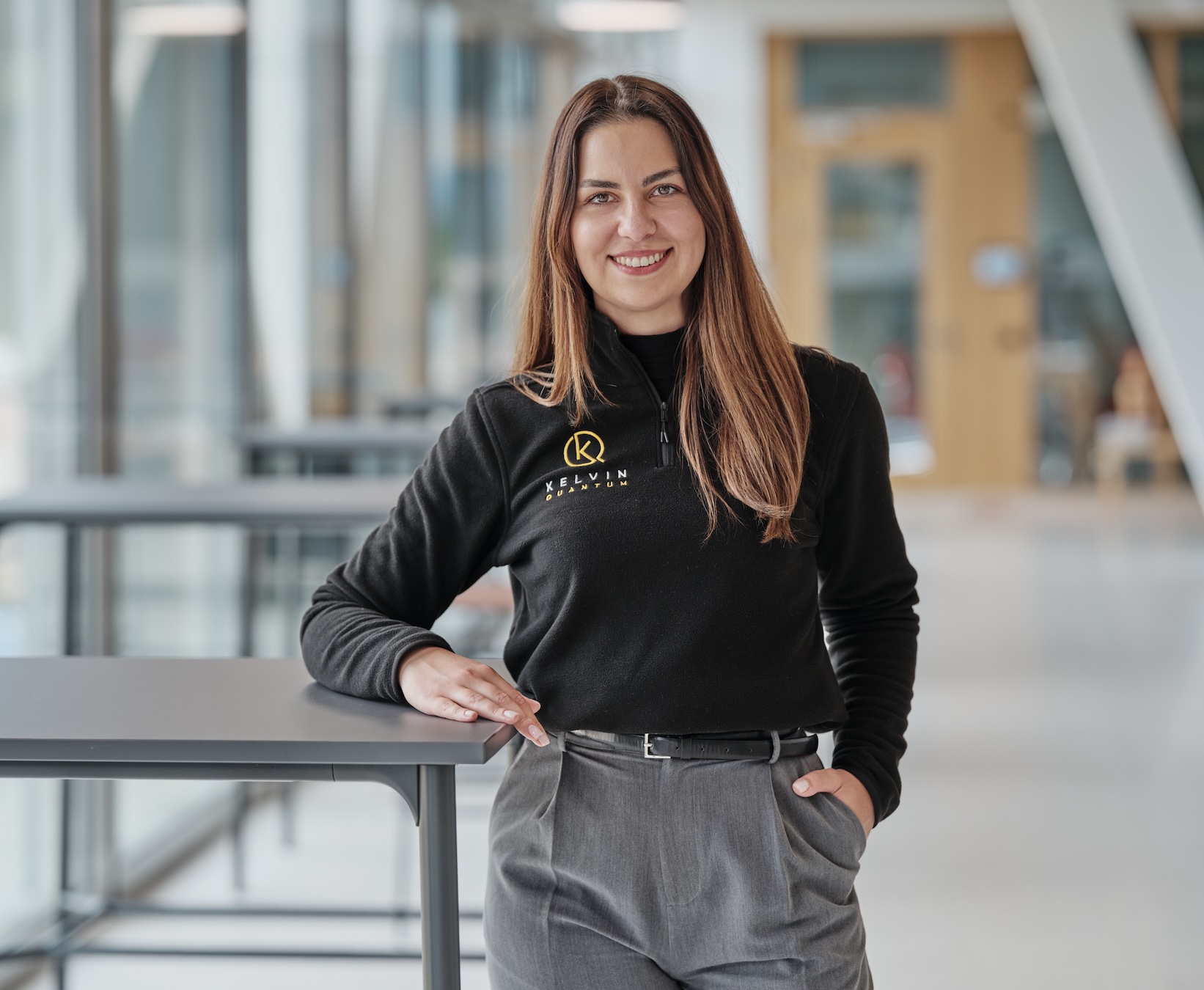
Dr Stavroula Kapoulea, co-founder and Chief Operating Officer of University of Glasgow spin-out Kelvin Quantum, has been awarded a £1.65 million UK Research and Innovation (UKRI) Future Leaders Fellowship.
Dr Stavroula Kapoulea, co-founder and Chief Operating Officer of University of Glasgow spin-out Kelvin Quantum, has been awarded a £1.65 million UK Research and Innovation (UKRI) Future Leaders Fellowship.
As one of 28 recipients in the latest cohort, she will lead a four-year project to develop cryogenic electronics and help address one of quantum computing’s biggest challenges: scalability.
At the heart of this challenge lies a hidden obstacle: the electronics that control and read out the qubits. Qubits operate inside a cryostat, an ultra-cold chamber close to absolute zero, while the electronics that drive them sit in racks at room temperature. Bridging that gap takes hundreds of individual cables.
At around a thousand wires, enough to control a few hundred qubits, up to half of a cryostat's entire cooling power is spent removing the heat those cables carry in. Scaling further towards the required hundreds of thousands this way is not simply difficult; it is physically impossible.
CONQRETE aims to bring quantum control and readout electronics into the ultra-cold environment where qubits operate, helping manufacturers move towards practical, scalable quantum computers.
For four years, five organisations will build this as one team: Kelvin Quantum, the National Quantum Computing Centre, the National Physical Laboratory, Compound Semiconductor Applications Catapult and Keysight Technologies.
Cryogenic chips, packaging, measurement and control software will advance together and be brought to a single test: a real quantum processor, controlled and read out entirely from within the cold.
Dr Kapoulea said: “This fellowship is a huge personal milestone for me. I’m really excited for the opportunity to bring together a great team, build on the partnerships we’ve developed through Kelvin Quantum, and take our technology much further.”
First published: 28 October 2026
Related links