

Public symposium aims to cast new light on AI’s hidden sides
Published: 23 September 2026
A public event which explores the hidden ethical implications and impacts of artificial intelligence is set to return to Glasgow next month.
A public event which explores the hidden ethical implications and impacts of artificial intelligence is set to return to Glasgow next month.
The University of Glasgow will host the Lovelace-Hodgkin Symposium for a third year on Tuesday 13 October, following the sold-out success of previous events.
Academics, artists, musicians and filmmakers will contribute to the event, which is based around the theme of ‘Making the Invisible, Visible: AI, Stories, Power & Participation’.
Together, they will investigate elements of the fast-expanding field of AI which are talked about less often than the technology’s potential effects on the economy or the job market.
Instead, they will pose questions around what AI hides, what it reveals, whose voices it foregrounds, and ask who gets to have a say in how the technology is developed.
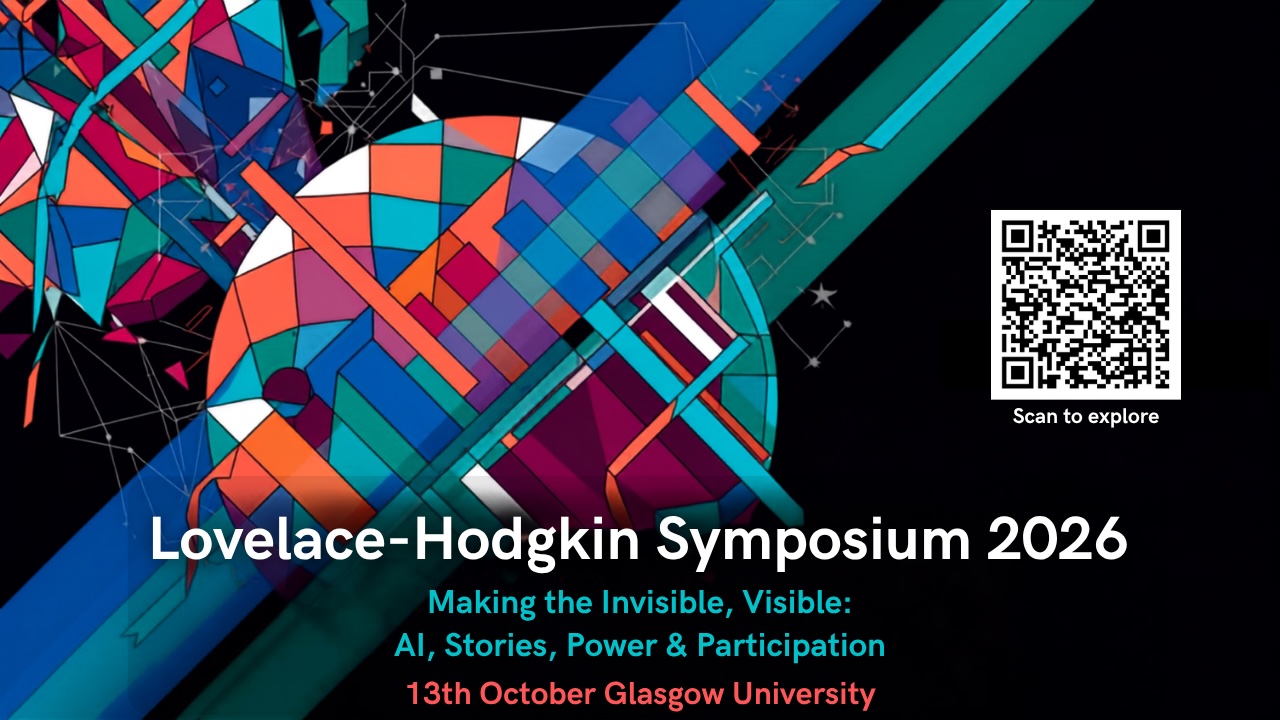
The event is structured as a journey from how the technology works to who controls the stories it tells, across a series of presentations, games and workshops.
The University of Glasgow’s Dr Jake Lever will uncover the nuts and bolts of how large language models work, using a simple game and audience participation to ask whether a system based on biased data can ever produce neutral results. The theme will be further explored in another game from The University of Glasgow’s Professor Anna Feigenbaum, which explores the infrastructure, decisions and labour which determine the outcomes of AI responses to users’ queries.
The University of Glasgow’s Dr Tim Peacock will move the conversation on to what AI hides, with a game highlighting the unintended consequences of AI, including cybersecurity and data ownership. Then, Dr Kimia Witte and Dr John Donaldson of the University of Glasgow will examine the ethical and social implications of absent, incomplete and invisible data, and how these gaps can shape biological outcomes, research and policy.
Following a performance of ‘Artificial Child’, an AI-inspired new song from singer-songwriter Maaike Siegerist, the day’s third section will look at who gets to tell the stories that AI shares. Emma Robertson and Miguel Jardine of ShiftReturnDigital will showcase a digital model of pioneering mathematician Ada Lovelace, built using bespoke AI trained on historical data, which will discuss how her research led to the development of computing. The University of Cambridge’s Dr Beryl Pong will discuss how drone technologies paired with AI are used to shape perception, knowledge and authority.
After a drinks reception, the day will close on the theme of reclaiming visibility and perception. Producer Michael Watts will host a screening of the LifeMosaic film ‘Mapping & Monitoring in Indigenous Territories’, which showcases six indigenous filmmakers from Asia, Latin America, and Africa using ancestral and technological approaches to mapping and monitoring biodiversity.
The festival is organised for the third time by Dr Ciorsdaidh Watts and Dr Lydia Bach, who lead a wider Theme of AI Ethics, Literacy & Impact at the University of Glasgow’s Centre for Data Science & AI. Their work includes the development of an online FutureLearn course called ‘AI Ethics, Inclusion & Society’ and the launch of a monthly AI Ethics Book Club which is open to all.
Dr Watts, who is also a senior lecturer in the School of Chemistry, said: “This year, we’ve worked hard to turn what was previously a more academic symposium into something that feels more like a one-day festival, with games, live music, art and film. AI is having real impacts on our everyday lives, and it’s important that we ensure the questions the event is looking to explore are accessible to everyone.
“The symposium is named after Ada Lovelace and Dorothy Hodgkin, whose work on mathematics, computing and chemistry weren’t fully recognised in their time. Fittingly, it takes place on Ada Lovelace Day, and we’re excited to present a digital representation of Ada Lovelace herself, made using a custom-built AI system and designed to help tell her story using a wealth of data about her life and work.”
Dr Bach, who works in University’s People and Organisational Development team, said: “This isn’t an anti-AI event at all; instead, we’re aiming to expand the conversation, which often feels like it’s framing AI as something that’s happening to us rather than something we have control over. We want to help people understand that they have agency in their relationship with AI, and they can have a voice in how these technologies are designed, governed and used.
“As part of the event, we’ll also be displaying creative works made by staff, students and others who have taken part in events and activities we’ve previously organised to explore questions AI, data, power, participation and visibility. Attendees will have the chance to meet the people behind these works and discuss the issues they raise.”
The Lovelace-Hodgkin Symposium will be held at the Glasgow University Union’s Debates Chamber on Tuesday 13 October. Tickets, which cost £5, are available from Humanitix. The ticket price can be waived for anyone for whom the cost would be a barrier to attendance. Proceeds will help support a community project with the Children’s Wood Charity.
First published: 23 September 2026
Related links