

Gaelic, Scots and Norse place-names lead scientists to Scotland’s hidden oyster beds
Published: 15 September 2026
Analysing original Gaelic and Scots place-names has helped a team of scientists rediscover the locations of important oyster beds on the West Coast of Scotland
Analysing original Gaelic and Scots place-names has helped a team of scientists rediscover the locations of important oyster beds on the West Coast of Scotland.
The discoveries, made on Mull and Islay, by a team of researchers at the University of Glasgow, with support and guidance from local tradition and knowledge bearers, highlight the fundamental links between language, traditional knowledge and the natural habitat.
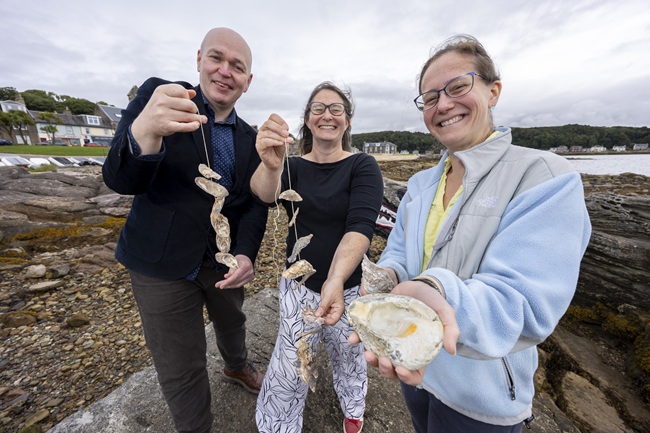
Locating the oyster beds has been hailed as an exciting moment for Scotland’s coastline by ecology and wildlife experts, who hope to use the discoveries to help rebuild oyster populations in suitable coastal locations.
Acting in a similar way to tropical coral reefs, the presence of oyster beds in Scotland is key to the health of its shoreline and waters. However, while native oysters were once extremely abundant in coastal European waters, including Scotland, only remnant populations are known to remain due to overharvesting and disease.
Rediscovering the West Coast oyster beds is the culmination of several years of work undertaken by Project Eisirean, a collaboration between ecology and environment researchers and Gaelic and education experts at the University of Glasgow alongside local community organisations on the west coast of Scotland. The work, funded by grants from UK Research & Innovation, was led by Dr Anna McGregor, an expert in coastal ecology, who had the original idea of locating oysters through traditional place-names and then applying scientific techniques to confirm oyster presence within them.
Historically shellfish have been a key food source within coastal communities, as shown by frequent mentions in place-names as well as stories, songs & lore. Using this knowledge, the research team searched for the inclusion of the Gaelic words for oyster or oysters – eisir, eisirein and eisirean – and oyster habitat – sandy banks and tidal causeways - in place-names around Scotland’s coast.
The research team were able to identify at least one important oyster bed that hadn’t been previously documented, as well as confirming that oysters could have been present at some other sites.
Researchers say the discoveries have highlighted the important role language can play in unlocking previous knowledge about our coastlines and countryside. With further support from NatureScot and Argyll & Bute Council, the team now plan to build on their findings through continued work with local communities in Islay and Mull, alongside oyster bed restoration and protection work in key areas, using those areas to understand why oysters grow well in them.
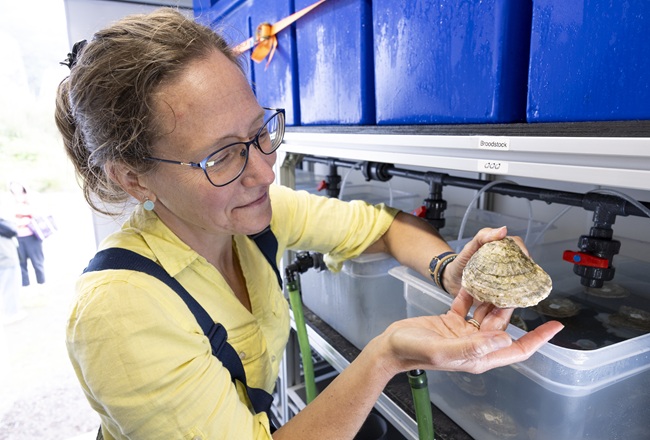
Dr Anna McGregor, ecologist at the University of Glasgow and Project Eisirean lead, said: “Project Eisirean has been a truly collaborative project that has highlighted the importance of keeping indigenous language and knowledge alive, and the role it can play in helping us to better understand the environment we live in.”
“Finding the oyster beds on the West Coast of Scotland has been an exciting time for us all and, working with local communities to engage more with the marine world in their local place and work towards good stewardship of the resources that are left, we hope to ensure these beds remain healthy for years to come.”
The aims of this project are fully in line with the strategy of the Native Oyster Restoration Alliance – NORA – which coordinates projects across Europe to enhance the restoration of flat oyster reefs.
Hein Sas, Secretary of NORA, said: “The Eisirean project can serve as an example for other projects on how cultural heritage can help to identify suitable restoration sites. Additionally, the involvement of local communities is essential for the acceptance of restoration measures. This surely helps the implementation of the EU Nature Restoration Regulation in various European countries.
“We highly appreciate that Project Eisirean will present its results on the NORA website which serves as the Alliance´s hub for knowledge transfer.”
As part of the oyster bed restoration work, the research team will now trial the feasibility of a mobile oyster hatchery, in the hope it could supply oyster larvae to coastal communities and help rebuild oyster beds in key areas. The first mobile hatchery is being trialled in Millport, with plans to trial more in the future.
The Project Eisirean team included one of Scotland’s foremost song writers Gillebrìde MacMillan to create a song that recognises the role of oysters in Scotland’s coastal history and celebrates today’s work to restore them, which will be performed at the Margrat Duncan competition at the Royal National Mòd 2026 in Glasgow. The team are also working on bilingual outreach educational lessons for children, to encourage teachers to explore their local coastal spaces and promote stewardship of them, centred around the important role that oysters play in coastal ecosystems.
Fiona Mackenzie of An Comunn Gàidhealach, organisers of the Royal National Mòd, said: “This project is a powerful example of how indigenous languages carry unique wisdom that is essential to our understanding of both heritage and place. Gaelic has an important role to play in protecting our natural world.
“Articulating the enduring relationship between our coastal communities, marine environment and the Gaelic language is incredibly rewarding, and it feels fitting to celebrate this through music. It will be a privilege to see this story of ecological and cultural renewal showcased on a national and international stage at the Royal National Mòd in Glasgow later this year.”
Enquiries: ali.howard@glasgow.ac.uk or elizabeth.mcmeekin@glasgow.ac.uk
First published: 15 September 2026