

Glasgow and Dublin to co-host prestigious International Congress of Mathematics
Published: 24 July 2026
The cities of Glasgow and Dublin are set to co-host the prestigious General Assembly and International Congress of Mathematicians (ICM) in July 2030.
The cities of Glasgow and Dublin are set to co-host the prestigious General Assembly and International Congress of Mathematicians (ICM) in July 2030.
The ICM is the most respected global conference in all of mathematics. During the congress, up to four Fields Medals - widely considered to be the mathematical equivalent of a Nobel Prize - will be awarded to mathematicians under the age of 40.
The decision was made public by the International Mathematical Union yesterday (Thursday 23 July) during the 2026 International Congress of Mathematicians in Philadelphia, USA, where the Fields Medal winners were also announced.
The successful bid to bring the ICM to the UK and Ireland is the result of a collaboration between mathematicians at the University of Glasgow (UK) and Maynooth University (Ireland), and the Edinburgh, London and Irish Mathematical Societies. It was endorsed by more than 50 mathematical societies and adhering organisations across the world.
Throughout the two-year bid process the Glasgow-Dublin bid strongly emphasised the importance of people, and of collaboration. The joint bid, which is the first ever multi-country proposal to host the meeting, beat competing proposals from Tokyo, Japan and Hong Kong, China.
Professor Chistoph Sorger, Secretary General of the International Mathematical Union, said: “On behalf of the IMU, I congratulate Glasgow and Dublin on being selected to host ICM 2030, and we look forward to working with them to deliver an outstanding and influential program of events.”
https://www.youtube.com/watch?v=cck4vHZU3wg
In 2030, the ICM and General Assembly will be held at the Scottish Event Campus (SEC) in Glasgow and at the Royal Dublin Society, a philanthropic institution which has supported science and innovation since 1731. Up to 6000 participants are expected to attend.
Professor Andy Schofield, Principal and Vice-Chancellor of the University of Glasgow, said: “This is fantastic news for Glasgow and Dublin, and for the mathematical communities of Scotland and Ireland. We are honoured to have been chosen to host the International Congress of Mathematicians, one of the world’s most important scientific gatherings.
“The decision to bring the bring the Congress and the General Assembly to two countries for the first time reflects our rich mathematical heritages and the strength of the shared research communities that connect us. It is also testament to the collaborative spirit that has been at the heart of this successful bid. We look forward to welcoming the global mathematical community in 2030 and to showcasing Glasgow’s creativity, innovation and hospitality.”
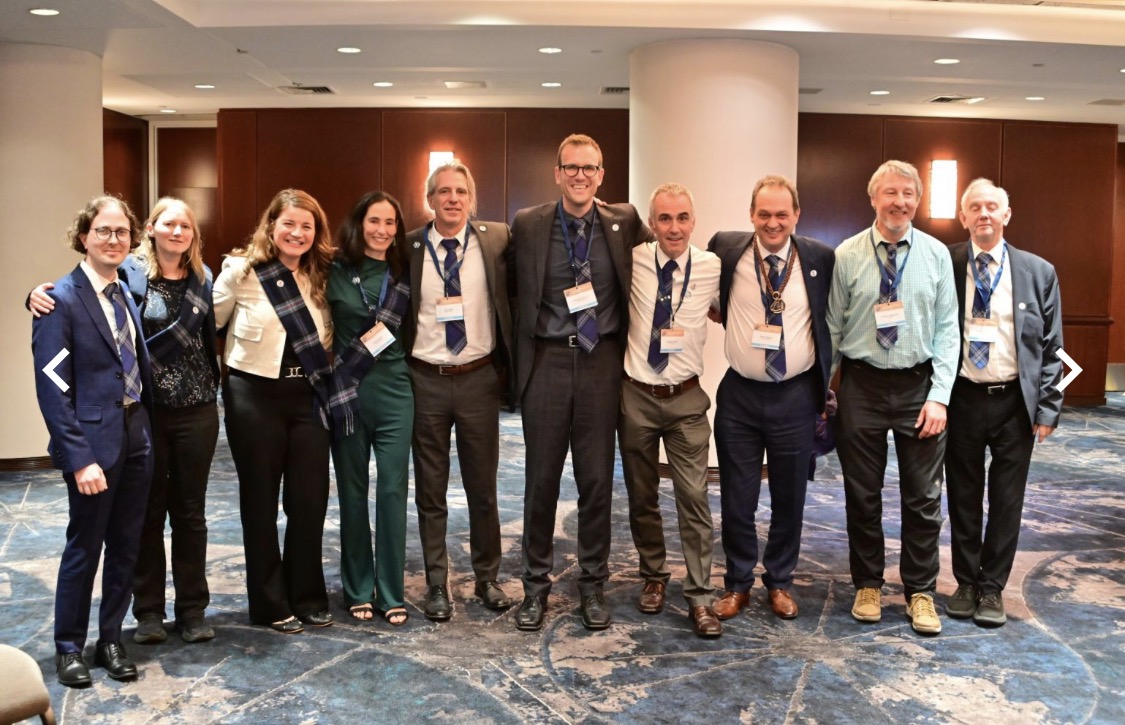
Members of the Glasgow-DUblin bid team gather at the 2026 ICM: (l-r) Damian Gvirtz-Chen (University of Glasgow), Tiffany Vlaar (UofG), Beverley McLean (Glasgow Convention Bureau), Ana Lecuona (UofG), Andy Wand (UofG), Michael Wemyss (UofG), Brendan Owens (UofG), Mark Chaplain (University of St Andrews), Thomas Huettemann (Queen’s University Belfast), Simon Salamon (King’s College London). Image credit: International Mathematical Union
In response to the success of the Glasgow-Dublin bid, the governments across Ireland and the UK have declared that 2030 will be a dedicated Maths Year, which will contain many events specifically aimed at inspiring future generations of mathematicians and innovators across Ireland, Scotland, the UK and beyond.
The Scottish Government's Innovation, Technology and Tertiary Education Minister, Ben Macpherson, said: “Glasgow has a proud tradition of excellence in mathematics, home to world-leading universities and generations of pioneering mathematicians. Co-hosting the International Congress of Mathematics with Dublin, for the first time ever shared between two countries, reflects the strong research ties between Scotland and Ireland, and will bring thousands of the world's leading mathematicians to both cities.
“Maths skills matter at every age. They help children do well at school, and adults in work and daily life too. That's why we're driving the biggest update to the maths curriculum in over a decade, making knowledge and skills clearer and benchmarking against international standards, so young people can reach their full potential.
“We also fund Maths Week Scotland every year, helping schools, families and people of all ages enjoy and learn maths together, with fun activities that celebrate the subject.
“I want to thank the University of Glasgow and others across the city for the work they have done to bring the Congress to Glasgow and I wish partners well as they organise this exciting event."
James Lawless, Irish Minister for Further and Higher Education, Research, Innovation and Science said “The General Assembly and International Congress of Mathematicians will be a landmark event, showcasing Ireland and Scotland’s shared commitment to excellence in mathematics, research and education. The Year of Mathematics in 2030 will be an opportunity to inspire the next generation of mathematicians and innovators across both countries and beyond.
“As someone who studied mathematics at university, I know the value of the subject and the opportunities it can create. Mathematics underpins so much of modern life, from scientific research and technological innovation to finance, engineering and data science. Just as importantly, it teaches people how to think critically, analyse complex problems and make informed decisions. This is an opportunity to celebrate mathematics and to encourage more young people to see where it can take them.”
The ICM was last held in the UK in 1958, and in Europe in 2006. Jan Philip Solovej, president of the European Mathematical Society, said "By 2030 it will be 24 years since the ICM was last in Europe. We very much look forward to working with the Glasgow-Dublin ICM to spread the benefits of hosting this congress as widely as possible, helping to inspire the next generation of mathematicians all across Europe and beyond".
First published: 24 July 2026