

Comms tech breakthrough could help 6G networks cut through interference
Published: 22 July 2026
A breakthrough new development in communications research may have solved a key problem with one of the enabling technologies set to underpin the 6G networks of the future.
A breakthrough new development in communications research may have solved a key problem with one of the enabling technologies set to underpin the 6G networks of the future.
A team of engineers led from the University of Glasgow have found a way to help wireless signals redirected by reconfigurable intelligent surfaces cut through the omnipresent electromagnetic interference caused by the ultra-connected modern world.
The research, recently published in a new paper, could help to ensure that the next generation of communications technologies are reliable and secure. These future networks are expected to deliver integrated sensing and communications, or ISAC, which combine ultrafast data transfer with sophisticated awareness of the world around them to deliver new advances in areas including healthcare, automation and transport.
The number of connected devices on the planet is currently estimated to be more than double the Earth’s human population of eight billion. These computers, phones, wearable devices, vehicles and machines communicate with each other over wifi, Bluetooth and mobile phone networks, each contributing to the growing issue of electromagnetic interference, or EMI. As EMI rises, it becomes more challenging for devices to communicate clearly with each other through the constant background noise.
One promising solution to the problem is reconfigurable intelligent surfaces, or RIS. They are ‘smart surfaces’ studded with programmable elements which can manipulate electromagnetic waves. Each element is capable of independently reflecting, focusing and redirecting incoming electromagnetic signals, boosting signal strength and enabling new sensing and positioning applications.
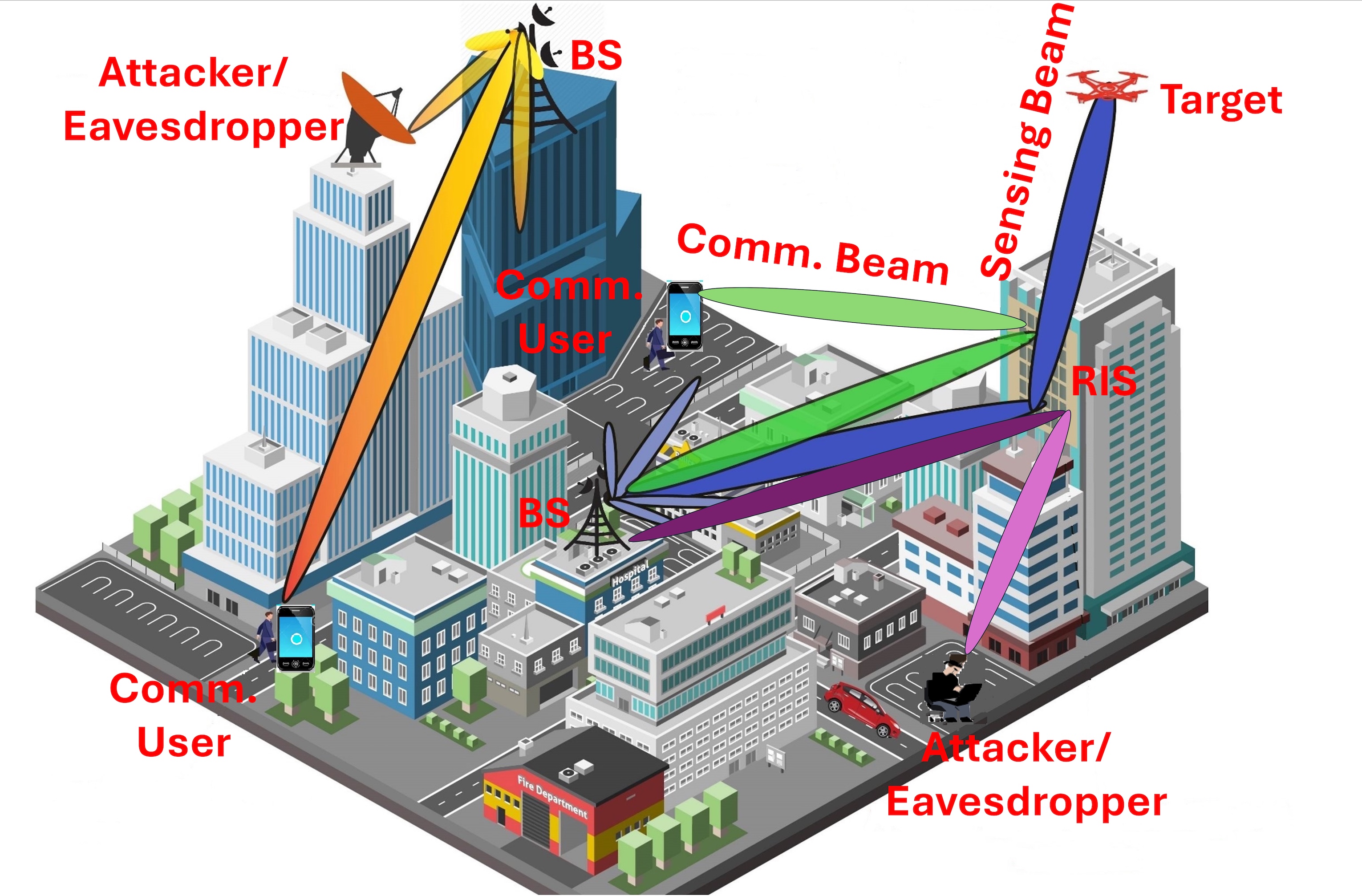
Saber Hassouna, a research associate at the University of Glasgow’s James Watt School of Engineering, is the paper’s first author. He said: “A reconfigurable intelligent surface is like a mirror. When sunlight hits a mirror in your hand, you can tilt it to send the light towards the area you choose. RIS does the same thing with wireless signals. Instead of reflecting radio waves randomly, it intelligently concentrates the energy on the areas intended to receive it. A significant additional benefit of that is security – the boosted signal only reaches the intended recipient, making it harder for anyone else to intercept it.”
Previous RIS research from the University of Glasgow and from researchers around the world has clearly demonstrated the potential of the technology to underpin 6G communications networks. However, one problem has persisted, which is that RIS reflects all the signals which reach it, meaning can boost electromagnetic interference alongside the intended signal, slowing data transfer and reducing the accuracy of positioning.
Some researchers have investigated ways to cancel out the interference, which has tended to weaken the desired signal at the same time. The Glasgow-led team have instead found a way to filter out the interference instead, maintaining the strength of the boosted signal, and more clearly identify the location of the end user.
It works by analysing and identifying the unique statistical ‘fingerprint’ of the interference, as well as conducting a sweep of beam directions to find the strongest signal. That data is then applied to the algorithm which controls how the RIS directs signals, enabling it to work more effectively and accurately. The team calls this an EMI-aware framework.
The James Watt School of Engineering’s Jalil Kazim, a co-author of the paper, said: "Previously, cancelling out this kind of interference meant the base station had to do a huge amount of intensive digital signal processing, and that computation is expensive in energy terms. By placing an intelligent surface in the environment, we can shape the signal path in a way that helps handle the interference before it ever reaches the base station. That eases both the computational burden and the energy cost on the network itself."
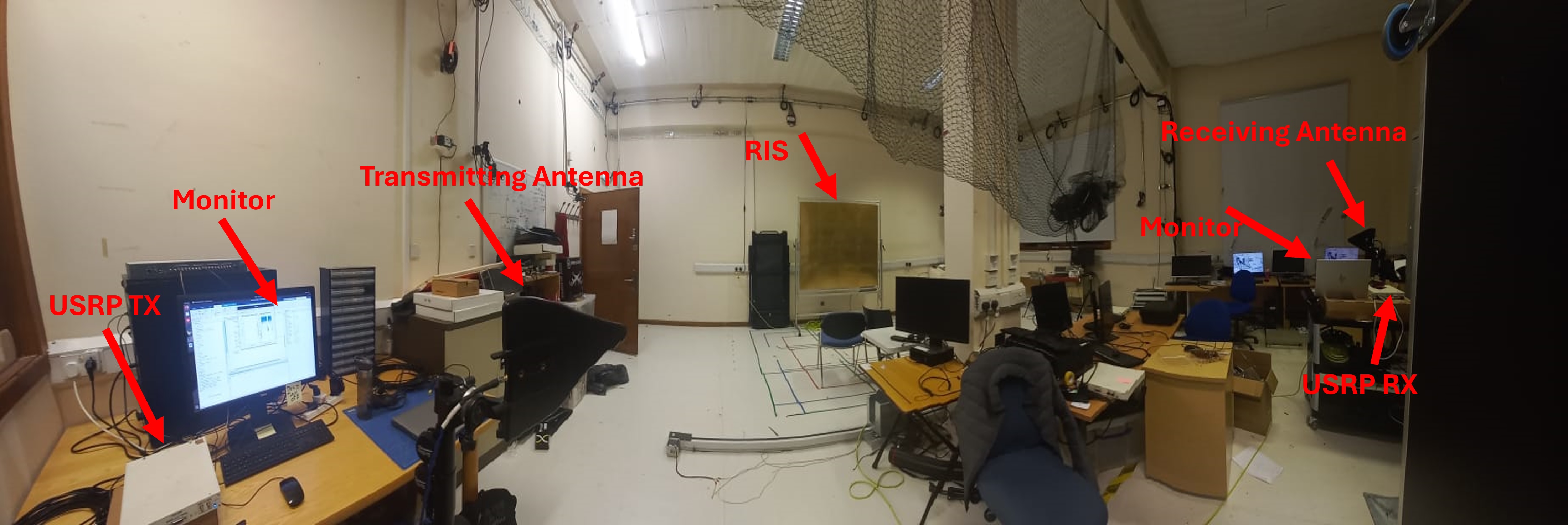
In the paper, published in IEEE Journal of Selected Topics in Electromagnetics, Antennas and Propagation, the team show how they tested their EMI-aware framework’s performance in the lab using a RIS built from more than 4,000 elements arrayed in a 64x64 grid. Signals supplied by software-defined radios operating at 3.5Ghz, the frequency band currently used by 5G networks.
In the experiment, five users were positioned around a room - three ‘legitimate’ users inside, and two placed in an outside corridor to represent potential eavesdroppers. Guided by the team’s algorithm, the surface concentrated its energy on the three intended users while leaving the two in the corridor without a usable signal.
The results matched the level of performance predicted by simulations conducted by the team. They found that the RIS sharply raised data rates and delivered accurate location data about the users, even the two outside the lab in the corridor, clearly demonstrating the potential of their EMI-aware framework.
Professor Muhammad Ali Imran, head of the James Watt School of Engineering, is a co-author of the paper. “Security, privacy and resilience are no longer optional extras in these networks but essential requirements. Our surface can direct the signal towards the users we trust and deny it to the ones we don’t, bringing us closer to the secure, flexible networks which will define the communications and sensing technologies of tomorrow.”
The team’s research is part of wider efforts at the University of Glasgow to shape the future of integrated sensing and communications technologies. The Centre for Integrated Sensing, Communication and Computing for Cognitive Cities, or ISAC³, launched in February 2026 with a mission to develop the ‘cognitive’ cities of the future which will revolutionise urban life.
Professor Qammer Abbasi, the paper’s corresponding and lead author, is also the director of ISAC³. He said:"This work demonstrates how intelligent wireless environments can become an active part of the network, rather than simply reflecting signals. At the ISAC³ Centre, our vision is to develop networks that seamlessly integrate sensing, communication and computing to create secure, resilient and sustainable digital infrastructure.
“By making reconfigurable intelligent surfaces aware of their electromagnetic environment, we are not only improving connectivity but also strengthening security, reducing energy consumption and enabling the reliable operation of future applications such as connected healthcare, autonomous systems and smart cities. This is an important step towards AI-native 6G networks that can intelligently adapt to the real world while delivering tangible societal and economic benefits.”
Researchers from King Fahd University and the University of Leicester also contributed to the research and co-authored the paper.
The team’s paper, titled ‘Integrated EMI-Aware RIS Framework for Robust Communication and Localization: Simulation and Experimental Evaluation’, is published in the IEEE Journal of Selected Topics in Electromagnetics, Antennas and Propagation.
The research was supported by funding from UKRI’s Engineering and Physical Sciences Research Council (EPSRC) and the Ibn Battuta Global Scholarship Program.
First published: 22 July 2026