

Flipped chromosomal segments drive natural selection
Published: 5 March 2026
When a species lives in two distinct types of habitats, individuals with traits better suited to each habitat will thrive and reproduce, naturally selecting descendants with those traits.
When a species lives in two distinct types of habitats, individuals with traits better suited to each habitat will thrive and reproduce, naturally selecting descendants with those traits. But what about mobile aquatic species that live across a broad range of temperatures and latitudes?
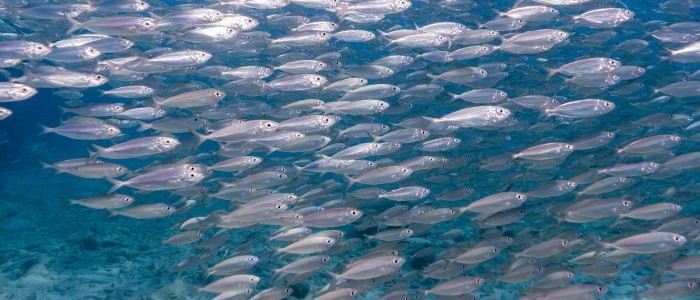
New research, led by Cornell and the University of Connecticut in collaboration with Dr Arne Jacobs at the University of Glasgow, finds that chromosomal inversions – which occur when a chunk of chromosome containing tens to thousands of genes breaks off, flips and reattaches – help these species maintain genetic differences adapted to various regions, even when they interbreed.
The study, published in Science, focused on Atlantic silversides, a small fish species that lives all along the Atlantic coastline of the United States. The fish has long been a model for scientists seeking to understand how natural selection and adaptation work in the ocean.
To explore the genetics underlying adaptation, the research team caught silversides ready to spawn from Georgia and New York. They cross-bred them, raised their offspring under different temperatures to imitate conditions along the Atlantic coast, and bred those fish again. The researchers then measured nine important characteristics, such as growth rate and swimming performance, and studied the fish’s genetics.
Nina Overgaard Therkildsen, associate professor of natural resources and the environment in the Cornell CALS Ashley School of Global Development and the Environment, and co-senior author, said: “Each chromosomal inversion locks together a large set of genes, effectively forming a genetic switch with two states, flipped or not flipped. What’s surprising here is that multiple ‘switches’ can combine to generate smooth, continuous variation, not just on-or-off differences.”
Dr Arne Jacobs, co-first author of the study from the School of Biodiversity, One Health & Veterinary Medicine at the University of Glasgow, said: “We have known for nearly 100 years, long before the discovery of DNA structure, that single chromosomal inversions can cause phenotypic change by acting as binary switches. Our paper is super exciting because we were now able to show how multiple inversions can act together to create continuous variation along a steep environmental cline. This has crucial implications for understanding how organisms may rapidly adapt, for example to environmental change.”
Hannes Baumann, associate professor at the University of Connecticut, said: “The work is stunning in its complexity and comprehensiveness.
“Silversides, like many species, have several massive inversions on multiple chromosomes. The novelty of our study is that we show that these inversions contain vital genetic information for genes that determine growth, metabolism, vertebral number and lipid content.”
When fish from different regions mate, their offspring inherit a mix of genes from both parents. Chromosomal inversions, the study found, lock together groups of favorable genetic mutations, preserving beneficial gene combinations in spite of ongoing genetic mixing within the species. Without inversions, this mixing would break apart the gene combinations that work well together for survival in either cold or warm water, producing hybrid offspring poorly suited to either environment, Therkildsen said. These chromosomal inversions were most significant in influencing Atlantic silversides’ growth rates and number of vertebrae.
Professor Therkildsen added: “The large effects of inversions on critical adaptive traits suggest they play a fundamental role in maintaining local adaptation.
“More broadly, traits like growth are usually thought to be shaped by thousands of tiny genetic changes. Our results suggest that in this species, selection can instead act on a small number of powerful genetic switches. That difference could shape how quickly – and how predictably – populations respond as oceans warm and seasons shift.”
The research was supported by the National Science Foundation.
Enquiries: ali.howard@glasgow.ac.uk or elizabeth.mcmeekin@glasgow.ac.uk
First published: 5 March 2026
Related Links
Dr Arne Jacobs - research profile
School of Biodiversity, One Health and Veterinary Medicine
Link to study