

“I really needed this right now”: Why Recognition Matters
Published: 15 October 2025
Recognition initiatives like Together, Research Excels show that even small gestures of appreciation can boost morale, break down hierarchies, and foster inclusive research cultures. Simple acknowledgments—through campaigns or personal thanks—highlight unseen contributions and strengthen collaboration across all roles.
Written by:
Caitlin McDonald (she/her), InFrame Project Coordinator
Within a few minutes of sending out the nominations from the University of St Andrews’ Together, Research Excels project, my email started pinging.
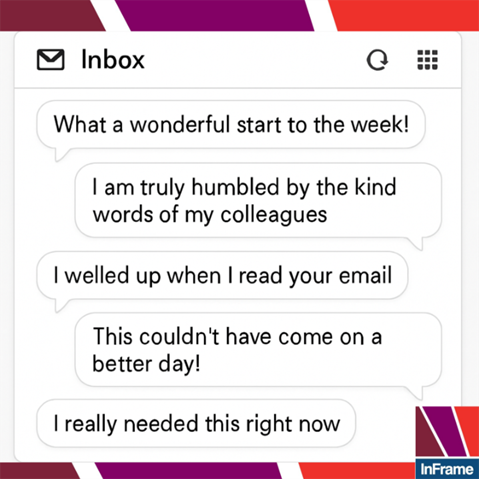
As I read these lovely emails, I was struck by just how much a 100-word acknowledgement of appreciation from a colleague can mean. Together, Research Excels, which follows on from the success of the People Make Research initiative at the University of Glasgow, has shown that our colleagues, including those from job families that are often overlooked, benefit from being recognised in this way. A simple, “I see you, I acknowledge your hard work, and I appreciate you” from a colleague goes a long way, particularly at a time when uncertainty in the sector remains high, staff are stressed and recognition is not always visible, leaving some staff feeling overworked and taken for granted. Indeed, a key finding in Vitae’s 2025 Research Culture Landscape Survey, showed that while 60% of respondents felt their research contributions were valued, this dropped to 15% for technicians and only 10% for professional staff. Recognition schemes like this will never entirely solve this problem but instead they create an opportunity to lift colleagues up, demonstrate the value of a diverse research community and remind everyone who works in research that they do not work in isolation. Furthermore, the nominations themselves help to paint a picture of how the research ecosystem functions, where connections lie, and where individuals make an impact on others. The InFrame project will gather testimonials from the campaigns run at St Andrews, Edinburgh and Glasgow and analyse the data to discover what collegial leadership looks like at all levels and use this as a base for our Inclusive Framework for Research Leadership.
Currently, I work on a large, cross-institutional project and interact with colleagues from both professional services and academia every day. Because of the type of work the InFrame team do, we are constantly reminded that we couldn’t do our jobs without the help of others, both within our team and within the wider research communities of the Universities of St Andrews, Glasgow and Edinburgh and we try to do our best to bestow praise and credit where it is due. But what if you don’t work within a big team?
Prior to working in professional services, I completed a PhD in Film Studies and continued to publish my research afterwards. Like many other scholars in the Humanities, I often thought of myself as a 'lone wolf'. I didn’t have a big lab, or a team behind me. Most of the time, I worked on my research entirely alone in my spare room, or at a quiet desk in a library and I was always credited as the sole author. When I published, I was recognised as having put in the work: my name was right there at the top of the page, colleagues and friends congratulated me and I could bask in the warm glow of a job well done (or, perhaps as is more often the case, fret about the typo on page 4!)
But who else contributed to that success? Well, obviously the editors of the books and journals I published in, their names are right there on the cover, too. Ok, I guess the peer reviewers contributed, the unknown helpers who guide us, and mould our work to make sure it is up to scratch (yes, even reviewer 2!). The archivists and librarians are obvious; the keepers of knowledge who share their expertise to help us find exactly what we need. The colleagues, mentors and advisors who I grabbed a coffee with and gave me the time, space and encouragement to bounce my ideas off them perhaps made the biggest impact. And what about the administration and finance teams who help book travel or process reimbursements for research trips and conferences? They are always there to answer any silly questions I throw at them, so I know my life would have been a lot more difficult without them.
Suddenly it becomes clear that although I viewed myself as a solitary researcher, I was helped by a large research community at almost every step of the way. It might not be possible to recognise and thank every colleague who makes a difference, but it is clear from the responses to Together, Research Excels that recognition and praise really do impact colleagues for the better. We have all had a colleague, who is quick and efficient at their job, but will step up and go above and beyond their normal call of duty to help when needed. This often-unseen work doesn’t tend to gain praise or awards, and it cannot be quantified through metrics, but it does contribute to the smooth running of research-intensive universities and without them, breakthroughs would be fewer and far between. By giving them the recognition they deserve we are highlighting good research culture behaviours and visibly breaking hierarchies by demonstrating the input of colleagues at all grade levels. Recognising colleagues of all job families also helps to break down the ‘them vs. us culture’ that often exists between research professionals and academic staff, which persists to act as a barrier to collegial working.
Recognition can come in many forms, but it doesn’t have to be complicated. You can take part in initiatives like Together, Research Excels, People Make Research or Seek, Find, Celebrate which are run yearly at the universities of St Andrews, Glasgow and Edinburgh. Alternatively, you can publicly praise colleagues for their contributions in team meetings or even just send an email of thanks and appreciation directly to them or their line manager. Sometimes all it takes is a simple acknowledgement to brighten someone’s day and encourage them to keep pushing to make the research community a better place.
First published: 15 October 2025