

Commemoration Day
Commemoration Day is one of the oldest and most significant events in the University’s ceremonial calendar. Celebrated annually, it marks the foundation of the University of Glasgow in 1451 and is usually held on the second Wednesday in June.
The day brings together staff, students, honorary graduands and invited guests to celebrate the University’s history, traditions and achievements. Events include a Service for the Commemoration of Benefactors in the University Chapel, the conferring of honorary degrees by the Chancellor in the Bute Hall, and the Commemoration Day Lunch.
In 2027, Commemoration Day will take place on Wednesday 16 June.
Honorary Graduands 2026
The Honorary Degrees to be awarded at Commemoration Day 2026 are:
DOCTOR OF LETTERS (DLitt)
Professor Guido TABELLINI
Intesa Sanpaolo Chair in Political Economics at Bocconi University, Milan
DOCTOR OF SCIENCE (DSc)
Dr Stuart CAMPBELL, FRCPEd, FRCOG, FACOG
Emeritus Professor of Obstetrics and Gynaecology
King’s College, London
DOCTOR OF MUSIC (DMus)
Stuart MURDOCH
Musician
DOCTOR OF THE UNIVERSITY (DUniv)
Ncuti GATWA
Actor
Jacqueline MCLAREN
Lord Provost of Glasgow
Baroness Catherine SMITH KC
Advocate and Life Peer, House of Lords
Sarah SMITH
BBC North American Editor
History of Commemoration Day
The current form of Commemoration Day has been celebrated for more than a century, but its origins can be traced back to an annual May banquet first recorded in 1492, at which the toast Resurgat in Gloria Alma Mater ("May the Alma Mater rise in glory") was established.
Commemoration became an official University observance in the late seventeenth century. In 1690, the Commissioners of Visitation directed that "at all yearlie laureations... there be honourable mention made of the founders and benefactors by publick recitall". This instruction was adopted, and the act of commemoration subsequently took place at the close of the annual graduation ceremony.
In 1903, the General Council proposed the establishment of an annual Commemoration Day following graduation ceremonies "in order to maintain the connection of the graduates with their university". The first Commemoration Day was held in April 1904, and the principal elements of the programme have remained largely unchanged ever since. In 1924, the celebration moved to June and became a distinct event within the University's ceremonial calendar.
Events on Commemoration Day
Chapel Service for the Commemoration of Benefactors
Commemoration Day begins with the Service for the Commemoration of Benefactors in the University Memorial Chapel. The service acknowledges those who have made significant contributions to the University since its foundation in 1451 and gives thanks for their generosity and support.
The service is attended by the Chancellor, the Principal, senior officers of the University, honorary graduands and invited guests.
Following the call to prayer by the University Chaplain, the focal point of the service is the reading of the Roll of Benefactors, a tradition dating back to the seventeenth century. The service also includes prayers of commemoration for the Chancellor, the University and its community, together with music provided by the University Choir and Organist.
Meeting of the University in the Bute Hall
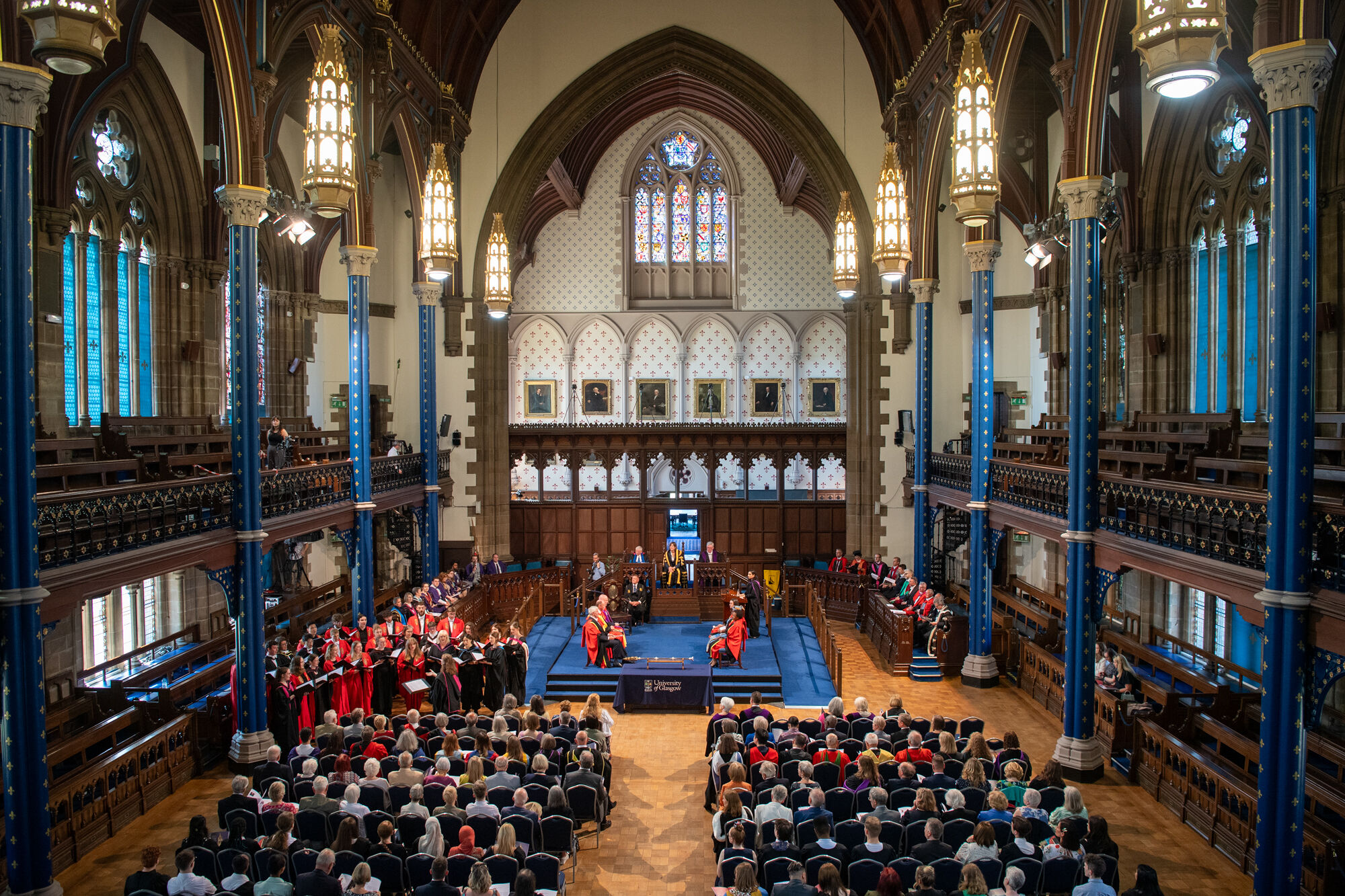
The principal ceremony of Commemoration Day is the Graduation Ceremony, which takes place in the Bute Hall.
During the ceremony, individuals whom the University wishes to honour are presented to the Chancellor for the conferral of honorary degrees.
The academic procession enters the Hall led by the University Mace, accompanied by the Organist and University Choir singing the traditional student anthem, Gaudeamus Igitur. The Mace then departs and returns with the Clerk of Senate, followed by the honorary graduands and their promoters.
Each honorary graduand is presented individually and invited to sit upon the ancient Blackstone Chair before the degree is conferred by the Chancellor using the traditional Latin words of conferral. The newly appointed academic hood is then placed upon the graduand by the Bedellus.
Throughout the ceremony, the University Choir performs choral works selected for the occasion. At the conclusion of the proceedings, the academic procession departs the Bute Hall accompanied by the Organist before continuing around the University Quadrangle, led by a Piper.
Commemoration Day Lunch
Commemoration Day concludes with a lunch hosted by the Chancellor, the Principal and the Clerk of Senate.
The lunch brings together honorary graduands, members of the University community and invited guests to celebrate the University's traditions, achievements and continuing contribution to society.
Traditions of Commemoration Day
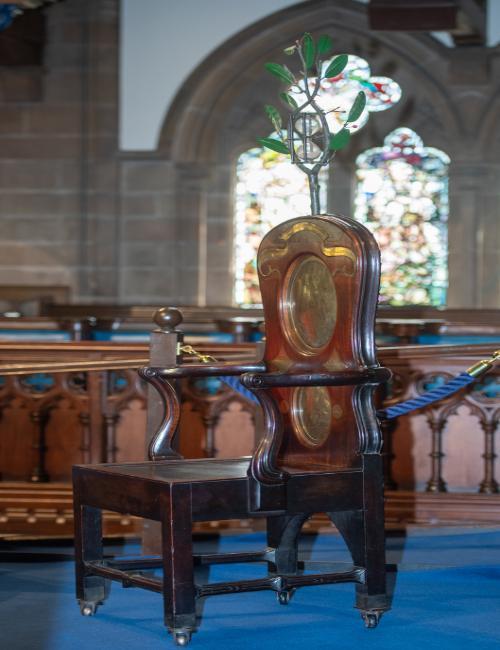
The Blackstone Chair
Commemoration Day is the only occasion in the University's ceremonial calendar on which the Blackstone Chair is used for the conferral of degrees in the Bute Hall.
A slab of dolerite set within an eighteenth-century oak chair, the Blackstone was used to examine students orally from the foundation of the University in 1451 until the mid-nineteenth century. The chair itself dates from 1775-76.
On the front of the chair are a series of brass plates, the largest displaying the arms of the University. Above these are the names of the University's founders: Pope Nicholas V, King James II of Scotland and Bishop William Turnbull of Glasgow.
Set into the top of the chair is an arrangement of bay leaves surrounding an hourglass filled with sand, reflecting its historic role in the examination of students.
The Roll of Benefactors
In 1690, the Commissioners of Visitation appointed "that at all yearlie laureations... there be honourable mention made of the founders and benefactors by publick recitall".
Each year on Commemoration Day, the Roll of Benefactors is recited by the Principal during the Service for the Commemoration of Benefactors in the University Memorial Chapel.
The Roll records the names of individuals, organisations and institutions whose generosity has helped shape the University from its foundation in 1451 to the present day. Their support has enabled the University to advance learning, research and student life across successive generations.
Through the reading of the Roll, the University remembers these gifts with gratitude and gives thanks for the lasting contribution of its benefactors.
The Roll now contains more than 150 names and remains one of the most distinctive traditions of Commemoration Day.
Music at Commemoration Day
Music plays an important role in Commemoration Day and is provided by the University Choir and Organist.
The day begins with music in the University Memorial Chapel, where hymns, organ music and a choral anthem form part of the Service for the Commemoration of Benefactors. Music is selected to reflect both the traditions of the University and contemporary University life, and may also draw inspiration from the honorary graduands being recognised that year.
The Meeting of the University in the Bute Hall opens with Gaudeamus Igitur, the traditional student song, as the Academic Procession enters. Throughout the ceremony, the Choir performs choral works chosen to complement the occasion, while the Organist provides the ceremonial music accompanying the academic procession.
Dr Katy Cooper, Director of Chapel Music, notes that the music is chosen to celebrate the University's history, culture and traditions, while also recognising the achievements and interests of the honorary graduands being honoured.