

Study Exchange and Grade Conversion: a Guide for Students
Introduction
Academic research shows that study exchange has a positive impact upon final Honours degree classification. You should not accept suggestions that taking part in study abroad is academically risky – this should never be the case. While the reasons for this positive impact are not entirely clear, it seems that students studying abroad become more confident learners. The chance of study abroad may also be seen as providing a ‘second chance’: if grades in year 1 have not been the best, study abroad provides another opportunity of proving academic ability.
This guide aims to provide you with the necessary information on how the grade conversion process works and what role you play in it. The bottom line is that when you are studying abroad, you remain a University of Glasgow student who just happens to be studying elsewhere, and thus grades awarded at a ‘host’ institution should be treated as if these were grades awarded at Glasgow. (Put another way, students who go abroad should not be unfairly advantaged or disadvantaged in relation to students who stay in Glasgow.)
When you study abroad, your grades at your host institution will count towards meeting the requirements for entering an Honours degree (if you go abroad in your 2nd year) or towards your degree classification (if you go abroad during your 3rd year). There are some limited exceptions to this rule (in particular, a ‘language year’ abroad). Furthermore, any graded coursework outside the scope of your programme – for instance, introductory but graded language courses – will be converted, even if this is only in the calculation of your GPA (rather than for your Honours classification, for example).
It is important that you read this guide carefully. You should also read it periodically – that is, before departure, while abroad, and after you return - in order to obtain a full understanding of the grade conversion procedure.
Overview of the Process
To ensure that you are appropriately rewarded for your academic efforts while abroad, the University strives to translate your grades in a transparent, just and fair manner. The procedure should also be prompt. It is important that you are familiar with the way your grades will be converted. If you think application of the conversion table will not result in a just and fair translation of your grades, you must collect supporting evidence while you are abroad. You have the right to make this information available before your grades are converted.
The box below displays the timeline of the grade conversion process.
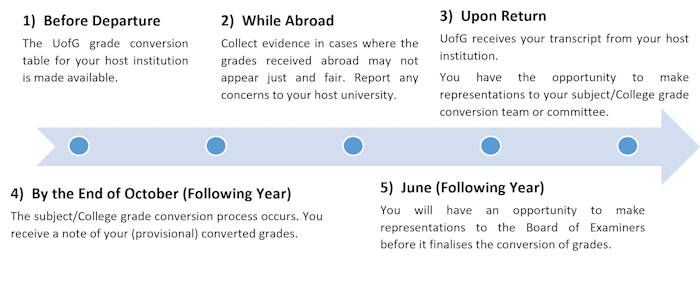
Before You Depart
The starting point for translation of the grades you receive abroad is the University’s published conversion tables. Conversion tables are reviewed regularly by the University’s Translation of Grades Subcommittee and are based on a range of inputs such as grade distributions, international grade conversion practice, assessment conventions at the host university and the experience of previous students. It is important to note that because it may be more difficult to receive the same grades at some partners than at others and in certain subjects, conversion tables may on occasion differ between partners within the same country, or even between different subjects at the same partner university. You should familiarise yourself with the conversion table for your host institution as this will be the foundation for the conversion of your grades. The current tables have been derived from existing subject tables and take account of grade conversion tables adopted by other leading UK Universities to try to ensure consistency – and fairness.
These tables are kept under review at University level, so these can change even when you are abroad, and changes may have retroactive effect. To reiterate: these tables are not set in stone, they are a starting point only for the process of grade conversion. Over time, the University will monitor the extent to which ‘profiles’ of students are consistent with other indicators suggesting the tables may need amendment (across subject-areas, or in relation to specific subjects) or should be applied in individual cases with a degree of flexibility (to take into account particular circumstances).
You will also wish to learn something about how learning, teaching and assessment methods may differ from Glasgow’s before your departure. Information on these issues (supplied by past students who have studied abroad) is being made available on Moodle (and you will be able to provide information for the use of future students). Part of the challenge – and the experience of study abroad – is the realisation that systems of higher education across the globe vary.
While Abroad
As you settle into your host university, you will start to learn more about the academic system and assessment methods. At some point, you will start to receive results from coursework or final assessment. It may be possible to resit or resubmit assessments to obtain a higher grade – if this opportunity exists, you should take it, for the grade conversion will apply to the final result reported to us by your host university. (This merely reflects significant variations in local practice: in many university systems, students are expected to make multiple attempts at assessment. Resits are not necessarily ‘resits’ as understood at Glasgow.)
In some cases, you may feel that your grades when ‘translated’ according to the published conversion table will not result in a just and fair outcome. This is likely to be because of factors such as extenuating personal circumstances or because the conversion table does not seem to accurately reflect the actual grades awarded by the host institution. If either applies, you have certain responsibilities.
- Personal Circumstances
In the case of extenuating circumstances, you should follow the required procedures of your host institution. That is, if you have been ill, or other personal factors have been at play, you must raise these with your host university. Exhaust any domestic remedies. Any suggestion of ‘serious deficiencies’ in assessment procedures should also be raised with the host institution. If you believe that you have not been assessed in a fair and just way after raising such issues with your host institution, you may raise the issue again when you return home with your subject grade conversion team or committee.
- The Conversion Table Does Not Seem to Reflect the Grades Awarded
If you believe that the conversion table does not reflect reality, you should collect supporting evidence to allow the grade conversion to be adjusted in your case. Remember, the conversion tables are only a starting point. Such evidence should include the actual distribution of grades awarded to the student cohort as a whole, and the distribution of grades gained by visiting students (that is, all non-home students studying at the host institution). You should thus collect evidence showing that you have performed at an exceptionally high level. You may find it easier than you think to obtain the grade distribution in a class as many institutions publish this information openly on noticeboards. Take a photograph with your phone if necessary.
The evidence you produce may thus allow an adjustment to be made to application of the conversion tables. The conversion tables may themselves also be amended on the basis of evidence supplied by you and by the host university.
All of this has the consequence that until your translated grades have been confirmed by the Board of Examiners, your converted grades are provisional. In other words, the conversions remain recommendations to the Board of Examiners.
Upon Your Return
The host university should send your official transcript to the University of Glasgow upon the completion of your exchange. However, at some institutions it may be your responsibility to ensure that the University of Glasgow receives your transcript. Make sure you know how the procedure at your host institution works. (It is not impossible, but rarely the case, that Glasgow has to keep pressurising the host institution to confirm the overseas grades.)
Upon your return, you will have a chance to make representations to your subject/ College Grade Conversion Committee. You certainly should do so if you believe the application of the grade conversion tables to the grades awarded at your host institution would not be just and fair. If you want to submit evidence, you should provide as much detail as possible. Include your communications with the host institution and any other relevant materials.
The Grade Conversion Committee is responsible for allocating a recommended grade conversion based on your reported results (i.e., the final reported result that appears on your grade transcript from the host university). The starting point for this process – as discussed above - is the grade conversion table. Beyond that, the Committee may additionally consider other evidence such as analysis of attainment of other Glasgow students at the host institution as well as any representations you submit.
However, there are certain circumstances or factors which the Grade Conversion Committee cannot take into account.
In the case of extenuating personal circumstances:
- The Grade Conversion Committee cannot reconsider circumstances which have already been brought to the attention of partner institutions and taken into account in the determination of grading. (i.e., you cannot benefit twice from personal difficulties.)
- Only circumstances that are recognised to be relevant in the University of Glasgow may be considered by the Committee (and thus matters such as transportation difficulties, computing issues or your failure to ensure that you have properly enrolled on a course cannot be considered).
- If you believe you were treated unfairly during assessment and you have raised this with the host institution while abroad, the Committee may consider representations on these matters.
There are certain matters that a Grade Conversion Committee will refuse to consider:
- Submissions that a pass at Glasgow is 40 per cent but a pass in other institutions may be at say 50% are ill-conceived and thus irrelevant. The University of Glasgow does not generally use a percentage scale; it employs an alpha-numeric scale (ie, A1, A2, etc, and equivalent grading descriptors from 0 to 22). There is no standard percentage equivalent to the Glasgow marking scale that is used for the purpose of translation of grades. Grades in overseas institutions are converted to grades on the Glasgow scale and never into percentages.
- The fact that the marking scheme uses a ‘bell curve’ or similar scheme whereby marks are determined not by reference to grade descriptors but by position in class. The University of Glasgow can only go by the raw data supplied by the host institution.
- The method of teaching. For example, teaching at some universities may be based purely on lectures, while others may demand a higher level of independent work. You should research the methods of teaching at the host institution before applying.
- The method of assessment. The fact that you may have had oral examinations abroad but have never had an oral examination in Glasgow, is not relevant to the translation of grades process.
- The level of the course selected by you is at ‘Master’s’ level. You may (but need not) seek admission to Master’s level courses. Glasgow students have coped well with Master’s courses throughout the years. If you do decide to enrol in a Master’s level course, you cannot expect that the University of Glasgow can take this into account (even if it is more challenging). These courses will thus be treated as the equivalent of Honours level courses in Glasgow and not as PGT courses. Simply because you are taking such courses is no reason to expect any change to your grade conversion. (If you have been specifically directed to take a course by your subject mobility coordinator that is clearly inappropriate to your current level of study, the matter is different. Here, too, you may wish to submit a student complaint or make use of student appeal procedures.)
- Home students work too hard. It is sometimes argued that the level of attainment at partner universities is very high and that home students at the host institution work ‘night and day’ to achieve very good grades. While the University recognises that there may be a high level of competition in some institutions, it cannot speculate about how a particular performance might translate in Glasgow terms. The Grade Conversion Committee translates grades based on what is actually achieved at the partner institution. (However, if you allege that home students are given special privileges, that is, that visiting students are not treated equally, you should raise this issue while you are still at the host.)
- The relative ranking of an institution. Institutional rankings are based on a number of factors and the assumption, sometimes made, that a lower grade in a higher ranked institution should equate to a higher grade in a lower ranked institution is fallacious.
Certain information can be very helpful in supporting a representation:
- Specific information about marking practices (e.g. ‘it is not the practice to award the highest grade in this class’) together with supporting evidence (e.g. an email from the course convenor or administrator).
- Grade profile information indicating that you performed to a higher level than you think is indicated by the preliminary conversion (e.g. ‘I was 2nd out of 250 students but I am only getting an A5’; or ‘I was the top student and given a dean’s award, but my grade only translates as B1’).
We do not expect to receive representations from students with grades which convert to an overall A grade on the Glasgow scale on the basis that these are excellent results and cannot be regarded as detrimental. Such students have suffered no detriment. Note, particularly, that in many subjects, grades of A1 or A2 are extremely rare in Glasgow.
How your Grades will be Treated
The Grade Conversion Committee will recommend the outcome to be reported to the Board of Examiners. In other words, the Committee has no authority to decide – its conclusions must be considered at a meeting of the relevant Board, normally in June. Where the Committee has not been able to make a recommendation, it will report this accordingly to the Board.
It is not possible to include in MyCampus, and therefore in University of Glasgow Higher Education Achievement Records, the individual results from courses taken abroad. Thousands of such courses are taken annually. The individual results will be in your transcript from the partner institution.
The Committee will present to the Board of Examiners the grade point average based on the converted grades of all the courses taken abroad which count for Honours purposes. Once approved by the Board, this is the grade which will be published on MyCampus. Thus the data that has been taken into account in calculating your overall degree classification will be clearly visible on MyCampus. For example, suppose you have 8 courses on your transcript from the partner institution. Each course will be translated into a Glasgow grade and the average of those Glasgow grades will be calculated in the normal way (e.g. producing a figure such as 16.6). This will produce a grade point mean which will be rounded in accordance with the Assessment Regulations (for example, 16.6 would be rounded to 17 which is a B1). That grade B1 (17 grade points) will then be taken forward as the recommendation to the Board of Honours Examiners for the purpose of classifying your final degree. Thus 40, 60, 80 or 120 credits (depending on your degree programme and duration of study abroad) at B1 will used in the overall calculation when classifying your degree.
The procedure may differ slightly in a small number of cases where specific non-Honours course grades need to be published on MyCampus. In that case, the translated grade will appear against a relevant course heading (e.g. Jurisprudence (Abroad)) in MyCampus indicative that a course, undertaken at a partner institution, has been deemed equivalent to a compulsory course in Glasgow. The translated grade, in such a case, will be used for all purposes including progression.
Appendix: The Grade Conversion Process Explained – Frequently Asked Questions
What is grade conversion?
The grades achieved in courses that you take when you study abroad are converted into Glasgow grades and the converted grades count (in terms of study exchange in year 3) in the process classifying your Honours degree under the University Assessment Regulations.[1] You should think of grade conversion as a process, rather than simply as a calculation. Our aim is to make the process as just and fair, and as transparent as possible, so that you have confidence that the work you do when abroad will be appropriately recognised in Glasgow.
What is the conversion based upon?
The starting-point is the conversion table. Tables have been established based on experience of a partner institution’s marking practices, in many cases using information gathered over a number of years. A range of factors is taken into account in the construction of a table; this may include grade distribution information from the partner, experience of similar institutions in the same country; information from other partner institutions and from other UK universities.
What is a conversion table supposed to do?
A conversion table measures academic performance abroad in Glasgow terms. In other words, it attempts to compare, as accurately as possible, a mark gained in a partner institution to a Glasgow grade. For example, a mark of 29 in a particular subject at a particular Italian University, might equate to an A4 at Glasgow because this reflects our evaluation of that level of performance in that subject.
It is important to remember that a conversion table is a guideline rather than a guarantee: a starting-point rather than a translation. A conversion scale may be revised retrospectively on the basis of evidence that it is no longer appropriate (see below).
Are all conversion tables the same?
A conversion table is only the starting point when it comes to converting a grade. Occasionally, tables need to be adjusted where there is clear evidence that they no longer constitute a fair measure of student academic performance. This is because they reflect our experience of marking practices in host institutions. Therefore it is quite possible that the grade distribution in one subject is consistently different to the grade distribution in another despite both subjects being taught at the same institution. This is certainly the case in Glasgow where, despite having a single marking scale and one uniform Assessment Regulations, the grade distribution is not the same in every course and may vary slightly from one subject to another.
This explains why there might be some variation between subjects when it comes to converting a particular grade. For example, suppose at the University of Neverland you achieved a mark of 12 in History and 12 in Politics. It is quite possible that the 12 in History translates to a Glasgow B3 in History but that in Politics it is converted to a B1, or even an A5. The department of Politics at the partner university may simply award fewer grades above 10 than the department of History does and the tables as developed in Glasgow should reflect this. Therefore you should be aware that a grade may sometimes be converted slightly differently in different Schools.
What is an ECTS grade?
ECTS is the European Credit Transfer and Accumulation System. As the name implies, this system is used in Europe but increasingly universities elsewhere are making use of it. It is therefore becoming an international frame of reference which can be very useful in assisting with the grade conversion process.
The ECTS grading scale is a relative system of grading, rather than an absolute one. This means that grade distribution can be demonstrated in percentage terms, with the top ten per cent of students, for example, achieving an ECTS grade A.
|
Grade |
Best/next |
Definition |
|
A |
10% |
outstanding performance with only minor errors |
|
B |
25% |
above the average standard but with some errors |
|
C |
30% |
generally sound work with a number of notable errors |
|
D |
25% |
fair but with significant shortcomings |
|
E |
10% |
performance meets the minimum criteria |
|
FX |
|
Fail – some more work required before the credit can be awarded |
|
F |
|
Fail – considerable further work is required |
Many universities, including Glasgow, have an absolute grading system. This means that any performance that falls within a particular grade descriptor will be awarded that grade without taking any account of the percentage of students who will come within a particular grading band. Having said that, the ECTS scale is regarded as an appropriate one; awarding a grade A to the top ten per cent of students is not unreasonable, even if it does not reflect actual results in many Glasgow courses (where a higher or lower percentage of students may achieve that result). Therefore, generally speaking, an ECTS grade A would equate to an A in Glasgow.
Some universities, it should be noted, have much smaller grading scales than we have in Glasgow. An example is the University of Lund in Sweden. Here is an example of a conversion table which uses both the raw grade (the grade awarded by the host institution) and the ECTS grade:
|
University of Lund Grades |
ECTS Grade |
Glasgow Grade |
|
AB |
A |
A3 |
|
AB |
B |
B1 |
|
BA |
C |
B3 |
|
BA |
D |
C2 |
|
B |
E |
D2 |
|
U |
FX |
E2 |
|
U |
F |
F/ G |
Note that Lund only has two passing grades: AB (pass with merit) and BA (pass). About 40 per cent of students at Lund achieve the grade of AB, although this can vary by programme. Within that percentage, only a proportion of students achieve a performance equivalent to an ECTS grade A. Lund will supply us with both the raw grade and the ECTS equivalent and this is the basis for the conversion. Usually, therefore, a student who achieves an AB (ECTS B) grade will be awarded a B1 in Glasgow if the above scale applied.
You might think it strange that it is not possible to achieve a grade of A1 or A2 if you study at Lund. In fact, it is possible to achieve such a grade but supplementary evidence would be required to justify it. For example, if you could demonstrate that the exceptional grade you obtained was as rare an achievement as the equivalent exceptional grade in the subject in Glasgow, then it would be open to a grade conversion committee to reward such an excellent performance with a grade above A3. That is why the conversion of grades is a process, rather than simply the application of a table.
What is converted?
The grades converted are those which appear on your transcript. Sometimes we receive additional information, for example the grade plus an ECTS grade equivalent. Transcripts may be sent to the University’s International Office or directly to you. If the latter is the case, please ensure that the International Office has a copy of the transcript.
Who carries out the conversion?
Practice may vary. The actual calculation may be carried out administratively within your College or you may be asked to calculate your own conversion on the basis of instructions given to you. In the latter case, you will be given clearly told how to present the conversion data and the conversion will be checked and re-checked. Conversion tables should be available online for you to consult.
Who oversees the conversion?
A grade conversion committee, consisting of several members of staff including the Study Exchange co-ordinator, will oversee the conversion process and recommend to the Board of Honours Examiners a converted grade or set of converted grades for each student.
What role do I have?
Whether or not you are invited to calculate your own converted grades, you are able to contribute to the conversion process by making observations on the conversion table. If you feel that a conversion table does not properly reflect the merit of your own academic performance, then you should let us know and explain why. You should provide as much evidence as possible in support of what you say. An opportunity will be given to you to make observations if you wish.
What happens if I am ill?
If you are unwell, or other circumstances affect your examination performance while at the partner institution, then we expect you to follow any procedures put in place by the host institution. We will not normally take this into account as part of the conversion process. Most universities have an equivalent of our good cause rules and it is your responsibility while abroad to make sure you know what they are if and when the need arises.
Which grade counts?
Generally, we will count the best grades which you achieve when abroad. Therefore, if you are able to undertake a resit examination, it is the resit examination which will count.
What if a conversion table changes?
A conversion table is the first step in a process and the content of tables may, from time to time, change as new information becomes available about grade distribution or marking practice in a partner institution. Therefore the information in a published conversion table is a 7guideline only and conversion committees are not bound by it.
What status does a converted grade have? Can I appeal it?
A converted grade is provisional and is not a final grade. It is a recommendation to the Board of Honours Examiners which meets in June. The expectation, in most cases, is that converted grades will be confirmed by the Board of Honours Examiners without amendment.
Percentages and conversions
Please note that the University of Glasgow does not generally use a percentage marking scale. It uses a system based upon grade descriptors with primary grades and secondary band. The Assessment Regulations are set out in the University Regulations.
Students sometimes attempt to convert results achieved abroad on the basis that a Glasgow grade can be expressed in terms of percentages. This is entirely incorrect as a way to conceptualise the marking scale used in Glasgow. For example, students have sometimes attempted to take the 22 point Glasgow scale (A1 to H) and to suggest that an A1 represents in percentage terms 95% or above. Therefore, they have argued, a score of 90% would equate to an A2. That is entirely misconceived and a rather crude way of looking at it. Grade conversion is based on the best data available in terms of grade distribution and our knowledge of marking practices in the relevant partner institution: this is reflected in the conversion tables.
------
[1] If you take part in study exchange in year 2, the grades will count in the calculation of your GPA. Where summer school, etc short-term mobility takes place, it may be the case that your grades are converted, but the credits will normally constitute ‘extra’ credits above the annual 120 credits of study, and thus not be counted as part of your degree programme requirements.