Translation of Grades Study Abroad: a Guide for Staff
Introduction and context
1. There is an expectation that the conversion process for grades gained during a period of UG mobility at a partner university should be transparent, fair and just. There should be no basis for any apprehension that conversion procedures and grade conversion outcomes should in any sense be a discouragement to students from participating in the study abroad programme. This document sets out arrangements which operate across the University. These procedures seek to standardise procedures and to respond to developments in international best practice in the translation of grades, including within the Erasmus+ programme.
2. In all cases of student mobility, we adhere to the key obligations set out in the Erasmus+ Student Charter.[1] This includes the obligation to make clear, in a learning agreement prior to the commencement of the mobility, the credits students are expected to earn; the obligation to provide students with full academic recognition for the activities completed satisfactorily during the mobility period; and the obligation to provide complete information on the recognition of student achievement.
3. Those charged with grade conversion in Glasgow should confirm proposed conversions of grades to students as soon as possible, and should aim to do so, whenever possible, by the end of October in the session following the mobility period.
------
[1] https://erasmus-plus.ec.europa.eu/resources-and-tools/erasmus-student-charter-0
Which grades must be converted
4. Prior to undertaking studies abroad, students must know what courses will be recognised for study abroad purposes. The overriding principle is that final grades awarded at a ‘host’ institution should be treated as if these were grades awarded at Glasgow. All assessed coursework taken at a partner institution and which is graded by the host university is subject to grade ‘translation’ and recognition upon a student’s return.[2] In other words, coursework taken overseas involving the allocation of a specific grade by the host university (rather than merely graded by ‘pass/fail’) is given full academic recognition. This can, on some programmes, include, for example, courses that are translated at Ordinary level which do not affect the Honours classification.
5. Assessment arrangements and expectations differ across different partner institutions. Grade conversion must be based upon the actual grade reported to the University of Glasgow by the host institution. Students must be made aware of the rules governing identification of the coursework taken abroad that is to be taken into account by a Board of Examiners, and the manner in which it is to be recorded in determining the classification of an Honours degree award.
6. Student in some subjects may undertake study abroad in year 2. Where a student goes abroad during year 2, grades awarded overseas must be taken into account for entry into Honours. In other words, there should be no difference in treatment between students remaining in Glasgow, and those who study overseas.
7. As far as reporting grades which are to count for Honours classification is concerned, overseas grades (after being ‘translated’) must be reported to Boards of Examiners in a transparent manner, specifying clearly how each final grade awarded by the partner has been translated and the weighting, expressed in Glasgow credits, of each course taken abroad. In addition, all junior Honours coursework undertaken abroad should be aggregated into one overall (arithmetical) mark.
8. In terms of reporting grades for non-Honours courses, this may be done by aggregating courses taken abroad into one overall (arithmetical) mark. Alternatively, where courses taken abroad are ‘matched’ (i.e. regarded as equivalent to compulsory courses undertaken in Glasgow), grades can be translated and added to a course in MyCampus the title of which should include the epithet ‘(abroad)’.
9. Grade conversion should mirror existing arrangements.[3] Boards of Examiners when determining Honours classifications at the end of year 4, however, must be able to apply the Code of Assessment in the normal manner. It must always be readily obvious to Boards of Examiners that a certain element of the coursework undertaken has involved overseas grades that have been converted into UofG grades.
------
[2] Assuming the courses have been approved in advance (for example, in the learning agreement). In some Schools, students are encouraged (and even expected) to undertake courses of their own choice providing always that the course is of a requisite standard and that there is no substantial overlap with courses already undertaken in Glasgow. Elsewhere, students find they are directed to particular courses which appear to replicate those they would have undertaken if they had remained in Glasgow.
[3] Clause 16.37(a): The weighting of courses for the calculation of an Honours classification for an undergraduate Honours degree should normally follow the credit weighting of those courses in the third and fourth years of the Honours programme. These weightings must be set out in the programme specification.
Conversion tables
10. Conversion tables will be published at University level, but in some cases may have effect at subject or degree level. The creation of the tables will be undertaken by the Translation of Grades from Study Abroad Sub-Committee (TGSA) of Academic Standards Committee and publication will be the responsibility of Academic Policy & Governance. These tables will be kept under review by the TGSA in light of experience of partner institutions and analysis of student performance.
11. Modification of tables may be required where there are clear reasons for this. In determining whether to modify a conversion table, account may be taken of a number of factors. Many of these may only become evident with the benefit of hindsight (i.e. after a student has returned, and/or after a number of years of experience with the host institution.) These factors may include the following:
- Assessment conventions at the host institution (i.e., grade profiles, etc. indicating the normal distribution of grades awarded at the host institution);
- Published conversion tables of other UK universities;
- The normal distribution of grades gained by returning students;
- Particular variations in the normal range of grades awarded (at different levels of study, or on account of differences in delivery of learning and teaching methods);
- The normal distribution of grades gained by Glasgow students in recent sessions;
- The range of marks awarded in courses at a similar level at Glasgow (with a view to ensuring that no particular institution particularly favours or penalises UoG students- although it should be recognised that research suggests students in general perform better when abroad).
12. Past experience of reported grades from overseas should thus be used as continual guidance, and in certain cases it will be appropriate for conversion committees to seek additional information from the host university (but there should be no obligation to attempt to obtain information that may not be readily available). While seeking this information may result in delay, the procedure proposed below will mean this is most likely to occur when students themselves have requested that the existing conversion table be reconsidered.
13. Proposals for modification of the conversion tables at subject level should be made to TGSA, providing details of the proposed modification and as full a rationale as possible for this.
Procedures for conversion
Before departure:
- Conversion table published
- Courses to be taken agreed in a Learning Agreement
After return:
- Date fixed for conversion committee (before the end of October if possible).
- Students invited to make representations about conversion.
- Students notified of proposed conversion.
- Further opportunity for making representations to the grade conversion committee prior to confirmation by the Board of Examiners.
14. The aim of the grade conversion process is to convert overseas grades to their University of Glasgow equivalent in as fair, just, transparent and prompt a manner as possible given administrative constraints.
15. The following considerations apply to conversion of grades:
- Students should be given the right to make a written representation as to the fairness of conversion tables prior to the grade conversion process. This may include a statement of circumstances affecting their performance but only where those circumstances, for good reason, were not, or could not be, taken into account by the partner institution.
- Student representations, wherever possible, should be supported by evidence, such as grade profile evidence specific to the courses undertaken.
- In cases where bias or irregularity is alleged, the expectation is that students should make use of remedies available at the host university. Allegations of irregularity in the conduct of assessment overseas should first be drawn to the attention of the host institution by the individual student as soon as practical. Only when this has been done should a conversion committee consider its own views on whether such representations are meritorious.
- Assessed work completed and assessed at another institution cannot be reassessed at the University of Glasgow.
- Fairness also dictates that compelling personal circumstances which may have affected performance at the host institution may be taken into account. Again, the expectation is that students make use of remedies available at the host university and it would be wrong to take such personal circumstances into account if these have already been taken into account by the ‘host’ institution. While conversion committees cannot modify any grades awarded by partners, they may forward representations to the relevant Board of Examiners at the appropriate time.
16. Conversion committees should ensure that any representations concern circumstances that would be taken into account at Glasgow.[4] They should ascertain whether students have made use of any prescribed procedures for drawing such circumstances to the attention of the ‘host’ institution (as this is necessary to ensure that compensation is not awarded twice). Committees will require to take a position on whether a student claiming there has been a significant impact upon performance because of personal or medical grounds may be affected by the rule applying where a student has not completed 75% of the required coursework for Honours classification.[5]
------
[4] This would thus preclude representations concerning e.g. the method of teaching; the level of course or the suggestion that certain courses are inherently more difficult because they are offered at ‘postgraduate’ level overseas; or the fact that the marking scheme uses a ‘Bell curve’ or similar arrangement whereby marks are determined not by reference to grade descriptors but by position in class.
[5] This rule is currently under review.
Status of conversion committee outcomes
17. Grades that have been converted by a conversion committee and which constitute coursework that forms part of a student’s final Honours classification are recommendations to the relevant Board of Examiners, i.e., grade conversions reported to students remain provisional until approved by the Board of Examiners.
18. Students must be told of the recommended grade conversion as soon as is practicable. This will allow students to make any further representations to the relevant Board of Examiners well in advance of the Board’s meeting (and if necessary, to make a subsequent appeal against the Board’s decision). It should be made clear, as noted above, that the grade communicated is provisional until approved by the Board of Examiners.
Ensuring adequate control
19. Where it is considered that a change is needed to the conversion tables this requires approval by the Translation of Grades from Study Abroad Sub-Committee.
20. TGSA may amend or remove an existing table; introduce a new table specific to a subject area, degree programme or College; or consolidate existing tables.
21. TGSA will also receive and consider statistical analyses relevant to grade conversion and annual reports from Colleges on the operation of the system.
Annex: Translation of Grade Methodology for Exam Boards
The Assessment Regulations (§16.37) specifies that where a student’s Honours GPA falls between clear classifications (e.g. in the range 17.1-17.4 between 2.1 and 1st), they will go up only if the student has 50% or more grades at the higher level.
This means Boards should proceed as follows in the case of students who studied exclusively in Glasgow during their Honour programme:
- Step One: calculate the student’s Honours GPA based on their results. If this number falls within the bounds of a classification the process stops there and the degree is classified (e.g. if they obtain a GPA of 17.5 that is a 1st). If not,
- Step two: work out whether the student’s grades are, to the extent of 50% or more, at the higher level (for instance, if the GPA is 17.2, but the student has 50% of more grades at A, they get a 1st).
In the case of students who studied abroad, the process is slightly different.
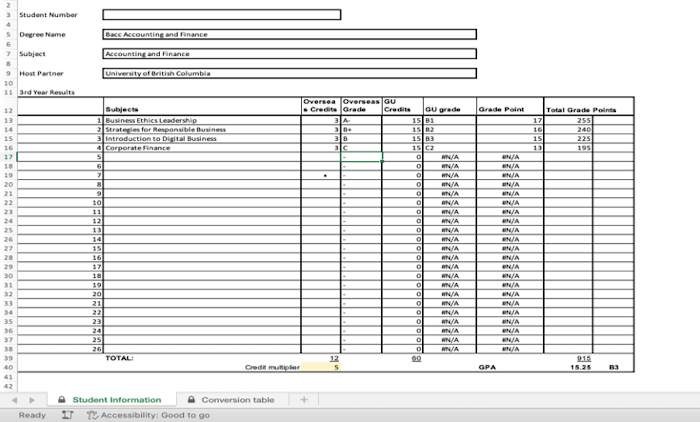
- Step One: for courses taken abroad, translate the course grades into Glasgow grades and use these to calculate the Honours GPA.
- Step Two: the Honours GPA is rounded in the normal way (for example, 15.25 becomes 15 i.e. B3).
- Step Three: The grade represented by the rounded GPA (in the example, B3) is reported as the recommendation to the Board of Examiners. It will count for 60, 80 or 120 credits depending on how many credits counting for Honours purposes were taken abroad and this will be published, in due course, on MyCampus. This grade is then taken into account in calculating the degree classification. Should the outcome fall between classifications, the credits gained in each course taken abroad will not be looked at individually and only the rounded figure will be counted for the 60, 80 or 120 Honours credits, as the case may be, completed abroad. In the example below, 60 credits at B3 will be reported and the individual translated grades used to calculate the final grade point mean will not be taken into account by the Board of Examiners.