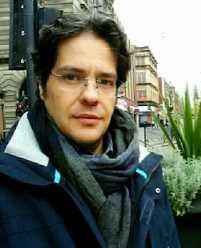
Cristian Collina
Supported by the Friends of Glasgow University Library
Cristian Collina is a political scientist interested in politics, international relations, social development, and the comparative law of Russia, former Soviet states and post-socialist Europe and Asia. He holds a PhD in Political Science from the University of Turin, where he has been a research fellow on Russian and Eastern European politics and an adjunct lecturer of Political Science and Legal Traditions of Eastern Europe. Presently, he is an associated member of the Institute of Studies on Asia and an adjunct lecturer of Law and Society in Asia.
His current research interests cover the long-term dynamics of the contemporary Russia-West relations and their theorisation with special regard to the concepts of unevenness and combination in social, political and legal development and their common ground with the theories of geopolitical coexistence. Dr Collina is interested in the rediscovery of the work of those Western scholars who first engaged in these concepts and theories in the interwar and early post-Cold War periods. His research at the UofG Library will focus primarily on the Rudolph Schlesinger Archive. Schlesinger (1901-1969) was a leading scholar in Russian/Soviet Law and society, co-founder of the Institute of Soviet and East European Studies of the University of Glasgow, and co-founder, along with other prominent scholars of the time, such as Karl Polanj, of the academic journal “Co-Existence. A Journal For The Comparative Study Of Economics, Sociology, And Politics in a Changing World”. “Co-existence” was issued from 1964 to 1996 and, throughout this time, was home to a multidisciplinary critical scholarship on the Soviet development model and foreign policy, seeking to understand the complexity of Soviet Russia and Russia-West relations.
The Library Fellowship will allow the researcher to address salient questions, such as what is the origin and the intellectual background of coexistence theories in the West? How do they relate to the theories of uneven and combined development? How did the Western theories of coexistence differ from the Soviet ones? Why were they abandoned during the Post-Cold War unipolar phase of international relations, and how can they return anyway helpful to understand the current emerging multi-polar phase? Indeed, the research project looks back at the theories of coexistence and uneven and combined development, both to understand their intellectual genesis in the West and to assess their relevance to the current scenario of Russia-West relations after the unipolar phase.
The Archive and Special Collections section of the UofG Library is home to several resources relevant to the study of Russian development and Russia-West relations. To investigate Shlesinger's theories, the making of the journal Co-Existence and its intellectual community, I will work on the Shlesinger Archive, a rich collection of documents and papers connected to his studies and the life of the journal “Co-existence”. To investigate the wider intellectual debates preceding and accompanying the foundation of the journal, the research will focus on other special collections such as Bisset, Trotsky and Farmer, containing documents, books and pamphlets about Russia-West relations in the interwar and early Cold War periods. The fellowship will give me an opportunity to assess the conceptual links among coexistence, unevenness and combination, further analyse the political history of USSR/Russia-West relations and compare and contrast the current phase with the interwar and early Cold War periods. The information and data collected through this fellowship will represent a valuable base for my future research papers on Russian political development and the evolution of Russia-West relations.