


Me by David Mackay
David Mackay (BSc 1979, DEng 2014) first learned to fly in the University Air Squadron during his time at UofG. In 2019, as chief pilot with Virgin Galactic, he became the first Scottish-born person to reach space, on a test flight almost 90 km above Earth.
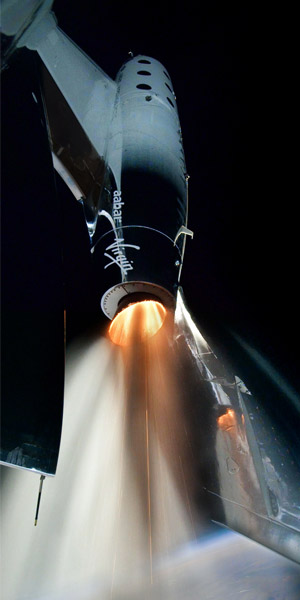
You’ve said you wanted to fly in space since witnessing the Apollo moon landings as a child. Many would have felt the same – what’s different about you that made you actually go and achieve it?
I think I was stubborn enough not to give up on the dream. My mother used to say I was very ‘thrawn’ – an old Scottish word – which meant I'd get an idea and wouldn't let it go. I don't like to be beaten by things.
Do you remember any pivotal points in your childhood that contributed to your ambition?
Watching the moon landings was incredible – very inspiring and exciting for a young kid – and I found out that those early astronauts were former military test pilots. I was living in Helmsdale, in the north of Scotland, and saw these military aircraft flying overhead from RAF Lossiemouth. I thought it would be fantastic to be a pilot and fly down those valleys at high speed, so I put together a very bold, ambitious plan of becoming a test pilot and then an astronaut. I always knew the chances of it were very slender, but I think if you don't try, you'll never get there.
"I was always curious about things. I used to repeatedly dismantle my bicycle down to the very last ball bearing then clean it all up and put it back together again, and pretend that I’d made it better than it was before.”
Your career has involved flying some of the world’s most demanding aircraft – have you had any dicey moments during testing?
There were several challenging moments – one when I was a test pilot on a Hawk, which is the aircraft that the Red Arrows fly. When we tried to lower the landing gear, one of the main gear stuck up. We tried everything, without success, and had to land like that. We immediately fell onto one wing – we're doing about 120 miles an hour at this stage, scraping down the runway. We went off the side of the runway onto the grass, then hit a crossing road – and I thought we were about to cartwheel. When you think something really bad is going to happen, your brain slows everything down. I knew if I pulled the handle of the ejection seat, it would probably hit the ground, so I decided I would just ride it out … and thankfully, it all worked out OK.
Do elite pilots like you still feel fear – whether over flying or anything else in life?
There are certainly things that scare me. I think if you don't have a sense of fear, you shouldn't be a pilot, because that would imply that you're way too relaxed about what you're doing in your job. I think a healthy sense of fear is a very important tool for everybody to have.
If someone had told you on your first day at Virgin Galactic how long the journey would be before you made it into space, would you still have signed up?
I was passionate about the project from the start, but the implications of the move on myself (giving up a well-established career as an airline pilot with Virgin Atlantic) and my family all made the decision very difficult. Ultimately, my family could see that this was an incredibly exciting opportunity. I was by no means certain it was going to work, but I did know that I would do all I could to try. So the bottom line is yes, I would still have signed up!
You became the first Scottish-born astronaut in 2019. How did it feel when you actually reached space?
The overriding initial feeling was actually a huge sense of relief, because it was a test flight, and the vehicle flew really well. We also had an engineer in the cabin who we were going to allow to unstrap, during a suborbital flight. That’s now become pretty common practice, but at the time it had never been done before. They don't have long to get back into their seat, in weightlessness, and strap themselves back in before re-entry. When I first heard the idea I thought, can you really do that safely? It was pretty bold.
Can you describe the moment you first saw Earth from space, and how it made you feel?
I was astonished at how bright the Earth's surface is. The first time we went up over the Mojave Desert, it felt like I was standing on a sandy beach on a bright sunny day. In contrast to that, looking into space, it’s the darkest, mattest black I've ever seen. So you've got this incredible range of brightness, which I've never seen captured in the same way on film or on still. You can see so much of the curvature of the Earth that you get a sense of its scale. I could really envisage the size of the planet we're above, and to me, it's not big. This is a small planet.
"The impression I got from space was of a very small, very beautiful, very vulnerable planet – and there's no other option out there. We are so far away from anything else that to me, there's no realistic Plan B. This is it, and we have got to look after our planet.”
Living in New Mexico now, where do you regard as ‘home’ and why?
Really, my home is Scotland, and always will be. I feel this connection with the place, and my family, for many generations, all come from the Northern Highlands, north and west coast. When I'm there, I feel a contact with the land and the people ... it just feels that's where I should be.
Outside of your work, how do you like spending your time?
I've got an old British sports car I bought as a project – an E-type Jaguar. I spend a lot of time working on it and taking it on long journeys. Just recently, we did a 1,600-mile journey up around the Four Corners area – Arizona, Utah, Colorado and New Mexico. Beautiful. It's an open-top car, so it's fantastic for seeing the scenery. I love tinkering with it, and again, trying to pretend I'm making it better.
What is your happiest memory?
The birth of our children, which is just such an amazing thing. It's almost magical how a young person starts off almost completely dependent on you – helpless – and suddenly becomes a person, and it just happens so incredibly quickly.
Where is your favourite place in the world?
Bettyhill, on the north coast of Scotland. I lived there until I was six and it’s a stunning place – just a small village but it's got two of the most amazing bays on each side.
How would you spend the perfect day?
It would be going somewhere new which exceeds my expectations – probably countryside, somewhere naturally beautiful and interesting. I’d finish off the evening with friends, and maybe a single malt.
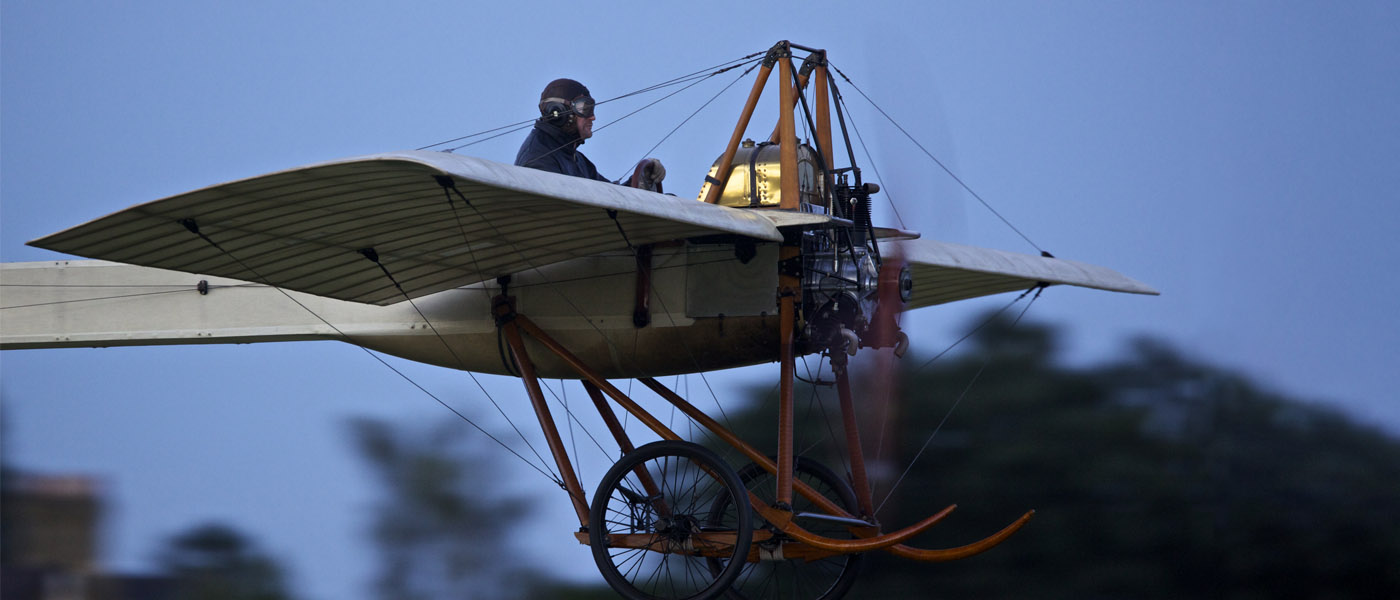
Dave in control of a 1910 Deperdussin monoplane, the second-oldest original flying aircraft in the world. Dave was a historic aircraft display pilot for 22 years. Image: Steven Jefferson
Memories of Glasgow
I came to study at UofG because it was the only place in Scotland that did aeronautical engineering, and it also had a University Air Squadron, which I was interested in as well. It was where I wanted to go.
I started off a diligent student, because I don't like failing, so I worked really hard in my first year and did well, and then I joined the Air Squadron – and flying was even better than I thought it was going to be. I loved it, and that was a huge distraction, so I didn't work as hard from that point onwards as I should have done, though I got there in the end.
A few years later I was in Glasgow giving a talk, and one of my professors from the School of Engineering was there too. That was an opportunity to apologise to him for not working as hard as I should have done at university.
The Air Squadron instructors were excellent, with high standards, but also very approachable. We could put our names down to visit RAF bases during the summer break. I did that and went home to Helmsdale, waiting to hear where they would send me to, expecting it to be RAF Lossiemouth, or maybe nearby Kinloss. Instead, when the letter arrived it was to Newquay Airport in Cornwall. I thought it was a joke. I was being sent from one end of the country to the other – it was something like a 30-hour overnight train journey.
I liked the unions, both of them, but mostly GUU. I have more memories of parties and bands there than anywhere else. And there was a great Indian restaurant, the Shish Mahal, not far down from the GUU on Gibson Street.
Dave continues to keenly follow the progress of space activities in Scotland. As part of the Clan Mackay Society, Dave is also keeping a watchful eye on the campaign to save the 17th-century St Andrew’s Church in Tongue, in the north of Scotland, where many chiefs of the clan are interred.
This feature was first published in October 2026.
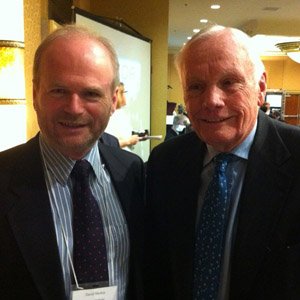
Dave meeting his hero, Neil Armstrong, in California in 2012. Image: courtesy David Mackay
Main image top: Gilbert Duncan
QUICKFIRE
Biggest hero
Neil Armstrong. As a kid, I watched him on a black & white TV, then many years later ended up sharing a panel on a conference with him. That was extraordinary.
Biggest challenge
Staying focussed. There are so many interesting experiences in life, I find it easy to get distracted.
Guilty pleasure
Chocolate – British or European.
Biggest regret
I think I was pretty selfish when I was younger – very driven. But it didn’t take me long to realise that you can’t do anything without being in a team.
Biggest extravagance?
That E-type Jaguar.