Building NHS Research & Technical Capacity
Through a Specialist Secondment Model
Secondments offer a powerful way to strengthen research and technical capability across the health system - building the skills, insight, and cross-sector experience needed to drive NHS-led innovation.
For Specialist Biomedical Scientist Alan Kennedy, a secondment with NHS GGC Biorepository was a transformative opportunity that deepened his pathology expertise, expanded his technical skills, and strengthened his confidence to contribute to NHS research and innovation.
Secondment Purpose
As genomics and spatial biology transform biomedical research, NHS Biorepositories play a vital role in providing high-quality, ethically sourced, and clinically annotated tissue for advanced studies. To build on this capability, a secondment was established to bring NHS operational expertise together with cutting-edge scientific practice.
Through his secondment, Alan gained practical exposure to advanced research methodologies and workflows, helping to build long-term innovation capacity within the NHS workforce.
Learnings & Outcomes
Alan said the secondment gave him “a wider view of how pathology contributes to research and how research is conducted,” motivating him to pursue future roles that bridge clinical practice and research.
The secondment provided him with:
- Broader understanding of end-to-end research processes
- Strengthened technical and governance expertise
- Increased confidence to lead innovation-focused projects
- Enhanced collaboration skills across clinical, academic, and industry partners
- Greater insight into translational research and biorepository operations
His experience demonstrates how specialist secondments can build innovation capacity within the NHS - creating a research-aware, cross-sector workforce equipped to drive new approaches in patient care.
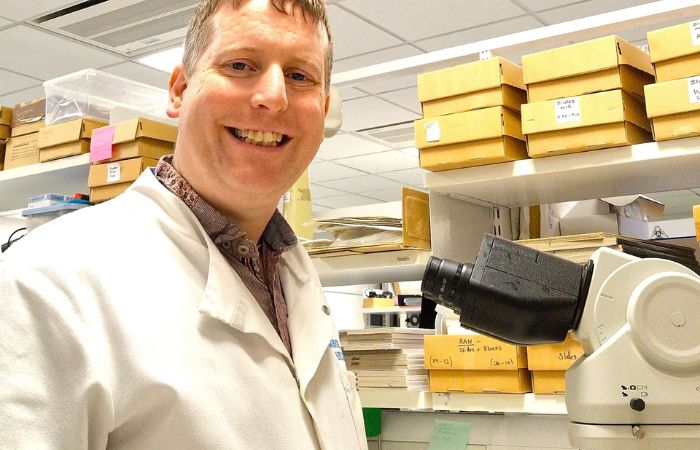
The Secondment Experience
Alan contributed to the Living Laboratory’s Radiogenomics and CYGNUS projects, focusing on improving workflows and processes to support genomics research.
His work included:
■ Reviewing and anonymising patient data, ensuring ethical and secure handling for research use.
■ Preparing and processing tissue samples through microtomy, digital scanning, and staining for genetic and imaging studies.
■ Supporting advanced analyses, including tissue microarrays, spatial transcriptomics, AI-assisted pathology, and DNA coring.
■ Collaborating with partners such as University of Glasgow, Canon Medical Research Europe, Azenta, and the Glasgow Tissue Research Facility.
Skills Development
- Developed advanced expertise in Microtomy, digital pathology, and scanning techniques, alongside advanced tissue preparation for genetic analysis, strengthening capabilities that support high-quality clinical research.
- Gained new technical skills in data management, data protection, database use, and collaborative platforms.
- Acquired hands-on experience with advanced digital imaging and pathology platforms such as Hamamatsu Nanozoomer and 3D histech, strengthening the NHS’s in-house capability to support advanced research and diagnostic innovation.
- Fostered cross-sector collaboration by building close working relationships with the University of Glasgow, Glasgow Tissue Research Facility, NHS GGC Pathology, Canon Medical, and Azenta.
Opportunities & Achievements
- Published work in Pathology in Practice
Highlighting the Biorepository’s role, its achievement of the first Biorepository UKAS accreditation in the UK, and its contributions to Living Laboratory research. - Shared insights through public engagement, including a presentation at Pint of Science, to help raise awareness of the Biorepository’s contribution to innovation and research within the NHS.
- Completed new training and certifications, including Laboratory IT and Clinical Informatics, Leadership and Management, and project management courses.
- Enhanced knowledge-sharing by applying gained expertise to help colleagues better understand Biorepository processes and increase awareness of the NHS’s role in clinical research and Living Laboratory projects.