

Honours students get a quick introduction to Organics and Botany in Archaeology
Published: 7 July 2026
A recent two day masterclass, held by Nysa Loudon, looked at the role Archaeobotany plays in fieldwork and research
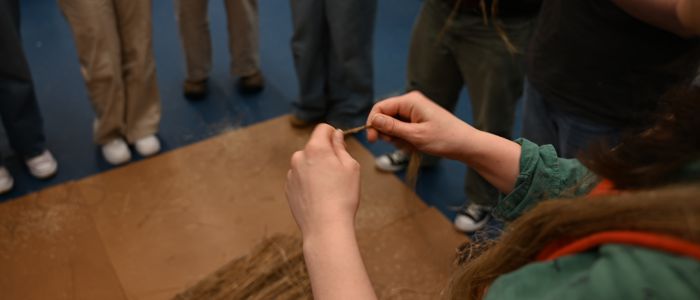
Nysa Loudon teaching how to make a simple 2-ply cordage with retted flax. Photo (c) Aristotelis Palyvos
On the 9th and 10th of June Honours Archaeology undergraduate students got to attend a masterclass in Organics and Botany in Archaeology taught by current University of Glasgow PhD student, Nysa Loudon (4th year). The 2-day masterclass gave the students a whistle-stop tour of the role of Archaeobotany (also known as Palaeoethnobotany) in archaeological fieldwork and research through lecturing and practical experience.
The first day, students cut into common grocery store fruits to learn about the anatomy and development of fruits and seeds. They were also given the opportunity to examine, sort, and even identify Bronze Age and Iron Age Scotland charred plant remains within flots and residues, engaging with and learning the first steps for most archaeobotanical research.
The second day focused on plant technologies in Scotland, specifically the use of plant fibres in making cordage, basketry, and fabrics. Loudon taught them how to use both domesticated plant fibres, like flax (Linum usitatissimum), and wild plant fibres, such as willow (Salix sp.) bast, purple moor grass (Molinia caerulea), and rush or Floss (Juncus effusus/conglomeratus), found in Scotland to make simple cordage and twined fabrics.
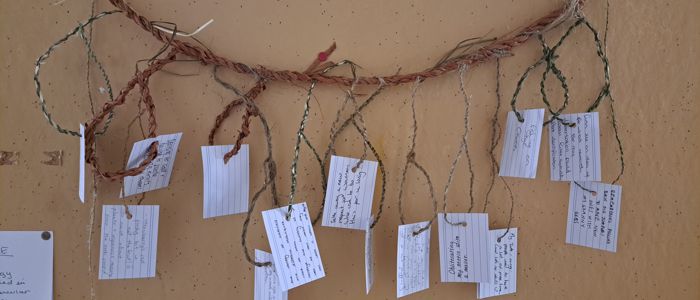
The 'Memory and Learning Snare' created together with Masterclass students with plant fibres found throughout the Scottish archaeological and historical record. Photo (c) Nysa Loudon
At the end of the masterclass, students incorporated their cordage into a group piece based on a St. Kilda puffin snare held at the Highland Folk Museum, Kingussie. The exercise, devised by artist Caroline Dear and adapted for this course, asked students to make a length of cord from one of the Scottish plant fibres introduced to them and attach a piece of paper detailing one thing they would take away from the masterclass or a memory of cordage and rope that they were thinking of while they were working. The cords were then attached to a central rope to make a ‘Memory and Learning Snare.’ It can be seen on display in the Archaeology corridor (level 3) in the Molema Building, Lilybank Gardens.
First published: 7 July 2026
<< Latest news