Transforming Research: The effects of sharing facilities on cultures & outcomes
Published: 30 July 2026
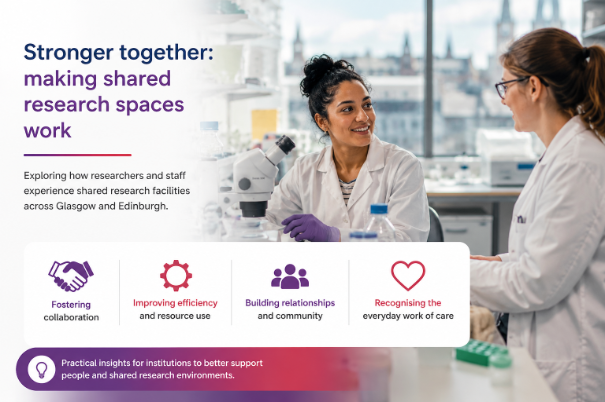
This project explored how researchers and staff experience shared research facilities across Glasgow and Edinburgh. It found that while shared spaces can foster collaboration and efficiency, their success depends on the everyday work of coordination, relationship-building, and care. The findings highlight practical ways institutions can better support shared research environments and the people who make them work.
Introduction
Shared facilities are increasingly central to institutional strategies, designed to foster collaboration, reduce duplication, improve sustainability, and manage spatial constraints. The project explored how sharing is experienced by facility users, including its benefits, challenges, and implications for research cultures.
We considered what sharing means to researchers and other parties sharing facilities with them:
- What are the benefits and drawbacks of sharing facilities from the perspective of those involved?
- What norms, values and forms of knowledge does sharing facilities enable or weaken; who and what is involved in making a success of these arrangements?
- What practical steps can be taken to derive further benefits to research cultures and outputs from shared research facilities?
Conceptual Framework
Drawing on Science and Technology Studies (STS), this project treats buildings as active agents in shaping research cultures. Facilities act as sites of knowledge production, status and hierarchy, and institutional identity. They are dynamic and continually reshaped through everyday practices, negotiations, and reinterpretation by users.
Methodology
The study adopts a qualitative multi-site case study approach across four shared facilities (two in Glasgow, two in Edinburgh). Data includes 33 semi-structured interviews, participant observation, and documentary analysis. Fieldnotes capture everyday interactions and informal encounters. The data was analysed through thematic coding.
Key Findings and Recommendations
Our findings show that shared facilities are shaped by everyday practices, spatial and technical constraints, institutional logics, and significant forms of emotional labour. Sharing could be episodic in different ways – from ‘hot desking’, to time slots with equipment, to events and engagement activities. Participants highlighted the challenge of managing user expectations alongside technical and research work, while competition for space, equipment, and movement between settings introduced additional complexity. Support staff played critical coordination and hospitality roles in sustaining these environments. Facilities also functioned as sites of prestige and hierarchy, with ongoing tensions around belonging and space as user communities shifted and norms were renegotiated. Financial pressures and cost-recovery models have expanded staff responsibilities toward management and facilitation, while collaboration requires active curation through both formal events and informal encounters. Care work and emotional labour emerged as central yet often under-recognised elements of successful sharing. At the same time, engagement with diverse publics has generated new forms of interaction, requiring active stewardship and bridging skills across communities. Finally, increasing hybridity and expanded access are blurring institutional boundaries and reshaping identities, adding further layers of complexity to the management of shared equipment and spaces.
Institutional Recommendations
- Recognise and support the everyday work building users do to deliver shared research infrastructure.
- Invest in roles that enable collaboration and interdisciplinary exchange.
- Monitor belonging, inclusion, and hierarchy within shared spaces and support staff to address tensions and resolve challenges.
- Design-in flexibility that allows for adaptation and new ways of using buildings and equipment.
- Streamline governance structures for shared systems such as IT and budgeting.
- Review how costs are measured and attributed to different activities and consider how to streamline accounting processes and invest in future benefits.
- Improve booking, access, and space management systems to reduce inefficiencies.
- Support hybrid working through better integration of physical and digital environments.
Conclusion
Shared research facilities are complex sociotechnical environments requiring continuous negotiation, mediation, and adaptation. While they enable collaboration and efficiency, they also introduce new tensions and forms of labour. Understanding and supporting the human and organisational dimensions of sharing is essential to their success.
First published: 30 July 2026