

List of Equipment available through ANALOGUE
This section highlights each major piece of equipment
| Equipment | Description | |
| 1 | Automated wafer prober (AWP) | AWP provides increased efficiency, throughput and repeatability of measurements and offers high-precision placement of up to 1µm, temperature control to ±1°C, multiple wafer loading. Thus, enabling device validation and reliability research in a constrained timeframe. For instance, EPSRC projects related to quantum circuits (EPIQC), would leverage an AWP to accelerate testing and debugging. Quantum circuits are highly sensitive to noise and environmental factors requiring a controlled and repeatable test environment, enabling multiple designs to be rapidly characterised and optimised. |
| 2 | Automatic surface grinder (ASG) | The ASG is a precision grinding machine to remove the material from the workspace, enabling thinned microelectronic devices such as sensors, implantable, and quantum circuits. As an example, implantable devices such as neural probes applications (EP/X017516/1), require a precise and smooth finish to prevent damage to tissue. In wearables (EP/X034690/1), dies can be automatically thinned to improve mechanical resilience and flexibility, with improved reproducibility. |
| 3 | 3D Heterogen-ous Additive Printer | Additive 3D functional packaging enables the integration of bare dies, as well as stacked and vertical interconnects, including “many-layered” printed circuits, beyond traditional PCB tech and laminates. The µm-scale resolution over a large area enables sustainable circuits ranging from implants to packaged quantum computers. Transient circuits can also be realised using non-metal conductors. |
| 4 | Automatic die bonder | An automatic die bonder is required for placing dies, or components onto substrates/PCBs. For instance, magnetic sensors (EP/X031950/1) need the automatic die bonder to place the sensor array at the exact location required for optimal sensory performance. The die bonder supports micro-sensors and IC research, where reproducibility and reliability are an essential element in the research and large numbers of experiments are needed to optimise new bonding, substrate or semiconductor materials. |
| 5 | Automated wire bonder | The automated wire bonder attaches fine wires, e.g. gold or aluminium, to nanoelectronic dies with high precision, throughput, reliability, and substrate-compatibility. Reducing manual intervention eliminates human error and improves the accuracy and consistency of the bonds with a high yield, required for sensors, quantum circuits, and RF micro-systems. |
| 6 | Bond Tester | Bond testers validate the quality and reliability of bonded dies and wires, underpinning research on the reliability of nanoelectronics. Sensors, healthcare, and medical devices often use wire bonding to connect the sensing elements to the rest of the device. Testing the wire bonds’ quality and strength ensures the sensor/devices can accurately and reliably detect the intended physical quantity. |
| 7 | Lock-in Amplifier | This measures small signals produced by physical phenomena in sensors, e.g. temperature changes or magnetic fields. As an example, lock-in amplifiers will help extract small signals from quantum devices, to measure signals produced by electronic components to improve the device’s performance. The lock-in amplifier supports a wide frequency range of DC-8.5 GHz down to sub-nV accuracy. |
| Source measure-ment unit (SMU) | SMUs offer extremely accurate control and measurement of both voltage and current levels, allowing for precise characterization of the device under test. SMUs can be used to test a wide range of devices, from simple passive components to complex integrated circuits, sensors, semiconductor devices, and electronic systems. | |
| Mixed Domain Multi-Channel Oscilloscope | Oscilloscopes allow analysis and debugging of complex electronics that involve multiple signals and domains (e.g., analog, digital, and frequency). The simultaneous multi-domains acquisition provides a comprehensive view of the system and helps identify problems that may not be visible with traditional oscilloscopes. Thus, complex Mixed-signal ASICs for biomedical and quantum hardware applications can be characterised in less time and reduce the need for additional test equipment. |
Dicing Tool-Disco 3350
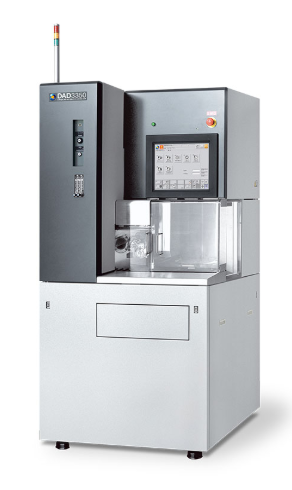
Dicing Tool-Disco 3350
DAD3350 can handle a maximum of Φ8-inch or 250 x 250 mm workpieces (user-specified specification). Selecting a 2.2 kW high-torque spindle (optional) makes it possible to process silicon up to difficult-to-process materials, such as ceramic. In addition, the microscope includes an air blow mechanism and a lens shutter to prevent contamination. Through condition monitoring the processing conditions and various other statuses can be known at any given time.
CAPABILITIES: To improve equipment productivity, auto alignment, auto focus, auto kerf check, and other image recognition functions have been installed.
High resolution XPTL Printer
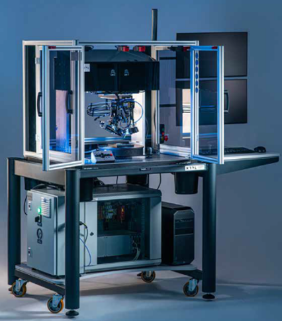
XPTL DELTA
XPTL DELTA printing system (ANALOGUE project)is an open prototyping platform delivering reliable, repeatable, and durable results for high performance materials. Easy to operate and maintain. Ideal tool for R&D in various microelectronics applications.
Printing on the edge - Edge interconnections printing with high resolution traces (10 µm), possibility to print over the edge of glass, silicon and flexible foils.
Redistribution layer prototyping - All printed RDL structure, down to 1 μm or 1 μm L/S density, variable materials, for example, metallic nanoparticle paste and high viscous polyimide.
Chip interconnection - Reliable connection for flexible hybrid electronics and advanced IC packages, high-density interconnections on stacked chips (Resolution <10 μm or 10 μm L/S), no satellite droplets and line width homogeneity to prevent electrical shorts.
AUREL Screen Printer
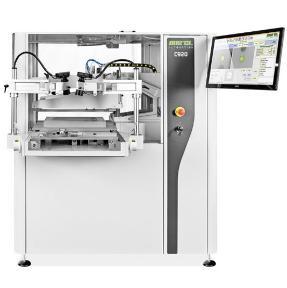
Aurel C920 Screen Printer
Aurel C920 Screen printer (ANALOGUE PROJECT) is a high precision free stand screen/stencil printing machine and meets the requirements for high quality automatic printing on large areas. The main application in the electronic are thick film, SMT, polymeric pastes, solar cells. C920 can be equipped with a vision system and two TV cameras to simplify the alignment operation between screen/stencil and substrate.
3D Nanodimension DragonFLY IV
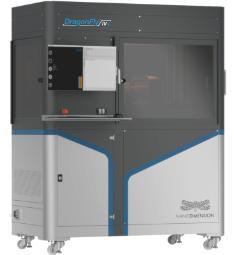
Dragon FLY IV
A multi-material, multi-layer 3D printer that generates entire circuits in one step – including substrate, conductive traces, and passive components