

Spin-out Glanadair unveils ozone device to tackle hidden source of hospital infections
Published: 23 November 2026
Ozone generated from ambient air could safely disinfect otherwise inaccessible drain systems and pipework in hospital sink units.
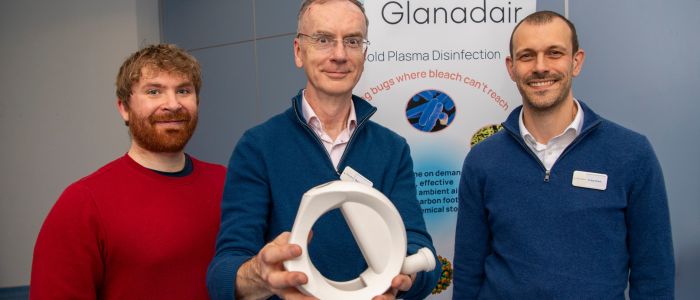
A University of Glasgow spin-out has developed a handheld device that uses ozone generated from fresh air to tackle one of the most persistent and overlooked sources of hospital infection - contaminated sink drains.
Developed through more than 15 years of university research and now being commercialised by Glanadair, the latest form of the technology is a device that creates ozone on demand using only air and electricity and can be placed easily over a drain opening in a hospital sink.
Ozone is generated by the device inside the drain system allowing it to reach bacteria hidden in areas that are difficult or impossible to clean using conventional methods such as bleach. Once treatment is complete, any remaining ozone is safely converted back into ordinary oxygen, leaving no chemical residue behind.
Widely recognised as one of the most powerful disinfectants available, the Glasgow team believes using ozone to target the root of drain contamination could help reduce the risk of healthcare-associated infections while reducing reliance on harsh chemical cleaning agents.
Professor Declan Diver, co-founder of Glanadair with Dr Hugh Potts, and one of the inventors of the technology, said: “About 10% of patients who go into hospital pick up another infection when they are there - and the source of that infection is the drains.
"Hospital drains can harbour harmful bacteria within biofilms that are very difficult to remove. Because ozone is a gas, it can penetrate those biofilms and reach places that liquid disinfectants often cannot.
"We essentially make disinfectant from fresh air. The challenge has always been how to generate and control ozone safely and effectively. That's what this device allows us to do.”
The science underpinning the device is already well established. In a recent peer-reviewed study published in the Journal of Hospital Infection, researchers demonstrated that plasma-generated ozone significantly reduced bacterial contamination within drains while preventing ozone from escaping into the surrounding environment.
The research showed that ozone generated from ambient air could safely disinfect otherwise inaccessible drain systems and pipework.
The technology builds on earlier University of Glasgow innovations that used ozone to extend the shelf life of fresh fruit and vegetables. Drawing on that experience, the team refined the underlying science and engineering to create a more powerful and practical system for infection-control applications.
Alongside its cleaning capabilities, the device can also record when a sink has been disinfected and by whom, creating a digital audit trail for hospital cleaning teams.
With a patent recently filed and now pending, the technology is being prepared for wider deployment and clinical workflow trials, with hospitals already expressing interest in evaluating the system.
Meanwhile, Glanadair is seeking investment to support manufacturing and has reached the final stages of the prestigious Scottish EDGE competition.
For Professor Diver the appeal of the technology lies in its simplicity. He said: "We're taking something that is freely available all around us, the air we breathe, and turning it into a powerful tool for infection prevention. If we can make hospitals safer using air, electricity and smart engineering, then that's a very exciting prospect."
The University’s active spin-out portfolio now comprises 34 companies, which have collectively secured £156 million in external investment, attracted £47.6 million in grant funding and supported 397 highly skilled jobs across health and life sciences, advanced manufacturing, digital technologies and energy.
Morven Fraser-Walther, Head of IP and Commercialisation, University of Glasgow, said: “Glanadair is a fantastic example of how world-class research at the University of Glasgow can be translated into technology with the potential to deliver real benefits for society.
“Our IP and Commercialisation team is proud to support spin out’s journey, helping transform an innovative idea into a business with genuine impact. We wish Declan and the Glanadair team every success as they take this promising technology to hospitals and healthcare providers around the world.”
Main image caption. Pictured left to right: Dr Adam Dowdell, Research Assistant; Prof Declan Diver, Professor of Plasma Physics and Glanadair co-founder; Dr Craig Stark, Plasma Physicist.
First published: 23 November 2026