

Genetic adaptation to living in warmer waters causes fish to be obese
Published: 28 July 2026
Fish that have adapted to living in warmer waters show clear physical and genetic differences to fish of the same species living at cooler temperatures
Fish that have adapted to living in warmer waters show clear physical and genetic differences to fish of the same species living at cooler temperatures.
New research, led by the University of Glasgow and published in Nature Communications, reveals that adaptation to warmer waters causes fish to display a range of behaviour and biological differences including obesity, overeating, and having a lower metabolism.
The findings have important implications for our understanding of the potential impact of global warming on aquatic life.
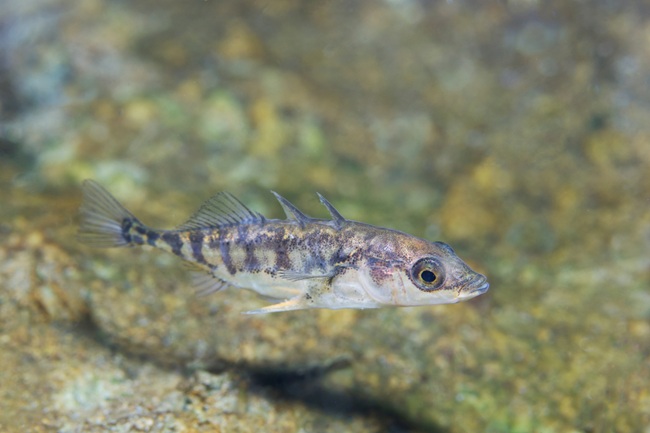
To carry out the study the research team headed to Iceland, where they used the country’s naturally warm geothermal waters as a model for the impact of climate change. There, the team studied the threespine stickleback, a species of fish that commonly lives in both Iceland’s average temperature (cooler) waters and its geothermal waters, where indigenous fish have had to adapt to living in unusually warm conditions. These warm water conditions reach upwards of 27.8°C and have been described by the researchers as like ‘fish hot tubs’.
The researchers studied the behaviour, appearance and genetics of the fish, and found clear differences between those living in cooler and warmer waters. The threespine sticklebacks living in warmer waters were hyperphagic, a condition that causes excessive hunger and overeating. The geothermal fish also put on more fat stores in the summer in preparation for the winter and hold onto fat more efficiently during periods of low food availability.
In addition to appearance and behaviours, the warm water fish also had a range of DNA adaptations. While these genetic changes were varied across different groups of geothermal fish, highlighting the unique and unpredictable nature of adaptation to specific environments. However, the research team did discover cellular differences shared by all warm water groups. There was a key genetic change, at the mapk pathway, a signalling mechanism with implications for growth factors and stress, was found among all fish that had adapted to living in warmer waters, but not in their cold-water cousins. The geothermal fish also harbour a flipped region of the genome (inversion) which is not in the cold adapted fish that allows them to live in geothermally warmed waters. Both the mapk pathway and the inversion work together to facilitate adaptation to warming environments.
Dr Kevin Parsons, co-lead author of the study from the University of Glasgow, said: “Our study is the first to show the specific genetic changes caused by adapting to warmer waters, offering key insights into the impact that climate change could have on aquatic ecosystems.
“We discovered that while the detailed DNA adaptations to warmer waters vary between fish populations, the overall impact of these changes was similar in all warm water-adapted fish, with changes to their body size, appetite and metabolism.”
Increasing global temperatures represent one of the biggest threats to wildlife, in particular to cold-blooded animals who rely on their environment to regulate their body temperatures. While some fish in the oceans may be able to migrate to avoid the impact of warmer waters, species in land-locked waters will either be forced to adapt or go extinct.
Dr Matthew Brachmann, co-lead author of the study from the University of Glasgow, said: “Climate change is already causing rapid temperature increases in our waters, forcing some aquatic life to adapt to survive. However, predicting the extent and impact of adaptation remains challenging, as the extremes of global warming have not yet been experienced by most species.
“By focusing on indigenous fish living in different natural water temperatures in Iceland we have been able to show the real-world impact of adapting to warmer waters, with adapted populations showing clear physical, behaviour and genetic changes.”
The study, ‘Parallel adaptation to geothermally-warmed habitats due to common structural variation and functional developmental pathways’ is published in Nature Communications. The work was funded by the UKRI Biotechnology and Biological Sciences Research Council and the UKRI Natural Environment Research Council.
Enquiries: ali.howard@glasgow.ac.uk or elizabeth.mcmeekin@glasgow.ac.uk
First published: 28 July 2026