

Five of Scotland’s Most Amazing Archaeological Discoveries from 2025
Published: 17 December 2025
UofG archaeologists and students are part a team named among the biggest discoveries from this year.
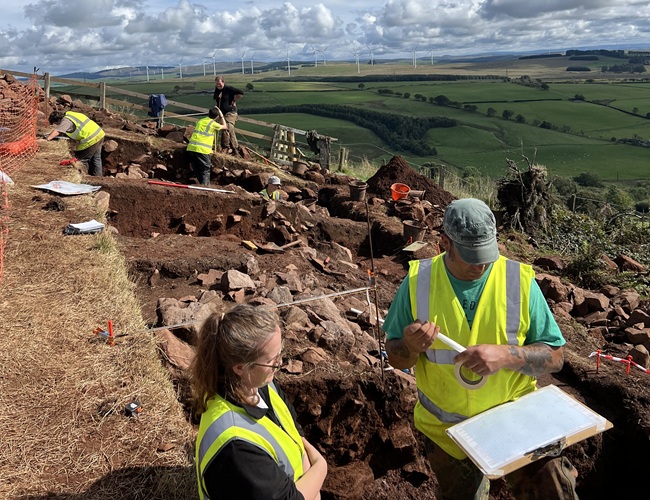
Evidence of a possible Roman siege is among the most ground-breaking archaeological finds of 2025.
Dig It!, a hub for Scottish archaeology coordinated by the Society of Antiquaries of Scotland, has compiled their annual list of some of the biggest discoveries from the year to celebrate the archaeologicl work that takes place across the country.
The University of Glasgow's discovery shows a possible Roman siege in Dumfries & Galloway. In August and September, experts collected evidence from a hillfort which may suggest that the site was besieged by an invading Roman force some 1900 years ago, making it one of only a handful of sites in Europe that still has upstanding evidence for a Roman attack.
Alternative theories have suggested that the hillfort, which dates to the Iron Age (800 BC to AD 400), was not significant enough to warrant a Roman attack and that the hillfort was long abandoned by the time the Romans got to the site.
However, survey work by a team from the UofG's School of Humanities | Sgoil nan Daonnachdan, the Trimontium Trust and the University of Manchester has revealed that Burnswark Hill was far more densely occupied during the time of the Roman invasion than previously thought, which they believe means that it was large enough to provoke an attack.
Subsequent excavations also revealed traces of a major phase of rampart construction or remodelling following the Roman attack. This has been interpreted as the hillfort’s inhabitants having survived or returned after a siege and beginning to rebuild.
According to the University of Glasgow’s Dr James O’Driscoll FSAScot: “These findings offer a rare glimpse into how Iron Age communities in Scotland built, defended, and reimagined their world in response to Roman power. It’s a story of resilience, identity and survival that challenges long-held assumptions about Scotland’s past.”
Dr Simon Gilmour FSAScot, Director of the Society of Antiquaries of Scotland, said: “This year’s top discoveries collated by our Dig It! project bring to light human stories from Scotland's past across five millennia; from cuisine and conflict to past beliefs and worldviews. I am particularly pleased to see how the public have played a part in many of these discoveries, whether by volunteering at an excavation or reporting their metal detecting finds to the Treasure Trove Unit.
"This is just a window into the range of exciting work that took place this year. If you are considering participating in archaeological endeavours in 2026, visit the Dig It! website and subscribe to the e-newsletter to learn about opportunities in your area.”
Dr Susan O'Connor FSAScot, Head of Grants at Historic Environment Scotland, said: "Dig It!'s list of top archaeological discoveries this year shows that history continues to be unearthed all over Scotland, and that we still have much to learn about the people who have lived, fought, and feasted on this land. Through our role as a primary funder of Dig It!, we are delighted to support archaeological stories such as these to further our understanding of Scotland's history and heritage."
Dig It! advertises archaeology events throughout the year, including fieldwork opportunities which are free and open to everyone with no experience required. The project is coordinated by the Society of Antiquaries of Scotland (Charity No. SC010440) to help deliver Scotland’s Archaeology Strategy and is primarily funded by Historic Environment Scotland.
Dig It!
-
Dig It! is a hub for Scottish archaeology which encourages members of the public to discover Scotland’s stories through archaeology by sharing events, leading on initiatives and projects, promoting the sector, working with underrepresented communities and more.
-
The project is coordinated by the Society of Antiquaries of Scotland (Charity No. SC010440) and primarily funded by Historic Environment Scotland.
-
For more information, visit www.DigItScotland.com
Evidence of a Possible Roman Siege in Dumfries & Galloway
-
This new work in 2025 is the latest update in a decades-long debate amongst experts about whether Burnswark hillfort was attacked by the Romans or merely used as an empty training ground for nearby Roman camps.
-
In the 1960s, experts found the largest collection of Roman lead sling bullets from any one site in Britain and North-western Europe, along with stone ballista balls, iron ballista bolts, arrowheads and even a Roman sword (the first ever found in Scotland).
-
The discovery of the ammunition around the entrance areas of the hillfort has been interpreted as evidence that these were used as targets for training Roman soldiers.
-
The 2025 work was undertaken by staff from the University of Glasgow, the University of Manchester and the Trimontium Trust.
-
Archaeology at the University of Glasgow is a vibrant community of students and staff working together and in partnership with a range of heritage organisations. The premier provider in Scotland, Archaeology at the University of Glasgow’s key strength is their commitment to practical heritage experience and vocational training that enables graduates to flourish in diverse future careers. For more information, visit https://www.gla.ac.uk/subjects/archaeology/
Other Projects on the Dig It! List 2025 include:
1) Evidence of Unique Neolithic Feasting in the Outer Hebrides
In September, experts at the University of Bristol concluded that crannogs (water dwellings) in the Outer Hebrides may have been hubs where people gathered and practiced unique culinary trends over 5,000 years ago.
2) Rare Bronze Age Structures in Shetland
From late May to early June, volunteers helped uncover rare prehistoric structures. Led by Archaeology Shetland and the SCAPE Trust, they unearthed a complex burnt mound and an underground corbelled structure, thought to be a well, at Gletness near Nesting
3) A Lost Medieval Settlement in the Borders
In May 2025, a lost medieval settlement occupied around 800 years ago was rediscovered near Horndean as part of the Uncovering the Tweed project. Local volunteers, school pupils and young adults from Borders Additional Needs Group worked alongside archaeologists from AOC Archaeology to excavate the site in the Scottish Borders.
4) Early Modern Amulet from the Highlands
In April, the Treasure Trove Unit (TTU) confirmed the discovery of an elfshot amulet. Uncovered near Fortrose by metal detectorist Lawrence Deans, the artefact contains a Bronze Age flint arrowhead which had been found by someone in the 17th or 18th century and mounted in a silver pendant as a charm. After being reported to TTU by the finder, the pendant was analysed by experts before being allocated to Groam House Museum in Rosemarkie, where it will go on display in 2026.
First published: 17 December 2025
<< December