

Me by John Tiffany
John Tiffany (MA 1994) is a powerhouse of modern theatre – a director whose work ranges from gritty social drama to magical blockbusters. Rising through the ranks in Scotland, he earned wide acclaim with the National Theatre of Scotland’s production 'Black Watch' in 2006, then went on to direct the musical 'Once' on Broadway and the record-breaking 'Harry Potter and the Cursed Child'. Known for his innovative and emotionally resonant style, John has won multiple awards, including two Tonys and two Oliviers, and has forged a reputation for ambitious storytelling.
When did you first realise that theatre was something you wanted to pursue professionally?
In Glasgow, luckily enough, when I started at the University. I’d thought I was going to be a doctor, or certainly something kind of sciencey. Like lots of sensitive children, I’d wanted to be a marine biologist and save the dolphins. But I’d always loved theatre, and a friend had a spare ticket for a Robert Lepage production. One particular scene was in a library in Venice, so there were all these books stacked up on the side of a shallow pool, then all they did was just shine a light from behind the books, and the next scene was suddenly the Manhattan skyline with the Twin Towers. In that moment, watching the play in Glasgow, something happened and it was like being born again. I try and explain what that moment did to me, but it’s hard. I thought, whatever that is, I want to do it. I want to do that to audiences. All my life, I've been chasing that.
You've said you wanted to recreate that feeling for your audiences – do you feel as though you’ve achieved that?
I suppose people say that they had a similar experience when the soldiers came out of the pool table in 'Black Watch'. There was a pool table on stage, then a knife comes up and suddenly you are in Iraq. And there’s a couple of moments in 'Harry Potter' where we disappear people and you genuinely don’t know how that’s happened.
In your collaborations with writers, designers, choreographers and so on, what are the best qualities that you bring as a creative partner?
I try to leave the ego back in the 20th century, and I get genuinely excited when someone has a better idea than me. There can be a patriarchal hierarchy in a rehearsal room, and directors with egos make the worst work.
Which production do you feel has pushed you the most, artistically or logistically, and why?
I suppose in terms of pressure and scale, and the risk that it could have all gone horribly wrong, it would be 'Harry Potter'. But I would say, artistically, it’s 'Black Watch', because it was the National Theatre of Scotland’s first year. It ended up being a kind of defining piece for them, and I think it’s because of the ambition to make the kind of theatre that connected with the audience in that way that actually kept me right.
"I enjoy bringing out the best in people and learning how to give them space to do their best work. And I always think that’s a place of fun and kindness, and taking the work seriously, but not yourself seriously.”
Do you have any little rituals or habits on opening night or in rehearsals?
My ritual used to be eating Percy Pigs [a popular children's sweet] in the technical rehearsals. But when I was in Edinburgh earlier this year, I decided I would cut out sugar as much as possible from my diet, so it’s now grapes – sometimes mango chunks if I’m feeling very tropical.
Has the meaning of success changed for you over the years?
It's interesting – things like shows on Broadway, Tony Awards and Olivier Awards were never the goal, because I didn't think that was in the realms of possibility at all. I started off with quite a political standpoint, saying “Theatre can save the world!”, you know. But then, as you develop and the shows get more successful, you find yourself in a commercial sector. As can happen with Broadway shows, you realise you're making millions of dollars a week for dubious enterprises because they're the investors in the show. A point comes where you go, “Hmm, I don't think that's making the world a better place, John”. So actually, after we did 'Harry Potter' on Broadway in 2018, I took a sabbatical from all work and did a playwrights’ project in three comprehensive schools in Kensington & Chelsea. I worked with 67 kids for a year, because I just had to rinse the Broadway out of my hair.
"Because of what I’d learnt at Glasgow, I felt that Scotland’s theatre was very different to England’s – much more exciting and ambitious. I decided, very grandly, that I wanted to make theatre like that.”
What is your happiest memory?
My mum's mum lived in Morecambe, so probably driving every year to the Blackpool Illuminations.
Who would play you in a film of your life?
There'll never be a film about my life, so let's say Maggie Smith.
What's your idea of a perfect day?
It would be a Sunday, so a nice long breakfast with the papers, meeting friends for lunch, and then an afternoon film. Then home for 'Strictly' results.
Where’s your favourite place in the world?
Anywhere near a nice coral reef that's still alive, and I’d be scuba diving. The Great Barrier Reef is probably the best place. 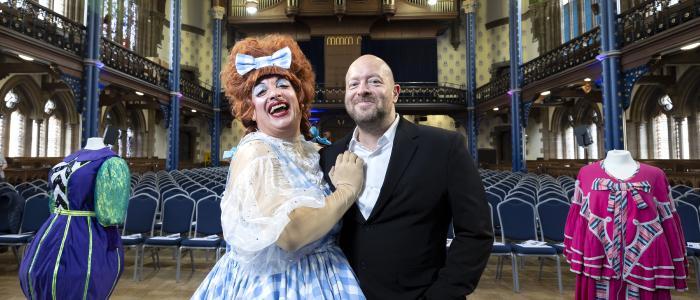
Back on campus – John in the Bute Hall introducing panto dame Johnny McKnight as the speaker of the prestigious Cameron Lecture. The lecture celebrates the life and legacy of UofG Theatre Studies lecturer Dr Alasdair Cameron, who taught John during his time at the University. (Image: Martin Shields)
Memories of Glasgow
I'd never been to Glasgow before I moved here; never been to an open day or anything. I literally turned up on the Friday and started university on the Monday. It was a long way away from Huddersfield, and I wanted to have a proper kind of education away from home.
My first impressions of the arts scene in Glasgow? I was like a kid in a candy store, because I think the first show I saw was Glenda Jackson playing Mother Courage. Pavarotti played the city at that time too. The Tramway was founded, and the Citz (Citizens’ Theatre) was on an absolute high. The council saw a real opportunity in using the arts as a regeneration tool, so it was just incredible.
It was a ritual to go to the Art School every Friday night. We'd meet in the Variety Bar, order drinks, then walk up that very steep hill.
I think I went to the GUU once, and I just thought: not for me. It didn’t admit women until 1980. But I’m sure it’s got better – it’s not so much ‘yard-of-ale' anymore.
I started off studying Biology then switched to Theatre & Classics. My Latin lectures were at nine o'clock, five days a week. 9am – I think I went to two! One of the final exams was translating a Catullus poem from Latin back into English. There were about 32 of them. I decided I'd learn every single poem in English, because that was easier for me – and then the first line in Latin. So when I saw what the poem was in the exam, I was like: “yep, fine, I've got this committed to memory.” And I managed a 2:1!
John will be reprising 'Once' as part of actor Alan Cumming’s first season as artistic director of the Pitlochry Festival Theatre in 2026. After working on the five-hour epic delivered in two parts that was 'Harry Potter and the Cursed Child', John thought that he was "done" with such big blockbuster spectacle projects. But there are now plans afoot to make an even bigger show, which he says are under wraps for now.
This article was first published in January 2026.
Main image: Manuel Harlan
QUICKFIRE
Biggest hero?
My mum. She allowed me and my sister to be exactly who we were.
Greatest achievement?
To still be directing plays, in this awful climate for the arts and theatre.
Biggest regret?
I once sat in front of Beyoncé on an overnight flight and I didn't say hello to her. I just thought, “What am I gonna say ... ‘Hello, you're Beyoncé’?”
Most treasured possession?
My dad, who passed away a few years ago, played for Marsden Silver Prize Brass Band, and I've got his brass band tie, which I treasure.
Most-played artist on your playlist?
Kate Bush.
Greatest extravagance?
Trainers. I'm 54, and I thought at some point I'd have to move into more grown-up footwear, but I've realised, no, they’re all I really care about. Especially Jordans, the Nike high-top ones. I've rationed myself to one pair a year.