

Our brush with cosmic history
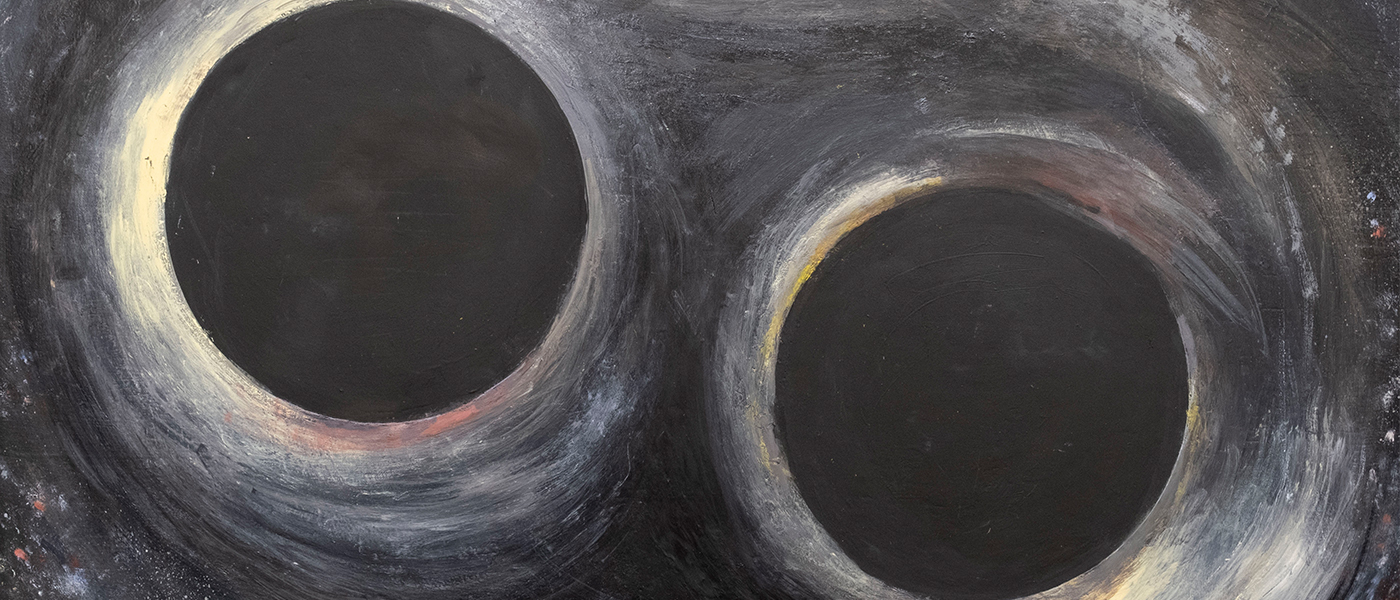 A Scottish artist has donated two new paintings to the University of Glasgow to celebrate the tenth anniversary of the first detection of gravitational waves.
Professor Dugald Cameron created the artworks in recognition of the University’s role in the historic first detection of gravitational waves, made by the USA-based Laser Interferometer Gravitational-Wave Observatory (LIGO) on 14 September 2015.
Professor Cameron, a former director of the Glasgow School of Art who is currently a visiting professor at the University of Strathclyde, has presented the paintings to the University’s Institute for Gravitational Research (IGR).
The paintings, titled ‘Dawn: Window of a New Era in Understanding’, are painted in oils and designed to be displayed as a diptych, with one above the other.
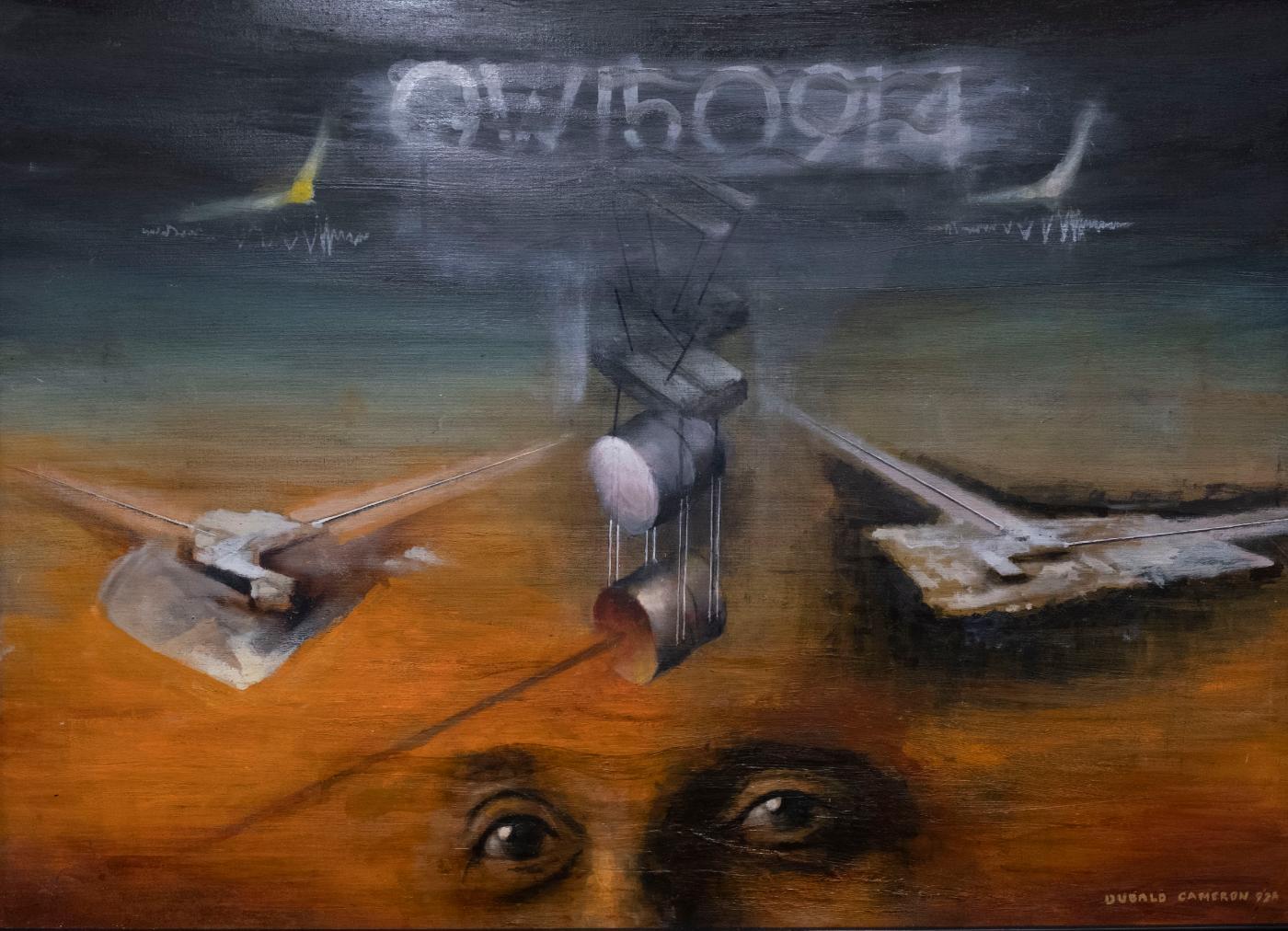
The upper canvas shows two black holes in the final fraction of a second before they merge together, while the lower painting shows the twin LIGO observatories and a visualisation of the historic first gravitational wave signal they detected in 2015.
In the centre of the painting is one of the delicate silica suspension systems that hold the detector's mirrors in place and make the detections possible.
These systems were developed by University of Glasgow researchers in collaboration with colleagues at the Rutherford Appleton Lab, the University of Birmingham and Caltech.
At the bottom of the canvas, Professor Cameron has painted the eyes of Albert Einstein. Einstein first predicted the existence of gravitational waves in his general theory of relativity, published in 1916, but it took nearly a century to build a detector sensitive enough to observe the minute ripples in spacetime caused by massive cosmic events like the collision of black holes.
Professor Sheila Rowan is Director of the IGR: “We’re delighted to be accepting this generous gift from Dugald as part of our ongoing celebration of the tenth anniversary of the first detection. Helping him to understand the science of gravitational waves so that he could accurately capture the science on canvas has given us a new way to think about our research, and it’s fantastic that we’ll be able to display the paintings here in our Kelvin Building on campus.”
Artistic collaboration
Professor Sir James Hough, who has worked on gravitational wave research at Glasgow since 1971 and founded the Institute for Gravitational Research in 2000, was closely involved in the artistic collaboration:
"Ten years on from the first detection of gravitational waves, the LIGO Scientific Collaboration has expanded to include the Virgo detector in Italy and the KAGRA detector in Japan, and we’ve made about 300 detections of gravitational wave signals. My colleagues and I worked closely with Professor Cameron over the course of three months, discussing how the concepts of gravitational waves could be represented in art, and the results do a stunning job of capturing the achievement of thousands of scientists from around the world working together to create the expanding field of gravitational wave astronomy."