Nursing BN
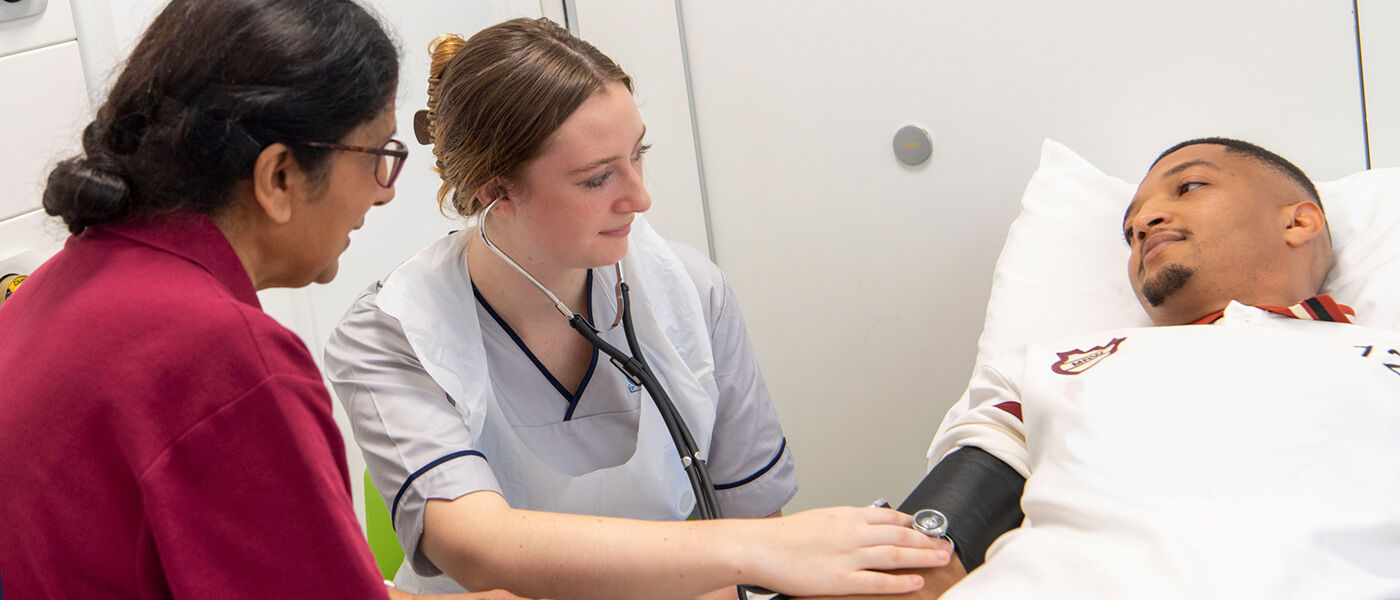
As the largest group within the healthcare workforce, nurses have a pivotal role in providing, leading and coordinating care. Nurses work within the multidisciplinary team, across a range of health and social care environments, supporting service-users to make informed decisions about their holistic healthcare requirements.
The Bachelor of Nursing (Honours) programme is consistently ranked at the top of university league tables: for 2026 Nursing at Glasgow is ranked 1st in the UK for Nursing & Midwifery in the Complete University Guide and 2nd in the UK for Nursing in the The Times and Sunday Times Good University Guide.
- September start
- Session dates
- Nursing BN (Hons): B700 4 year degree
- Glasgow: Gilmorehill campus
- Professionally accredited
Programme structure
The Bachelor of Nursing (Hons) programme is a four-year professional degree. Learning is equally divided between University and practice learning environments.
Year 1
In year 1, you will develop your knowledge and understanding of the professional and wider social context of nursing and health. In addition, you will study a range of sciences, including social sciences, anatomy, physiology, microbiology and biochemistry. You will also develop fundamental care skills and undertake clinical placements in hospital and community settings.
Year 2
In year 2, you will study adult nursing and deepen your knowledge and understanding of biomedical sciences and ethics. Biomedical science subjects include anatomy, physiology, biochemistry, genetics, microbiology, and pharmacology. Your core nursing courses will include the study of nursing theory, social policy, and research methods.
The focus of your study in year 2 is to provide a biological basis for linking health with ill health and disease processes. You will undertake more clinical placements and further develop your communication skills, relationship skills and knowledge of nursing procedures.
Year 3
In year 3, you will advance your study of adult nursing, research for evidence-informed practice, pharmacotherapy and human disease & pathology.
The focus of year 3 is on developing a holistic and integrated approach to the assessment, planning, delivery and evaluation of evidence-informed nursing care and therapeutic interventions for people with a range of health conditions. You will advance your study of clinical skills providing an opportunity to develop your knowledge and skills for holistic person-centred assessment.
Looking forward to your career as a registered nurse, you will learn the skills required to supervise nursing students and to consolidate your learning in relation to communication and relationship skills, preparing you for an array of opportunities on your clinical placements.
Year 4
In year 4, you will advance your study of health and social care policy, leadership, professionalism in nursing and global health challenges.
The focus of year 4 is to advance your understanding of the wider societal, environmental, economic, and political factors that impact on the health of people and populations and the ways in which you can influence healthcare.
You will have the opportunity to investigate an area of interest related to nursing and healthcare through a written dissertation. The final clinical placement is also incorporated into this year.
+++
Programme flow
The programme flow is very carefully planned to ensure that students meet the regulatory requirements. Students must adhere to this programme flow and holidays must only be arranged for the scheduled vacation weeks.
- for guidance: BN Clinical Planner 2024/25
---
+++
Key contacts
Admissions Officer: Dr Kate Hill
---
Programme alteration or discontinuation
The University of Glasgow endeavours to run all programmes as advertised. In exceptional
circumstances, however, the University may withdraw or alter a programme. For more information,
please see: Student contract.
Entry requirements
for entry in 2027
Summary of entry requirements for Nursing
Scottish Higher entry requirements (by end of S6)
- AABBB
- Additional requirements: Two Highers from Chemistry, Biology/Human Biology, Physics, Mathematics. National 5 Mathematics, English at Grade B. Interview.
Scottish Higher adjusted entry requirements* (by end of S5 or S6)
- MD20: BBBB (also other target groups*)
- MD40: AABB*
- Additional requirements: Two Highers from Chemistry, Biology/Human Biology, Physics, Mathematics. National 5 Mathematics, English at Grade B. Interview. Successful completion of Top-Up or one of our Summer Schools.
* See Access Glasgow for eligibility.
A-level standard entry requirements
- ABB – BBB
- Additional requirements: two A-levels from Chemistry, Biology, Physics, Mathematics. GCSE English and Mathematics at Grade B or 5. Interview.
Irish Leaving Certificate
- H2, H2, H2, H3, H3
- Additional requirements: Two Higher Level subjects from Chemistry, Biology, Physics, Mathematics. Plus English and Mathematics at minimum H4/O4. Interview.
IB standard entry requirements
- 34 (6,5,5)
- Additional requirements: Additional requirements: Two HL subjects from Chemistry, Biology, Physics, Mathematics. SL English and Mathematics at 4. Interview.
+++
Alternative routes
We welcome applicants who have/are currently studying at Colleges of Further Education or are existing graduates.
- HNC/HND in Applied Science or similar science based programme
- Additional requirements: Grade B in graded unit. Interview. Successful completion and grades in either Top-Up or Summer School/OPENS.
- HNC Care and Administrative Practice
- Additional requirements: HNC Care and Administrative Practice students will only be considered if candidates also have two Highers, at B grade or above, in science subjects (Maths, Chemistry, Physics, Biology/Human Biology). If Chemistry is not one of the two science Highers, candidates must have this at Nat 5 (grade B) or above. Grade B in graded unit. Interview. Successful completion and grades in either Top-Up or Summer School/OPENS.
- University of Glasgow Access Course (Chemistry & Biology)
- Additional requirements: Interview.
- SWAP Access to Health and Biological Sciences
- Additional requirements: Grade ABB (minimum). Interview. Successful completion and grades in either Top-Up or Summer School/OPENS.
- SWAP Access to Medical Studies
- Additional requirements: Grade ABB (minimum). Interview. Successful completion and grades in either Top-Up or Summer School/OPENS.
- Graduates
- Additional requirements: The degree must include Chemistry or Biology. If not, these must be obtained at high school level (Highers or A Level) within the last 7 years, before applying for admission. A minimum of Grade B is required in both subjects. Interview. Successful completion and grades in either Top-Up or Summer School/OPENS.
---
+++
Important information
Fitness to Practise
Fitness to practise guidance exists for those who wish to become nurses.
Please refer to the Higher Educational Occupational Physicians/Practitioners (HEOPS) website and access the HEOPS Fitness to Practise Standards for Nursing Students 2015 before applying.
The Bachelor of Nursing (Hons) programme requires students to act during their education in a quasi-professional role in relation to service users, therefore the University has a duty to ensure that students are fit to practise. Fitness to practise is assessed not only in terms of academic attainment, but also in accordance with relevant professional expectations. A copy of the Code of Professional Conduct and Fitness to Practise procedures will be available to Bachelor of Nursing (Hons) students on commencement of the programme, thereafter, annually.
Practice placements
During the programme, your placements will be allocated in various locations across the Greater Glasgow area.
Disclosure Scotland: Protection of Vulnerable Groups Scheme
Successful applicants are required to join the Protecting Vulnerable Groups (PVG) scheme provided by Disclosure Scotland on commencement of the Bachelor of Nursing (Hons) programme.
Health check
Offer holders must undergo health screening checks as a condition of entry. On commencement of the Bachelor of Nursing (Hons) programme, you must complete a full course of immunisation against the Hepatitis B virus. The University’s Occupational Health Unit provide Hepatitis B vaccinations. You are required to meet any NHS Scotland vaccination requirements.
Digital & technological literacy
Applicants are required to demonstrate capability in digital and technological literacy necessary to meet programme outcomes.
---
Admissions guidance
English language
For applicants from non-English speaking countries, as defined by the UK Government, the University sets a minimum English Language proficiency level.
English language requirements
International English Language Testing System (IELTS) Academic module (not General Training)
- Overall IELTS score 7.0
- At least 6.5 in the writing domain and at least 7 in the reading, listening, and speaking domains
FAQs
What do I do if...
my language qualifications are below the requirements?
The University's School of Modern Languages and Cultures offers a range of Pre-sessional courses to bring you up to entry level. The course is accredited by BALEAP, the UK professional association for academic English teaching.
my language qualifications are not listed here?
Please contact External Relations
If you require a Tier 4 student visa, your qualification must be one of the secure English language tests accepted by UK Border Agency:
- UK Border Agency Tier 4 English Language requirements
- UKBA list of approved English language tests [pdf]
Visa requirements and proof of English language level
It is a visa requirement to provide information on your level of English based on an internationally recognised and secure English language test. All test reports must be no more than 2 years old. A list of these can be found on the UK Border Agency website. If you have never taken one of these tests before, you can get an initial idea of your level by using the Common European Framework self-assessment grid which gives you a level for each skill (e.g. listening B1/writing B2 etc.) However, please note that this is not a secure English language test and it is not sufficient evidence of your level of English for visa requirements.
Further information about English language: English for Academic Study
Careers and future opportunities
Graduate destinations
Most graduates progress directly into professional roles aligned with their degree and professional qualification.
Job prospects
Graduate Outcomes data shows that:
- 100% of students are in work or further study within 15 months of graduating
- 100% of those in work are in graduate-level employment
- The average professional salary after 15 months is £31,158.
This subject-level data is from HESA Graduate Outcomes survey. It relates to graduates who completed their programme in 2023–24 and were surveyed 15 months after graduation. Includes single and joint honours programmes.
Skills development
As well as building subject specific knowledge and skills throughout your degree, you’ll also develop transferable skills by:
- Communicating with individuals, families and colleagues with clarity, empathy and professionalism across diverse care settings.
- Assessing health needs thoroughly, planning appropriate interventions and evaluating nursing care using evidence‑informed practice.
- Practising ethically and accountably, safeguarding patient dignity, autonomy, confidentiality and consent.
- Delivering safe, person‑centred care by performing essential nursing procedures and responding effectively to changing clinical situations.
- Leading and coordinating nursing care within interdisciplinary teams, contributing to shared decisions and improved outcomes.
Careers & employability support
Our Careers, Employability & Opportunity team are here to support you at every stage of your career journey. They’ll provide you with opportunities to explore your options, connect with employers in the UK and abroad, build your confidence and develop in demand skills.
You’ll have access to a wide range of support and resources that are designed to help you plan and prepare for your future including: masterclasses, 1:1 career coaching, a dedicated jobs board, employer events and much more.
Studying a degree programme in the College of Social Sciences will also give you access to the College Employability Programme. This consists of a suite of professional skills workshops, online modules, skills days and 1-1 appointments. These are designed to help you develop and communicate your key experiences and the transferable skills you need, to succeed in your studies and in your future careers.
Accreditation
The Nursing & Midwifery Council (NMC) recognises this programme for the purpose of registration as an Adult Nurse.
Degrees and UCAS codes
When applying you will need to know the UCAS code for the subject or subject-combination that you wish to apply to:
BN (Hons)

Fees and funding
Tuition fees
How and when you pay tuition fees depends on where you’re from: see Tuition fees for details.
Scholarships
The University is committed to supporting students and rewarding academic excellence. That's why we've invested more than £1m in additional scholarship funding in recent years.
Ann Hart Buchanan Student Scholarship
The University of Glasgow has been the recipient of a bequest from the estate of Mrs Ann Hart Buchanan for the purpose of nurse education and training.
It is proposed that a scholarship should be endowed to benefit a nursing student(s) on the BN (Hons) programme or student/nurse accepted for a postgraduate course of study in the Nursing & Health Care School at the University of Glasgow.
This scholarship will be awarded annually for the purposes of:
- Travel in connection with study or research that will enhance the student’s learning and learning experience (undergraduate or postgraduate)
- Supporting tuition fees for a graduate with BN (Hons) [1st or 2:1] to undertake a postgraduate course of study in the Nursing & Health Care School at the University of Glasgow within 2 years of graduation
- Support undergraduate student(s) with a minimum of one-third of the funds in any three-year period ie allocating £600 to an undergraduate student(s) within each 3 year period.
The Adi and Isca Wittenberg Scholarship
In 2025, one person will be supported with a Wittenberg Scholarship to study for a first degree or equivalent professional qualification. The Scholarship will focus on mental health related degree courses such as mental health nursing, psychology, or social work.
The scholarship will pay home tuition fees* and associated study costs. The specific amount awarded will be dependent on the candidate’s individual circumstances and university location.
*The Trust will help candidates who are successful at interview to negotiate home fees from their chosen university. The final award of a Wittenberg Scholarship will be dependent on successfully getting a ‘home’ tuition fee offer.
Please click here for more information: The Adi and Isca Wittenberg Scholarship
World Changers Glasgow Scholarship UG (EU)
The University of Glasgow continues to be committed to ensuring a strong relationship with our existing and future EU students, and supporting EU talent to make their home at the University of Glasgow.
We appreciate the challenging financial implications that have arisen for our European applicants, and are therefore delighted to offer the World Changers Glasgow Scholarship UG (EU) to new incoming EU students starting an undergraduate programme for Academic Session 2027-28. The scholarship is awarded as a tuition fee discount of £5,000 for every year of study and is subject to satisfactory progress for consecutive years of study. This discount cannot be combined with another University scholarship.
World Changers Global Excellence Scholarship
The University of Glasgow has a number of World Changers Global Excellence Scholarships available to new International and EU Undergraduate students for 2027 entry.
The scholarship is awarded as an annual tuition fee discount, based on the academic college of your chosen degree:
- £10,000 per year of study for students in:
- College of Medical, Veterinary & Life Sciences
- College of Science and Engineering
- £7,000 per year of study for students in:
- College of Arts
- College of Social Sciences
Scholarships are renewable each year, subject to satisfactory academic progress.
James McCune Smith Undergraduate Scholarship
The University of Glasgow has up to 30 undergraduate scholarships available for students of African/African-Caribbean backgrounds. The scholarship supports students who could face financial difficulties taking up their place to study at the university. The value of the scholarship is £4,000, paid in instalments for year one of undergraduate study. The scholarship is open to new applicants to the university for 2027 entry. Current students who have previously been in receipt of the award may reapply, however, preference will be given to applicants entering their first year of study.
Care Experienced and Estranged Student Bursary
The University of Glasgow is offering five bursaries specifically for Care Experienced and Estranged Students. These bursaries aim to support students who have been in care or are living independently due to family estrangement. Definitions of these terms are provided below, and further details are available here.
Care Experienced
"Care-experienced" refers to anyone who has ever been in care, regardless of the duration. This includes individuals who have been in the care of a local authority at any stage, whether through residential care, foster care, kinship care, or under a supervision requirement at home. This category also includes those who have been adopted from care.
Estranged
Estranged students are young people studying independently without family support due to a breakdown in family relationships. These students often have limited or no contact with their families, and any contact that does occur is usually infrequent or strained. Causes of estrangement may include emotional or physical abuse, conflicting family expectations, personality clashes, or differing values.
Each bursary is typically valued at £1,500 per year for each consecutive year of the degree programme.
Undergraduate Talent Scholarships
The University of Glasgow is awarding c.50 undergraduate Talent Scholarships to support students who could face financial difficulties in taking up their place to study at the University for 2027 entry. The value of each scholarship is typically £1,500 p.a. for each year of the degree programme, subject to satisfactory progress. Talent Scholarships are available to students entering any of the University's Colleges.
Dental School students are eligible for a Talent Scholarship in their first year of study only. They are eligible for the NHS Dental Student Support Grant in the following years.
Please note:
As part of this application form you will be asked to include 2 personal statements:
1. A statement detailing your motivation and commitment to education
and
2. A statement detailing financial and family circumstances which would make it difficult to take up your place at university without a talent scholarship
We recommend that you compose and save your statements separately before commencing your application form. You can then copy and paste your statements into the relevant section of the form.
You will be asked to provide financial information, such as household income information.
PLEASE NOTE: As the applicant, it is your responsibility to upload relevant supporting evidence, as requested through the application form.
Unfortunately, applications cannot and will not be considered without the required supporting evidence.
Cowrie Foundation Scholarship
The University of Glasgow and The Cowrie Scholarship Foundation (CSF) will offer a scholarship to support Black African and Caribbean heritage applicants from socio-economically challenged backgrounds. Applicants must be ordinarily resident in the UK and commencing an undergraduate study programme.
The Cowrie Scholarship Foundation wants to fund 100 Black British students through UK universities in the next decade.
The Education Matters Talent Scholarship
Education Matters is a charity dedicated to promoting and advancing education for individuals in the UK facing obstacles in accessing educational opportunities.
Thanks to the generous support of Education Matters, the University of Glasgow is pleased to offer two enhanced Talent Scholarships (£8,000 per annum for the duration of the awardee’s degree) for students commencing their studies in the 2027/28 academic year.
By clicking this link, you will be directed to apply for the Undergraduate Talent Scholarship. There is no seperate application form for the Education Matters Undergraduate Scholarship. The University will review all applications and use them to identify a pool of candidates who maybe eligible for the Education Matters Talent Scholarship.
If you are selected, you will be contacted separately and invited to attend an interview for the Education Matters Talent Scholarship. The date for these interviews has not yet been confirmed.
Please note:
As part of this application form you will be asked to include 2 personal statements:
1. A statement detailing your motivation and commitment to education
and
2. A statement detailing financial and family circumstances which would make it difficult to take up your place at university without a talent scholarship
We recommend that you compose and save your statements separately before commencing your application form. You can then copy and paste your statements into the relevant section of the form.
You will be asked to provide financial information, such as household income information.
PLEASE NOTE: As the applicant, it is your responsibility to upload relevant supporting evidence, as requested through the application form.
Unfortunately, applications cannot and will not be considered without the required supporting evidence.
Travel Bursaries
The University of Glasgow is offering travel bursaries to assist with public transport travel costs, to support undergraduate students who could face financial difficulties in taking up their place to study at the University for 2026 entry. The value of the bursary is 50% of your monthly public transport travel costs to get to University, up to a maximum value of £50 per month. Continuing students previously in receipt of the bursary can apply, however, preference will be given to new entrants.
The Scottish Government’s Young Persons’ Free Bus Travel scheme gives free bus travel to young people under 22 years of age. Please note that if you are under 22 years of age and can reasonably travel to Campus by bus, you will not be considered for the travel bursary.
GyanDhan Scholarship
The GyanDhan Scholarship 2026 is a test-based program for students across the globe, reflecting GyanDhan’s commitment to rewarding talent fairly. Open to students at both undergraduate and postgraduate levels, it supports higher studies in India and abroad, ensuring that ambition isn’t limited by past academic scores.
Sanctuary Scholarships
The University of Glasgow Sanctuary Scholarship has been created to support applicants with Refugee or Asylum Seeker status who are currently living in the UK and hold an offer to study with us in the 2027/28 academic year. The scholarship is open to prospective undergraduate and postgraduate taught students at the University of Glasgow applying for entry in September 2027/28. Please note that you must have applied to the University before submitting an application for this scholarship.
The scholarship will meet the cost of tuition fees for the duration of your programme, for applicants who are unable to access mainstream funding through Student Awards Agency Scotland (SAAS) or Student Finance. The Sanctuary Scholarship also provides a £5,000 per year stipend, to assist with study costs.
This scholarship is not available to PGdip, PDGE or part time programmes.
Undergraduate students with refugee status (or equivalent) and access to funding, are eligible to apply for the scholarship and would receive the £5,000 stipend towards study costs only, if successful.
Postgraduate Taught Masters students with refugee status (or equivalent) and access to funding, are eligible to apply for the scholarship and would receive the £5,000 stipend towards study costs and a partial tuition fee waiver, to cover any shortfall not met by your Postgraduate Masters tuition fee loan.
The Clan Gregor Society Prize
The Clan Gregor Society is offering an award incoming students to the University of Glasgow who descend from Clan Gregor. Students will be asked to submit an application highlighting areas of consideration such as academic excellence and financial need. The award is open to both Undergraduate and Postgraduate applicants who are joining us for 2025/26 entry.
The Dima Alhaj Scholarship
The Dima Alhaj Scholarship was set up in 2024 in memory of a University of Glasgow alumna. After graduating, Dima worked in Gaza with the World Health Organization as a patient administrator at the limb reconstruction centre, as part of the trauma and emergency team and was tragically killed in Gaza in November 2023.
The University is offering the Dima Alhaj Scholarship to 1 undergraduate applicant and 1 postgraduate taught applicant joining us in September 2027. Please note that you must have a programme application in progress before applying for this scholarship. If you have not yet started a programme application, please submit this first and then return to complete the scholarship application process.
This scholarship is not available to PhD, PGdip, PDGE or part time programmes.
This scholarship can not be combined with any other University of Glasgow scholarship. In the event you are offered 2 scholarships, the lower value scholarship will be removed from your student account.
Travel Bursary for Forced Migrants
The University of Glasgow is offering travel bursaries to assist with public transport travel costs, to support undergraduate and postgraduate students are currently asylum seekers and who could face financial difficulties in taking up their place to study at the University for 2027 entry. The value of the bursary is 50% of your monthly public transport travel costs to get to University, up to a maximum value of £50 per month.
Glasgow Highland Society Scholarship
The University of Glasgow is excited to promote this scholarship opportunity on behalf of the Glasgow Highland Society.
The Glasgow Highland Society is offering multiple grants of up to £500 for new and continuing students of Glasgow university who fit the eligibility requirements of the scholarship
The scholarships above are relevant to this programme. For more funding opportunities search the scholarships database
How to apply
Full-time students must apply through the Universities & Colleges Admissions Service (UCAS).
SQA applicants who are eligible for our Widening Participation programmes are encouraged to participate in one or more of these programmes, including Summer School, to support your application and the transition to higher education.
International students to Arts, Engineering, Law, Nursing, Science, and Social Sciences can also apply using The Common Application: however, if applying to more than one UK university, we recommend using UCAS. Applications to Dentistry, Education, Medicine, and Veterinary Medicine must be made through UCAS.
Application deadlines
- 15 October: if including Dentistry, Medicine, Veterinary Medicine or also applying to Oxford or Cambridge
- 13 January: all other UK applicants (unless otherwise stated on the UCAS website)
- 30 June: international students.
We do not usually accept any applications after these deadlines.
It's your responsibility to ensure the accuracy of your application before submission. Requests to correct application content, change degree programme or change college of entry, will not be accepted after these deadlines. This policy is in place to ensure fairness and consistency to all applicants, and no exceptions will be made.
- Apply at www.ucas.com or through your school or college
- Contact UCAS on 0871 468 0468
- Apply at commonapp.org (international students to certain areas only)
Subject league tables

Times & Sunday Times Good University Guide [Nursing]

Guardian University Guide [General Nursing]

Complete University Guide [Nursing]

QS World University Rankings [Nursing]