

Undergraduate degree programmes
Undergraduate degree programmes
- Marine & Freshwater Biology [BSc/MSci]
- Veterinary Biosciences [BSc/MSci]
- Veterinary Medicine & Surgery [BVMS]
- Zoology [BSc/MSci]
Admissions Guide to Veterinary Medicine & Surgery (BVMS)
Veterinary Medicine Admissions:
Please select from the categories below for more information:
BVMS International Entry Requirements
BVMS Criminal Conviction Policy
BVMS Procedures for Fitness to Practise
Admissions enquiries:
Student Recruitment Marketing and Admissions Team
McCall Building
School of Veterinary Medicine
University of Glasgow
G61 1QH
email: vet-admissions@glasgow.ac.uk
University of Glasgow Exploration Society (ExSoc)
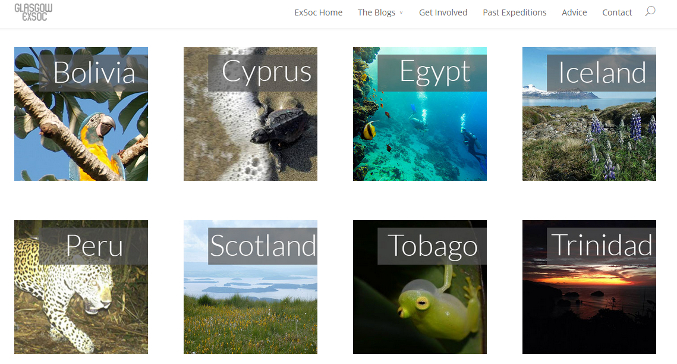
The University is also unique in having an historic Exploration Society (ExSoc), which has been helping teams of undergraduate students explore the world on zoological and geographical expeditions for many years. The earliest record of a student expedition is 1920, and over the past 90 years hundreds of students have had the chance to undertake research in the field. Officially founded in 1957, the Glasgow University Exploration Society has been promoting exploration and scientific fieldwork by members of the University, both students and staff, by sending expeditions abroad in the summer vacation.
Read the expedition blogs for more information about the research taking place.
BVMS Curriculum Transformation
The University of Glasgow's Veterinary Medical Curriculum is transforming. Keep up-to-date and find out how to get involved.
Impetus for change
- We have a mandatory 7-year cycle for curriculum review
- We recognise that the profession changes continually
- There has been evolution of veterinary educational practice.
- Students are looking for different things in their education.
Timeline
- The current curriculum review began in December 2025
- We will develop the structure of the new curriculum for approval in Jan 2027-28.
- We will run the new BVMS1 courses starting in Sept 2028
- We will run the new BVMS2 courses starting in Sept 2029
- We will run the new BVMS3 courses starting in Sept 2030
- We will run the new BVMS4 courses starting in Sept 2031
Our mission – what we strive for:
Building on our heritage to develop unique Glasgow graduates who are more than clinicians: scientifically driven, socially accountable and resilient professionals equipped to advance human, animal and planetary health through community, collaboration, critical thinking, and lifelong learning.
Meet the team
Curriculum Transformation Leads
- Prof Neil Evans - Director of Education (Veterinary)
- Prof Jennifer Hammond – BVMS programme leader
- Dr Alison Reid - Lecturer in Curriculum and Outcomes Assessment
Curriculum Transformation Coordinator
- Aidan Simpson
Curriculum Transformation Steering Committee
- Prof Neil Evans - Director of Education (Veterinary)
- Prof Jennifer Hammond – BVMS programme leader
- Dr Alison Reid - Lecturer in Curriculum and Outcomes Assessment
- Prof Pamela Murison - Professor in Veterinary anaesthesia
- Dr Rheinallt Jones - Lecturer in Animal Nutrition
- Gemma Masterton - Lecturer in Small Animal Clinical Skills
- Anita Guo - Clinician in Small Animal Hospital
- Mary Fraser - Online Distance Learner (ODL) Lecturer
- Lisanne Fulton - BVMS student
- Jodie Brogan – BVMS student
- Lorna Chambers -Lecturer
- Niall Connell - BVMS Portfolio Assessors
- Joel Hotchkiss - Senior Academic Clinician
- Ellie Wigham - Senior Lecturer in Veterinary Public Health
- Martin Tomlinson - Veterinary Academic Clinician in Disease Investigation
- Dr Maria Afonso - Lecturer in Anatomy and Diagnostic Imaging
Curriculum working groups
Four curriculum working groups will be established in June 2026
- Organisation and structure
- Assessment and progression strategy
- Clinical education and training model
- Faculty development, evaluation & scholarship
Curriculum Scoping groups
Four curriculum Scoping groups will be established in June 2026
- Digital and data fluency
- Flexible pathways
- Sustainability (Environmental and economic)
- EDI and cultural capability
Strategic Pillars for curriculum renewal
- Educating the whole veterinary professional
- One Health and societal impact
- Student-centred, inclusive learning community
- Integrated, flexible and future-focused
- Developing global leaders within veterinary sciences
Curriculum Design Process
We are using a pedagogically evidence-based framework created by the University of Glasgow to guide us through the process of Curriculum Transformation. This includes the following steps:
- Define Aims
- Determine Intended Learning Outcomes (ILOs)
- Determine Assessments
- Determine Teaching methods
FAQs
Will the curriculum still spiral?
Yes, the new curriculum is designed to be spiral, and topics will be covered a number of times at greater depth as students progress through the curriculum.
Will the teaching methods change?
The learning activities on the renewed curriculum will be developed to enable students to meet the new ILOs, with a focus on evidence-based practical, applied and interactive learning. Students on the renewed curriculum will have enhanced opportunities to pursue areas of interest and develop their individual professional identity.
What will happen to clinical rotations/BVMS5?
Clinical rotations will be a cornerstone of the programme, with a mix of core and selective opportunities. The new curriculum aims to provide a comprehensive and flexible final phase, with clinical experience built in earlier within the programme.