ORBITAL ANGULAR MOMENTUM (OAM)
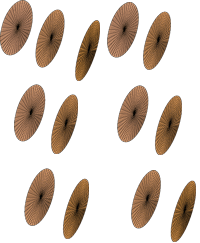
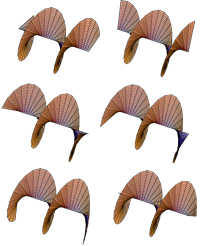
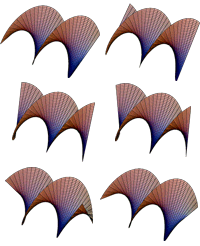
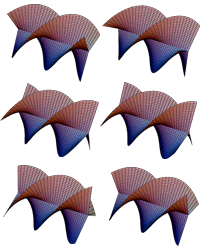
The phase fronts of light beams in orbital angular momentum (OAM) eigenstates rotate, clockwise for positive OAM values, anti-clockwise for negative values. The phase front with 0 OAM doesn't rotate at all.
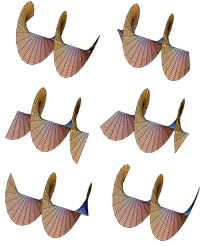
OAM = -1 hbar per photon (right-hand helical phase front)
OAM = 0 (plane wave)
OAM = +1 hbar per photon (left-hand helix)
OAM = +2 hbar per photon (two-fold helix)
OAM = +3 hbar per photon (three-fold helix: fusilli)
Orbital momentum of light
ORBITAL ANGULAR MOMENTUM OF LIGHT
In 1992 it was found theoretically by L. Allen et al. that Laguerre-Gaussian light beams possess an orbital angular momentum (OAM) of l hbar (i.e. l h/ (2 pi)) per photon, where l is the so-called azimuthal index of the beam (L. Allen, M. W. Beijersbergen, R. J. C. Spreeuw, and J. P. Woerdman, Orbital angular momentum of light and the transformation of Laguerre-Gaussian modes, Phys. Rev. A 45, 8185-8189 (1992)). These beams are examples of light beams with an intensity structure that is symmetric about the beam's axis and a phase structure of l intertwined phase fronts (see figure to the right) - the quantum-mechanical eigenfunctions of the OAM operator Lz = i hbar d/d phi. Since then, several groups, including our own, have demonstrated the mechanical effects of the OAM in that such beams: when microscopic particles absorb such light, they begin to rotate (conservation of angular momentum). Specifically, this has been demonstrated very elegantly in Optical Tweezers, where the same light beam traps ('tweezes') the particle, resulting in a microscopic tool that can not only hold microscopic particles still and translate them in the x, y, and z direction (this is what Optical Tweezers do), but also rotate them about the beam's axis.
CONSERVATION OF ANGULAR MOMENTUM
Angular momentum can never be 'created', only exchanged (just like energy and momentum). Take, for example, the absorption of a photon by a microscopic particle: the photon's angular momentum is transferred to the particle, which starts spinning (provided friction can be overcome). This conservation of angular momentum is a direct consequence of the isotropy of space, i.e. the fact that empty space 'looks the same' in all directions.
QUANTUM NATURE
Although the OAM was always measured 'per photon', there was always some doubt whether it really is a property associated with individual photons. (In the paper by Allen et al. it originally 'popped' out of a semi-classical calculation.) An experiment performed in 2001 by Alois Mair and colleagues in Anton Zeilinger's group (A. Mair, A. Vaziri, G. Weihs, and A. Zeilinger, Entanglement of the orbital angular momentum states of photons, Nature 412, 313-316 (2001)) answered this question by performing a fundamentally quantum-mechanical experiment with photons with OAM (Mair et al. were able to show that the orbital angular momenta of a pair of photons generated in parametric down-conversion are entangled; it doesn't get much more quantum than that!). For their experiment Mair et al. had to be able to detect photons with one particular value of the OAM. This was done with holograms which 'flattened' the phase fronts of photons with one chosen value of the OAM, allowing these photons to be focussed through a pin hole and detected. This procedure is a beautifully simple way to detect photons in one particular OAM stateâ albeit with limited efficiency: quite a few photons are not detected although they should be.
ANGULAR MOMENTUM AND ROTATIONS
Mechanical effect of angular momentum: makes things rotate
Conservation of angular momentum due to isotropy of space, i.e. its invariance under rotations
Quantum-mechanical eigenstates of angular momentum operators change phase under rotations but look the same otherwise
POTENTIAL FOR QUANTUM COMMUNICATIONS
Shortly afterwards it was proposed by Gabriel Molina-Terriza and co-workers at the University of Barcelona that OAM could be used to encode information in much the same way in which spin angular momentum can be used in quantum cryptography to encode information in the form of polarisation (left- and right-hand circular polarisation are the quantum-mechanical spin eigenstates with respective spins of -hbar and +hbar per photon) (Gabriel Molina-Terriza, Juan P. Torres, and Lluis Torner, Management of the Angular Momentum of Light: Preparation of Photons in Multidimensional Vector State of Angular Momentum, Phys. Rev. Lett. 88, 013601 (2002)). But OAM has a big advantage: whereas a single photon has only 2 distinct spin states, it has in principle infinitely many distinct OAM states. Information can be encoded either way (or as different colours), or in both ways simultaneously, thereby multiplying the number of distinguishable states. In principle, a single photon can in this way carry an arbitrarily large amount of information. The only trouble was that no method had been found that could distinguish all these OAM states with good efficiency.