

Professor Neil Metcalfe - Research Interests
Professor Neil Metcalfe - Research Interests
 Room 427, Graham Kerr Building
Institute of Biodiversity, Animal Health & Comparative Medicine
College of Medical, Veterinary & Life Sciences
University of Glasgow
Glasgow
G12 8QQ
Tel.: 0141 330 5968
Fax: 0141 330 5971
E-mail: Neil.Metcalfe@glasgow.ac.uk
Behavioural ecology, physiological ecology and life-history strategies
Behavioural ecology, physiological ecology and life-history strategies
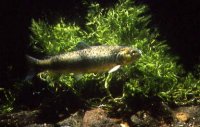 I am interested in the relationships between individual differences in behaviour or physiology and subsequent life-history patterns, and have investigated these mainly using experimental studies of fish populations. For instance, we found that small differences in the dominance status and competitive ability of very young salmon can have major consequences: more dominant fish grow faster, and are therefore likely to metamorphose and complete the life-cycle a year ahead of subordinate siblings. This is related to their physiology: we have shown that dominance in fry is linked to standard metabolic rate, and have been investigating this further by looking at the causes and consequences of variation in metabolic rate. In collaboration with John Armstrong of the Marine Scotland Freshwater Lab at Pitlochry we have looked at the effects of intraspecific variation in metabolic rate on digestive strategies and efficiency, and together with Ton Groothuis at the University of Groningen (Holland) have tested whether maternal hormones influence the metabolic rate of offspring.
We are now examining how variation in metabolic rate arises, how stable it is within individuals, and what are the costs and benefits of a high or low standard metabolic rate under different ecological conditions. This work is now being greatly extended by the recent award of a 5 year European Research Council (ERC) Advanced Grant that is exploring how variation in metabolic phenotypes is maintained as a result of context-dependent selection. The work is being carried out on brown trout and three-spined sticklebacks. The project is employing Sonya Auer, Karine Salin, Graeme Anderson and Eugenia Martin, and is involving experimental manipulations at every level from cells to populations. It involves collaborations with Colin Selman (in the component of the work examining variation in mitochondrial respiration), Richard Hartley (in measurements of ROS production in vivo), and Ian McCarthy and Simon Lamarre (Bangor University and University of Moncton, Canada, in work on protein synthesis).
In a separate line of research, I have been interested in exploring the role of oxidative stress in mediating life histories. In collaboration with Tom Pike, Jan Lindstrom and Jon Blount, I have been investigating how sticklebacks use carotenoids to advertise their health and viability, and how they trade off using carotenoids for signalling versus protecting against oxidative stress. I am now looking further at the role of antioxidants and oxidative stress in influencing fish life histories. Collaborative work with and Pat Monaghan is investigating how antioxidants influence life history decisions in zebra finches.
Current work is also examining the influence of maternal effects in determining offspring viability. The research is focusing on populations of both salmon and three-spined sticklebacks, and is testing whether variation in the early growth or current condition of adult spawning fish influences the viability of the offspring. The salmon work has been in collaboration with John Armstrong and Simon McKelvey (Cromarty Firth District Salmon Fishery Board), and the stickleback work with Kath Sloman (University of the West of Scotland). We are also testing whether parental condition in salmon influences the pattern of telomere attrition, levels of oxidative damage and rate of senescence, in collaboration with Pat Monaghan who has a related research group examining telomere dynamics.
Our work is carried out with fish in laboratory, natural or semi-natural conditions (e.g. using stream tanks such as at the - these allow us to observe the territorial behaviour of fish in a natural environment over which we have complete control, since we can alter water velocity and depth, food supply, fish density, bottom topography etc). We also use the extensive fish-holding facilities in the Graham Kerr Building on campus.
Effects of early growth trajectories on adult phenotypes
Effects of early growth trajectories on adult phenotypes
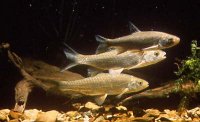 I am interested in the ecological factors that influence growth patterns (in particular the long-term effects of different growth trajectories). Many species of animal are capable of periods of accelerated growth (in particular after a period of poor nutrition - when conditions improve, they show 'catch up' growth and so compensate for the earlier deficit). However, there is increasing evidence that this rapid growth carries long term costs, in terms of future viability and survival. We are therefore exploring the consequences of changes in early nutrition (and hence growth rates) in a variety of species, looking both at the whole organism and at the cellular/molecular level.
Work on zebra finches (in collaboration with Pat Monaghan) has explored the effects of early diet quality on adult phenotype, metabolic rate, antioxidant status and rates of senescence, measured at both the cellular (e.g. telomere length) and whole organism level (e.g. flight performance).
 Experiments on green swordtails and sticklebacks (in collaboration with Jan Lindström and Pat Monaghan) have looked at effects of early growth rate on the behaviour of adult males and females, testing whether early nutrition affects future swimming performance, attractiveness to mates, dominance, fecundity, oxidative stress and lifespan. My group (in collaboration with Pat Monaghan) has also looked at the effect of decelerating (slow-down) growth trajectories as well as accelerating (catch-up) growth, and shown that while catch-up growth results in many and diverse costs in later life, slow-down growth is beneficial. These experiments are combined with theoretical modelling of life history decisions, and are now being extended in a new project on sticklebacks with Bart Adriaenssens and Eugenia Martin that is examining the cellular basis for long term effects including those in the next generation.
Current researchers working with me
Current researchers working with me
- (NERC postdoc): Why is fast growth costly, and what are the consequences for offspring viability?
- Mr Graeme Anderson (ERC research technician): The ecology of metabolic phenotypes: from cells to populations
- Dr Sonya K. Auer (ERC postdoc): The ecology of metabolic phenotypes: from cells to populations
- Dr Joseph Humble (NERC technician): The predictability and limits of evolution in response to increased temperature: insights from a natural 'experiment'
- Ms Eugena Martin (ERC/NERC research technician) The ecology of metabolic phenotypes: from cells to populations/ Why is fast growth costly, and what are the consequences for offspring viability?
- Dr Tommy Norin (Danish Council for Independent Research Fellowship): The influence of metabolic rate plasticity on animal behaviour and performance in a changing environment
- Dr Natalie Pilakouta (NERC postdoc): The predictability and limits of evolution in response to increased temperature: insights from a natural 'experiment'
- (ERC postdoc): The ecology of metabolic phenotypes: from cells to populations
- Dr Antoine Stier (Marie Sklodowska-Curie Fellowship) An avian model for understanding and preventing the negative effects of poor developmental conditions on subsequent health state, fertility and ageing rate
Current PhD students working with me
- Eleanor Lindsay 2016 - A synthetic salmonid intestine to test whether gut microbiota underlie variation in Atlantic salmon metabolic efficiency (MVLS-EPSRC funded studentship; jointly supervised by M.Llewellyn, U.Ijaz and W.Sloan)
- 2012- Do environmental conditions influence the viability of wild salmon through effects on oxidative and telomere dynamics? (NERC-funded CASE studentship, jointly supervised by P. Monaghan, W. Boner and J.D. Armstrong (Marine Scotland Pitlochry Laboratory)
- Agnieszka Magierecka 2015- Transgenerational effects of chronic environmental stress (FSBI funded studentship, jointly supervised by K.A. Sloman (University of the West of Scotland))
- Joshua Moatt 2013- The within individual and cross-generational effects of dietary restriction on rates of aging (BBSRC-funded studentship based in Edinburgh University, jointly supervised by C. Walling and D. Nussey)