


Quantum Optospintronics
Research
We explore the interplay of spin and light in molecules with key themes of quantum sensing, quantum information science, and optoelectronics.
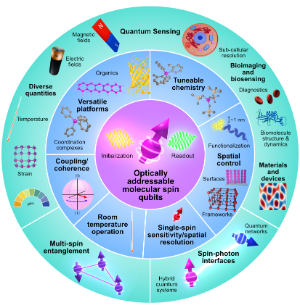
Quantum sensing with optically addressable spins
Spin-based quantum sensors exploit optical detection of spin states to measure magnetic fields and other physical quantities—such as temperature and strain—with exceptional sensitivity and spatial resolution, down to the single-molecule level. Spins in molecular systems are particularly attractive as quantum sensors: they open unprecedented target proximity through their ~1 nm size; afford attachment to desired locations through chemical techniques; enable the coupling to sensing fields to be engineered; and they can be tuned atom-by-atom. We explore molecular spins as sensitive probes of a range of physical quantities, with applications ranging from quantum bio-sensing to nanoscale magnetic resonance.
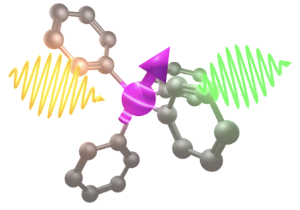
Molecular optical-spin interfaces
We are interested in coherent dynamics, entanglement generation, and optical interfaces of electronic and nuclear spins, and how the unique architectures available through bottom-up assembly can be harnessed for quantum information science. Deploying techniques ranging from cryogenic optical microscopy to electron spin resonance, we explore how to prepare, control, and harness molecular optically interfaced spins, and work with synthetic chemists to develop tailored functionality. We explore ground-state spins in inorganic co-ordination complexes, as well as photoexcited and ground-state spins in organic molecules.

Spin-based probes of optoelectronic materials
Molecular materials provide unique photophysical phenomena that can be used to enhance a range of applications including solar-energy harvesting, photocatalysis, light-emitting diodes, and bio-sensors. Spin-dependent dynamics play a central role in these systems, ultimately determining device performance. We use spin-sensitive techniques as a window into these systems, allowing us to unravel the microscopic phenomena underpinning next-generation optoelectronic materials and devices and therefore how they can be improved.