Textile Conservation MPhil

Textile Conservation is a multidisciplinary subject which combines academic knowledge with cultural awareness, aesthetic sensitivity and technical skill. This MPhil is both an academic programme and professional training; it will give you a framework of theoretical knowledge and a range of practical experience which will enable you to contribute to the understanding and preservation of culturally significant textile artefacts.
- Academic contact: karen.thompson@glasgow.ac.uk or
sarah.foskett@glasgow.ac.uk - Teaching start: September
- Glasgow: Gilmorehill campus
- MPhil: 24 months full-time; 48 months part‑time
Why this programme
 https://www.youtube.com/watch?v=oPkjLQXqiV0
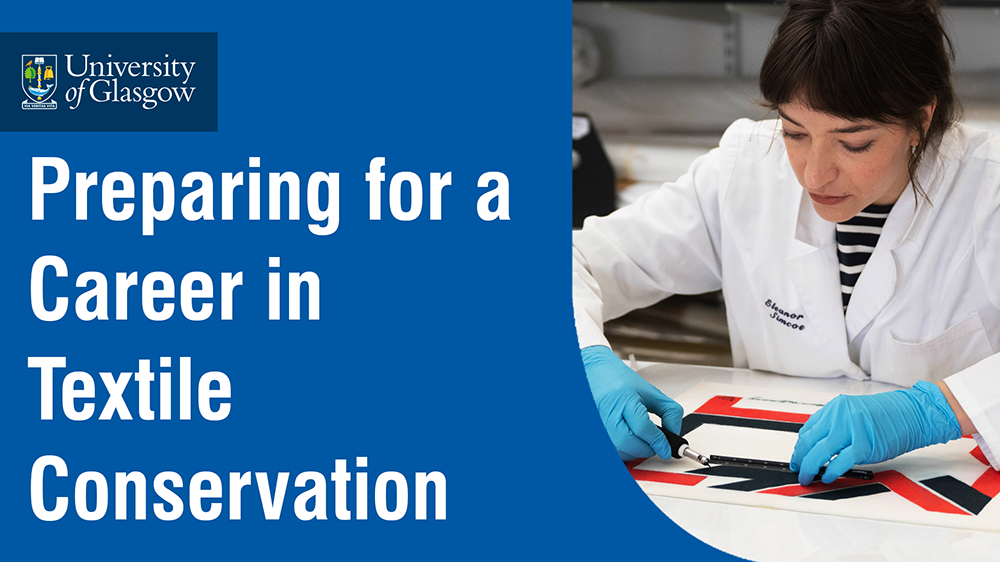
- This is the only programme of its kind in the UK, and one of only a few specialist textile conservation programmes in the world.
- You will be based in our specialist conservation laboratories.
- You will benefit from our close links with Glasgow Museums, as well as the University’s own Hunterian Museum. Glasgow’s civic and university collections are some of the richest and most diverse in Europe and are of international standing. You will have the opportunity to draw on the museums’ rich and varied textile collections.
- You will be taught by visiting specialists from local and national museums in Scotland and the wider UK.
- You will take part in a project-based work placement, where you can explore a possible future career while meeting professional practitioners and developing your skills and experience.
Programme structure
The students develop a wide breath of academic, practical and professional skills. You will take core courses over two semesters in each year, with a work placement in the summer between the first and second years. You will write up your dissertation over the second summer and submit it at the end of August.
Year 1
Core Courses
- Ethics in Textile Conservation Practice
- Principles And Practice: Core Skills
- Material Cultures
- Principles And Practice: Developing Skills
- Preventive Conservation
- Understanding Textiles: Technology
Summer Placement
Year 2
Core Courses
- Principles And Practice: Advanced Skills
- Deconstructing the Artefact
- Principles And Practice: Conservation Projects
- Research Management
Summer Dissertation
Programme alteration or discontinuation
The University of Glasgow endeavours
to run all programmes as advertised. In exceptional circumstances, however, the University may withdraw
or alter a programme. For more information, please see: Student contract.
Career prospects
The great majority of graduates of this programme and of its predecessor, the Textile Conservation Centre’s MA Textile Conservation programme, now work in museums and other institutions. Graduates of the two programmes have an outstanding record of employment on graduation and of remaining in the sector. They now work in nearly 40 countries and are in senior positions worldwide. Our graduates have worked in museums and conservation institutions from San Francisco to Singapore and from Auckland, New Zealand, to Alaska.
Many of our graduates have been awarded fellowships and internships in the UK, USA, Canada and Europe including Historic Royal Palaces, The National Museum of the American Indian at the Smithsonian, and the Abegg-Stiftung. In many cases these one-year internships, or short contracts, have resulted in graduates being permanently employed in their host institutions, such as the British Museum, National Museum Scotland. and Historic Royal Palaces.
However, it is worth noting that many graduates initially go on to short-term contract posts. It is easier to find employment as a textile conservator if you are able to be flexible in terms of location.
Fees & funding
Tuition fees for 2026-27
MPhil
Home & RUK
- Full-time fee: £15,500
International & EU
- Full-time fee: £29,355
UK part-time fee: £1722 per 20 credits
This programme is a two year programme. The fee stated is for one year of study. Students will be charged the same fee in each of the two years.
Fee status
Deposits
International and EU applicants are required to pay a deposit of £2,000 when an offer is made.
Deposits: terms & conditions
The following guidelines will apply in determining whether a deposit will be refunded. Where the deposit is refunded, a 25% administration fee will be deducted unless otherwise stated.
a: Deposits WILL be refunded to applicants under the following circumstances:
- Where the University is unable to offer you a place on the programme as specified on the offer. A full refund will be issued in this case.
- Death of a close family member (parent/guardian, grandparent, sibling, spouse, child/dependent). Official evidence (signed and stamped) must be provided.
- SERIOUS ill health of the applicant or a close family member (parent/guardian, grandparent, sibling, spouse, child/dependent). Official evidence (signed and stamped) must be provided.
- Applicant does not meet conditions of offer. This may be academic or language test requirements. Satisfactory evidence must be uploaded to the student’s applicant self-service to prove that they have not met the conditions of their offer (note that applicants who do not meet the language condition of their offer must show reasonable attempt to meet this, i.e. they must provide at least two language tests which were taken after the date the deposit was paid).
- Visa / ATAS refusal: we will only consider a refund if the visa / ATAS refusal was based on matters outside of the applicant’s control.
- If a refund request is received within 14 days of the deposit being received a full refund will be issued under the Consumer Protection Regulations.
b: Deposits WILL NOT be refunded to applicants under the following circumstances:
- An applicant decides not to attend the University for any reason not outlined above.
- Personal financial constraints / unsuccessful scholarship application.
- Applicant has decided to defer – in this situation the University will retain the deposit and hold it against the applicant’s account to secure their place for the following year of entry. You may defer twice. After the second deferral standard conditions will apply.
- There is still time to meet the English language test requirement before the final upload date. Please see section a) 4.
- Visa / ATAS was applied for too late. Please see section a) 5.
- Any documents used for admission are proven to be fraudulent. We work in partnership with Qualification Check to check academic qualifications. English language qualifications are verified with the provider.
- The refund request is received more than 30 days after the official course start date as outlined in your offer email.
Timeframe for requesting a refund
Refund requests must be received no later than 30 days after the official course start date as outlined in your offer email. As per section b)7 above the request will be denied.
Receiving a refund
- To comply with Money Laundering Regulations, the University will pay all refunds to the original payer using the source payment details. This is known as a “return to source” payment.
- All appropriate documentation and evidence relating to the original payment must be provided, when requested.
- All payments and refunds are in GBP currency - the University is not responsible for any exchange rate fluctuations or beneficiary bank charges associated with the refund.
- Where University approved payment methods have not been used, this may cause significant delays or prevent payment altogether.
- We will aim to issue the deposit refund within 8 weeks of receipt of information per point 2 above. At peak times this may be longer.
How to request a deposit refund
Please go to our enquiry form and select 'Fees and Deposit' as the enquiry reason and then 'Can I have a deposit refund?'.
Please upload all supporting documentation to your applicant self-service portal before submitting the above request.
Additional fees
- Fee for re-assessment of a dissertation (PGT programme): £370
- Submission of thesis after deadline lapsed: £350
- Registration/exam only fee: £170
The selection process for the MPhil Textile Conservation programme begins nearly a year before the start of the academic year, to allow students time to raise funds for their study. The closing date for applications is normally in November, for entry in the next academic year.
The fees for the MPhil Textile Conservation are high because of the intensive and high quality teaching and range of facilities and equipment that are provided on this internationally leading programme. We realise that fees at this level may appear daunting but, through our supporting charity, The Textile Conservation Foundation (TCF), we give considerable support to successful applicants to help them in their fundraising efforts. All those who accept places are given detailed guidance and support from the TC Foundation to help their own fundraising efforts; advice is also available from the College of Arts & Humanities Graduate School (for more information please see: School of Culture and Creative Arts Funding).
In addition there is bursary funding available through the Textile Conservation Foundation – all successful applicants are eligible to apply to the TCF for funding. There are some other sources such as smaller trusts and grant-giving bodies in the UK, as well as some overseas sources. The majority of students successfully secure funding for at least part of the cost of their fees.
If you are concerned, we recommend that you apply and that we discuss fees and fundraising as part of the interview process.
Prospective applicants could begin to investigate potential sources of funding, but you should not make contact with funding bodies before you have been offered and accepted a place on the programme.
Funding opportunities
Beatrix Whistler and James McNeill Whistler Scholarship
The Beatrix Whistler and James McNeill Whistler Scholarships originate with an important collection of works by Whistler gifted by Miss Rosalind Birnie Philip to the University in 1935. Since then, and thanks to further gifts and acquisitions, the Hunterian has come to hold one of the two leading collections of Whistler’s work in the world and History of Art (SCCA) has become an international centre of expertise for the study of Whistler and his 19th century world.
At her death in 1958, Miss Birnie Philip, Whistler’s heir and executrix, bequeathed the remainder of her art collection to the University, together with part of her residual estate for the purpose of establishing a scholarship scheme for students engaged in any branch of learning within the College of Arts & Humanities. In 2019, the Whistler scholarships scheme was revised in acknowledgement of the continuing links between Miss Birnie Philip’s 1958 bequest of artworks and her wish to support student learning at the University.
The Whistler Scholarships are open to students in all disciplines of the College of Arts & Humanities. The award committee is willing to consider both individual applications AND joint applications (from up to THREE students). Innovative interdisciplinary work is particularly encouraged. However, students may only involve themselves in the submission of ONE application (individual OR joint).
The Whistler Scholarships cover travel, accommodation and subsistence expenses ONLY.
The Snowdon Trust Master’s Scholarship
The Snowdon Trust Master’s Scholarship is accelerating exceptional Disabled Students through masters’ programmes into leadership positions to create change.
Do you have ambitions to change the world? Are you pioneering in your field? Are you creating change for Disabled People? Let us open some doors.
We are searching for individuals who choose to use their lived experience of disabling barriers to make a difference. To create change.
Please see Snowdon Trust, Investing in Disabled Students website for more details.
CONACyT (Consejo Nacional de Ciencia y Tecnologia) / FUNED Agreement
CONACYT offers a non-refundable scholarship, a monthly stipend and medical insurance of an approximate total of $20,000 USD (in the case of the UK, no medical insurance grant is given since students are already covered by the National Health System) The University of Glasgow offer a 30% discount to all successful CONACyT scholars who enrol at the University of Glasgow to complete a postgraduate programme.
ANID (la Agencia Nacional de Investigación y Desarrollo)
The University of Glasgow offers a 25% discount to all successful ANID scholars who enrol at the University of Glasgow to complete a postgraduate programme.
(Please note that this scholarship was previously known as CONICyT)
World Changers Glasgow Scholarship
The University of Glasgow is proud to announce the World Changers Glasgow Scholarship for September 2026/ January 2027 entry to acknowledge incredible applicants from India, Singapore, Nigeria, Thailand, Pakistan, Malaysia, Vietnam, Israel, Jordan, Palestinian Territories, Syria, Yemen, Chile, Brazil, Lebanon, Colombia and Mexico. The scholarship is awarded as a £5,000 tuition fee discount and will automatically awarded to all eligible applicants.
University of Glasgow African Excellence Award
The University of Glasgow African Excellence Award aims to support high achieving students from across Africa in their journey to become Future World Changers. We are looking for students who wish to undertake Masters level study (postgraduate diploma or certificate programmes are not eligible for this scholarship), to further develop their knowledge and skills, in order to positively contribute to their community in the future.
The University is offering up to 16 scholarships for International students from Africa, starting a one year postgraduate taught Masters programme, in any discipline for academic session 2026/27. The scholarship is a full tuition fee waiver.
University of Glasgow Caribbean Excellence Award
The University of Glasgow Caribbean Excellence Award aims to support high achieving students from across the Caribbean in their journey to become Future World Changers. We are looking for students who wish to undertake Masters level study, to further develop their knowledge and skills, in order to positively contribute to their community in the future.
The University is offering up to 4 scholarships for International students from the Caribbean, starting a one year postgraduate taught Masters programme, in any discipline for academic session 2026/27. The scholarship is a full tuition fee waiver.
Postgraduate Access Scholarship
The University of Glasgow is pleased to be offering Postgraduate Access Scholarships to support Home students who could face financial difficulties in taking up their place to study at the University. Applications are particularly welcomed from applicants who met any of our widening participation criteria, or equivalent, at undergraduate level. The value of each scholarship is £4,000 and they are for students undertaking a one or two year Taught Masters programme. For two year Taught Masters programmes, the scholarship is available in year one only.
University of Glasgow is committed to support as many self-funded students as possible which is why UofG discounts and scholarships cannot be combined with one another or any external sponsorship discounts (with the exception of Alumni Discount). This scholarship can not be awarded in conjunction with the Glasgow (UK) Excellence Award. In the case that you are awarded both, our team will get in touch with you to clarify which scholarship you would like to accept.
Glasgow Excellence Award (UK)
The University of Glasgow has a total of 40 Glasgow Excellence Scholarships available to UK students entering any of the University’s Colleges.
World Changers Glasgow Scholarship PGT (EU)
The University of Glasgow continues to be committed to ensuring a strong relationship with our existing and future EU students, and supporting EU talent to make their home at the University of Glasgow.
We appreciate the challenging financial implications that have arisen for our European applicants, and are therefore delighted to offer the World Changers Glasgow Scholarship PGT (EU) to new incoming EU students starting an postgraduate programme for Academic Session 2026-27. The scholarship is awarded as a tuition fee discount of £5,000 for every year of study and is subject to satisfactory progress for consecutive years of study. This discount cannot be combined with another University scholarship with the exception of the Alumni Discount.
Global Leadership Scholarship
The University of Glasgow has several Global Leadership Scholarships available to International fee students starting a postgraduate taught Masters programme in any discipline for Academic Session 2026/2027. The scholarship is awarded as a tuition fees discount for one year only.
India Excellence Award
This scholarship is now closed.
The India Excellence Award aims to support exceptional students from the country in their journey to become Future World Changers. We are looking for students who wish to undertake Masters level study (postgraduate diploma or certificate programmes are not eligible for this scholarship), to further develop their knowledge and skills, in order to positively contribute to their community in the future.
The University is offering up to 10 scholarships for International students from India, starting a one year postgraduate taught Masters programme, in any discipline for academic session 2026/27. The scholarship is awarded as a tuition fee waiver of £12,500 for one year only.
575th Anniversary World-Changer Scholarship
This scholarships is now closed.
For those ready to create the change the world needs
The University of Glasgow has been changing the world for 575 years. With 2026 marking the founding of the university in 1451, we are delighted to announce the 575th anniversary scholarship, empowering exceptional world-changers of tomorrow, at a pivotal moment in our history.
Established in 1451 in service of our people and our city, we have evolved from being the university for Glasgow, to the university for the world. During this landmark year, we are reflecting on centuries of impact locally, nationally and internationally, celebrating our achievements to inspire the world-changers of tomorrow.
Open to students looking to make positive change through their chosen area of study, successful 575th anniversary world-changers will join an international community that cross centuries and span continents, at a special time of celebration and reflection.
The University’s Principal and Vice Chancellor, Professor Andy Schofield, said:
“This milestone is not just about our past, it’s about the opportunities ahead and the future impact we can make together. Not only are we one of the oldest universities in the world, but one of the first to provide greater and fairer access to education. The 575th anniversary world-changer scholarships enable us to continue that legacy, while supporting students who will shape the world in the centuries to come.”
The scholarship offers at £15,000 discount to international students holding an offer for a PGT programme for the 2026-2027 year. Mphil 24-month Masters students can be awarded this scholarship for 1st year of study only.
DAAD-University of Glasgow 1-year Master’s grant
The University of Glasgow will offer a full tuition waiver to those students that successfully apply and are nominated by DAAD to the University. DAAD offers a monthly stipend and travel bursary, as well as health, accident, and personal liability insurance coverage in addition to the full tuition fee waiver from the University of Glasgow.
Wichtige Hinweise zu DAAD-Stipendien - DAAD (general info on DAAD tuition fee reimbursement)
Current list of tuition reduction / waiving offers (not including U Glasgow yet) : Stipendien für ein Masterstudium im Ausland - DAAD - Deutscher Akademischer Austauschdienst
Carnegie Masters Grants
If you have any questions about the scheme or would like to discuss your eligibility before applying, please contact: grants@carnegie-trust.org, the Scholarship team at the University of Glasgow will not be able to provide further information on this scheme.
Postgraduate study can open doors to better careers, new opportunities and higher earning potential, however cost can be a major barrier. Funding options for study at this level in Scotland are limited, but the new Carnegie Masters Grant from Carnegie Education Fund (CEF) help to address this problem.
This new scheme helps students from low-income Scottish households undertake masterʼs programmes of study at Scottish universities. It helps to cover the cost of tuition fees and, in some cases, will offer additional support for study costs.
The scheme aims to:
- Support people from low-income backgrounds who want to return to higher education to upskill or reskill to change career.
- Increase the numbers of low-income students undertaking postgraduate study in Scotland
- Equip graduates with the skills and expertise to meet current and emerging skills gaps in Scotland.
About Carnegie Education Fund Carnegie Education Fund is an independent charitable trust that aims to support participation in and improvement of Scotlandʼs higher education system through grants and research. It was established in 1901 as the Carnegie Trust for the Universities of Scotland (SC015600).
Alumni Discount
To recognise our returning University of Glasgow graduates, we are pleased to offer a 20% tuition fee discount to eligible self-funded alumni starting a Postgraduate Taught (PGT) Masters or Postgraduate Research (PGR) programme in the 2026/27 academic year.
Sanctuary Scholarships
The University of Glasgow Sanctuary Scholarship has been created to support applicants with Refugee or Asylum Seeker status who are currently living in the UK and hold an offer to study with us in the 2026/27 academic year. The scholarship is open to prospective undergraduate and postgraduate taught students at the University of Glasgow applying for entry in September 2026/27. Please note that you must have applied to the University before submitting an application for this scholarship.
The scholarship will meet the cost of tuition fees for the duration of your programme, for applicants who are unable to access mainstream funding through Student Awards Agency Scotland (SAAS) or Student Finance. The Sanctuary Scholarship also provides a £5,000 per year stipend, to assist with study costs.
This scholarship is not available to PGdip, PDGE or part time programmes.
Undergraduate students with refugee status (or equivalent) and access to funding, are eligible to apply for the scholarship and would receive the £5,000 stipend towards study costs only, if successful.
Postgraduate Taught Masters students with refugee status (or equivalent) and access to funding, are eligible to apply for the scholarship and would receive the £5,000 stipend towards study costs and a partial tuition fee waiver, to cover any shortfall not met by your Postgraduate Masters tuition fee loan.
The Clan Gregor Society Prize
The Clan Gregor Society is offering an award incoming students to the University of Glasgow who descend from Clan Gregor. Students will be asked to submit an application highlighting areas of consideration such as academic excellence and financial need. The award is open to both Undergraduate and Postgraduate applicants who are joining us for 2025/26 entry.
Travel Bursary for Forced Migrants
The University of Glasgow is offering travel bursaries to assist with public transport travel costs, to support undergraduate and postgraduate students are currently asylum seekers and who could face financial difficulties in taking up their place to study at the University for 2026 entry. The value of the bursary is 50% of your monthly public transport travel costs to get to University, up to a maximum value of £50 per month.
The scholarships above are relevant to this programme. For more funding opportunities search the scholarships database
Entry requirements
2.1 Hons (or non-UK equivalent) in any subject.
You will also require a GCSE/Higher/international equivalent Chemistry qualification. A pass in a distance-learning course, such as the International Academic Projects Chemistry for Conservators is also accepted.
Previous conservation or museum experience is desirable but not essential. It is, however, necessary to demonstrate an understanding of, and interest in, textile conservation as a profession. Candidates are recommended to gain insight into the sector and the type of work involved – for example, by visiting conservation laboratories, speaking with conservators, and engaging with professional bodies and related activities. Please upload a short personal statement of approximately 500 words in PDF format covering these requirements.
Substantial, directly relevant experience may be considered in place of formal qualifications. However, we may also ask for a sample of academic writing.
Applicants who meet these requirements will be invited to interview and asked to provide a portfolio of work. This may include examples in any medium, but must demonstrate excellent hand-stitching skills, with clear attention to detail and a high standard of finish. The portfolio should be submitted electronically in advance of the interview.
English language requirements
For applicants from non-English speaking countries, as defined by the UK Government, the University sets a minimum English Language proficiency level.
International English Language Testing System (IELTS) Academic and Academic Online (not General Training)
- 6.5 overall with no subtest less than 6.0
- IELTS One Skill Retake Accepted
- Tests must have been taken within 2 years 5 months of programme start date. Applicants must meet the overall and subtest requirements using a single test.
Common equivalent English language qualifications accepted for entry to this programme:
TOEFL (ibt, mybest or athome)
Tests taken up to 20 January 2026
- 90 Overall, no subtest lower than Reading 20; Listening 19; Speaking 19; Writing 21
- Tests must have been taken within 2 years 5 months of programme start date. Applicants must meet the overall and subtest requirements using a single test, this includes TOEFL mybest.
Tests taken from 21 January 2026
- 92 Overall, no subtest lower than Reading 22; Listening 20; Speaking 23; Writing 21
- Tests must have been taken within 2 years 5 months of programme start date. Applicants must meet the overall and subtest requirements using a single test, this includes TOEFL mybest.
Pearsons PTE Academic
- 65 overall with no subtest less than Reading 60; Listening 60; Speaking 65; Writing 60
- Online PTE not accepted for entry
- Tests must have been taken within 2 years 5 months of programme start date. Applicants must meet the overall and subtest requirements using a single test.
Cambridge Proficiency in English (CPE) and Cambridge Advanced English (CAE)
- 176 overall with no subtest less than 169
- Tests must have been taken within 2 years 5 months of programme start date. Applicants must meet the overall and subtest requirements using a single test.
Oxford English Test
- 7 overall with no subtest less than 6
- Tests must have been taken within 2 years 5 months of programme start date. Applicants must meet the overall and subtest requirements using a single test.
LanguageCert Academic/ Academic Online
- 70 overall with no subtest less than 65
- Tests must have been taken within 2 years 5 months of programme start date. Applicants must meet the overall and subtest requirements using a single test.
Password Skills Plus
- 6.5 overall with no subtest less than 6.0
- Tests must have been taken within 2 years 5 months of programme start date. Applicants must meet the overall and subtest requirements using a single test.
Trinity College Integrated Skills in English II
- Two subtests at 96 or higher, and two subtests at 80 or higher
- Tests must have been taken within 2 years 5 months of programme start date. Applicants must meet the overall and subtest requirements using a single test.
Kaplan Test of English
- Any two subtests at 480 or higher, and any two subtests at 450 or higher
- Tests must have been taken within 2 years 5 months of programme start date. Applicants must meet the overall and subtest requirements using a single test.
University of Glasgow Pre-sessional courses
Tests are accepted for 2 years following date of successful completion.
Alternatives to English Language qualification
- Degree from majority-English speaking country (as defined by the UKVI including Canada if taught in English)
- students must have studied for a minimum of their final year at Undergraduate level, or 9 months at Master's level, and must have completed their degree in that majority-English speaking country within the last 6 years.
- Undergraduate 2+2 and 3+1 degrees from majority-English speaking country (as defined by the UKVI including Canada if taught in English)
- students must have completed their final year of study in that majority-English speaking country within the last 6 years.
For international students, the Home Office has confirmed that the University can choose to use these tests to make its own assessment of English language ability for visa applications to degree level programmes. The University is also able to accept UKVI approved Secure English Language Tests (SELT) but we do not require a specific UKVI SELT for degree level programmes. We therefore still accept any of the English tests listed for admission to this programme.
Pre-sessional courses
The University of Glasgow accepts evidence of the required language level from the English for Academic Study Unit Pre-sessional courses. We would strongly encourage you to consider the pre-sessional courses at the University of Glasgow's English for Academic Study (EAS) Unit. Our Pre-sessional courses are the best way to bring your English up to entry level for University study. Our courses give you:
- direct entry to your University programme for successful students (no need to take IELTS);
- essential academic skills to help you study effectively at University;
- flexible entry dates so you can join the right course for your level.
More information on our Pre-sessional courses.
We can also consider the pre-sessional courses accredited by the below BALEAP approved institutions to meet the language requirements for admission to our postgraduate taught degrees:
- Heriot Watt
- Kingston Upon Thames
- Middlesex University
- Manchester University
- Reading University
- Edinburgh University
- ST Andrews University
- UCL
- Durham
For further information about English language requirements, please contact the Recruitment and International Office using our enquiry form
International students
We are proud of our diverse University community that includes students and staff from more than 140 different countries.
How to apply
To apply for a postgraduate taught degree you must apply online. We cannot accept applications any other way.
Please check you meet the Entry requirements for this programme before you begin your application.
Documents
As part of your online application, you also need to submit the following supporting documents:
- A copy (or copies) of your official degree certificate(s) (if you have already completed your degree)
- A copy (or copies) of your official academic transcript(s), showing full details of subjects studied and grades/marks obtained
- Official English translations of the certificate(s) and transcript(s)
- Evidence of your English language ability (if your first language is not English)
- Any additional documents required for this programme (see Entry requirements for this programme)
- A copy of the photo page of your passport
- A personal statement
We may also request additional documents such as a personal statement, portfolio, references or a sample of academic writing to support your application.
If we request a reference, this should typically be an academic reference. However, where this is not possible, a reference from a current employer may be accepted. If you already have a copy of your reference on letterheaded paper, you can upload this with your application. Otherwise, you may provide your referee’s name and contact details on the online application, and we will contact them directly.
You have 42 days to submit your application once you begin the process.
You may save and return to your application as many times as you wish to update information, complete sections or upload supporting documents such as your final transcript or your language test.
For more information about submitting documents or other topics related to applying to a postgraduate taught programme, see how to apply for a postgraduate taught degree
Guidance notes for using the online application
These notes are intended to help you complete the online application form accurately; they are also available within the help section of the online application form.
If you experience any difficulties accessing the online application, see Application System Help.
- Name and Date of birth: must appear exactly as they do on your passport. Please take time to check the spelling and lay-out.
- Contact Details: Correspondence address. All contact relevant to your application will be sent to this address including the offer letter(s). If your address changes, please contact us as soon as possible.
- Choice of course: Please select carefully the course you want to study. As your application will be sent to the admissions committee for each course you select it is important to consider at this stage why you are interested in the course and that it is reflected in your application.
- Proposed date of entry: Please state your preferred start date including the month and the year. Taught masters degrees tend to begin in September. Research degrees may start in any month.
- Education and Qualifications: Please complete this section as fully as possible indicating any relevant Higher Education qualifications starting with the most recent. Complete the name of the Institution (s) as it appears on the degree certificate or transcript.
- English Language Proficiency: Please state the date of any English language test taken (or to be taken) and the award date (or expected award date if known).
- Employment and Experience: Please complete this section as fully as possible with all employments relevant to your course. Additional details may be attached in your personal statement/proposal where appropriate.
Application deadlines
September 2026
- All applicants: 14 November 2025
Interviews
- Week Commencing 5 January 2026
More information about this programme

Postgraduate events